
 Health Cabinet Secretary Aden Duale represents President William Ruto at a high-level summit on child survival and nutrition convened by King Letsie III of Lesotho on the sidelines of the 81st United Nations General Assembly on September 24, 2026/ HANDOUT
Health Cabinet Secretary Aden Duale has said that Kenya is targeting 10 million learners under its school meals programme by 2030 as the government steps up efforts to tackle child malnutrition and improve access to essential services.
Duale said Kenya currently provides meals to about 2.6 million learners and is working to expand the programme to reach 10 million children by the end of the decade.
The president said this while representing President William Ruto at a high-level summit on child survival and nutrition convened by King Letsie III of Lesotho on the sidelines of the 81st United Nations General Assembly.
“Despite this progress, poverty, climate pressures and regional inequalities continue to drive malnutrition, with wasting affecting 5 per cent of children under five,” Duale said in a statement shared after the summit.
He said Kenya was strengthening a prevention-first approach through primary healthcare, supported by 107,000 Community Health Promoters, alongside climate-resilient agriculture and expanded school feeding.
“We are scaling school meals from 2.6 million to 10 million learners by 2030, while strengthening investment in the first 1,000 days, nurturing care, early childhood development and social protection,” Duale said.
The target builds on an existing government school feeding programme that has expanded considerably over the years.
The Ministry of Education said in March 2025 that the programme had grown from 240,000 beneficiaries to 2.6 million learners. It said the government was pursuing universal coverage by expanding healthy, nutritious and climate-friendly meals to 10 million children by 2030.
The government has also been moving towards a home-grown school meals model, under which food is sourced locally from smallholder farmers.
The Education Ministry said an aggregator model was being piloted in two counties, with the approach intended to connect school feeding with local agricultural production.
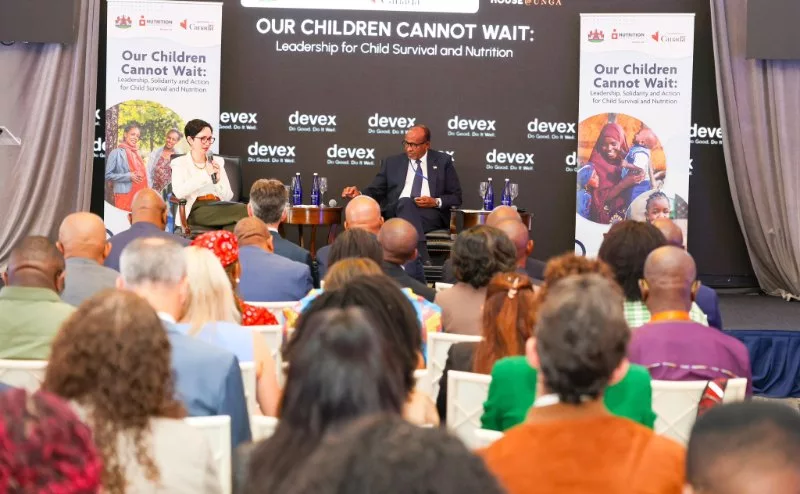 Health Cabinet Secretary Aden Duale represents President William Ruto at a high-level summit on child survival and nutrition convened by King Letsie III of Lesotho on the sidelines of the 81st United Nations General Assembly on September 24, 2026/ HANDOUT
Duale said under-five mortality had fallen from 115 deaths per 1,000 live births in 2003 to 41 in 2022, while stunting declined from 36 per cent to 18 per cent over the same period.
The figures are also reflected in recent health data. The World Health Organisation puts Kenya's under-five mortality rate at about 41 deaths per 1,000 live births in 2022, while UNICEF reports stunting at 18 per cent and wasting at 5 per cent among children under five in 2022.
The government has nevertheless identified malnutrition as an ongoing challenge, particularly among children affected by poverty, climate shocks and unequal access to services.
The Health Ministry has described Kenya as facing a triple burden of malnutrition involving undernutrition, micronutrient deficiencies and rising obesity. It said stunting had fallen from 36 per cent in 2003 to 18 per cent in 2022, while wasting declined from 7.5 per cent to about 4 per cent.
Duale said Kenya was therefore also calling for sustained financing for maternal and child health, stronger national health systems and climate-resilient food systems.
“Our measure of success must ultimately be whether every child, particularly those in vulnerable households, has the opportunity to survive, thrive and reach their full potential,” he said.







