
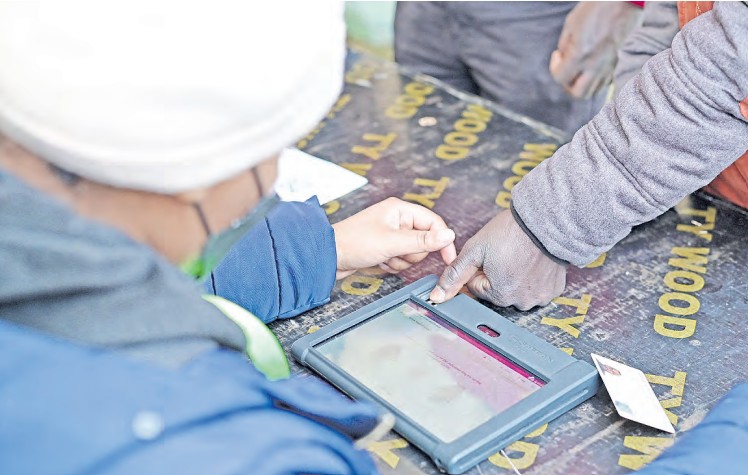
 An IEBC officer identifies a voter using a Kiems device during the August 9, 2022 elections.
Firms seeking to supply IEBC with election technology for next year's poll face tough new qualification requirements.
Among the stringent conditions issued by the Erastus Ethekon-led electoral agency is that firms must demonstrate access to Sh5 billion in financial resources.
The Independent Electoral and Boundaries Commission stated this in an addendum to its tender for the new Integrated Elections Management System.
Besides demonstrating their cash capacity, a bidder must have participated in at least two contracts in the last 10 years, each worth at least Sh2 billion.
The commission has also demanded that firms state their track record of handling major information technology contracts, with at least five years' experience in information-system contracts.
Firms must also demonstrate experience in supplying election technology in at least two countries.
A company bidding must show that it has handled large numbers of devices.
An entity seeking to bag the tender must show it supplied at least 50,000 devices cumulatively between 2021 and 2025.
The bidders would also be required to provide recommendation letters from five clients on implementation of election systems.
Firms would also have to provide completion certificates from three clients for election-system implementations during 2021–2025.
The move is likely to raise the bar for firms seeking to participate in the multi-billion-shilling procurement for the coming elections.
Concerns are rife that the wording of the tender is skewed to favour a particular contractor.
“It looks like they have skewed it to favour a particular contractor. If you say a bidder must have secured two contracts in the past 10 years, it appears they are trying to work with people they have engaged before,” Brian Weke, a poll expert, said.
In the tender, IEBC is further providing that a tenderer must also provide documentary evidence from previous clients showing successful implementation of election systems.
The requirements are contained in the latest tender addendum issued by the IEBC as it moves to restart the procurement.
The Public Procurement Administrative Review Board ordered IEBC to amend and republish the tender after it was challenged by one of the bidders.
The new requirements could significantly narrow the field of companies capable of bidding for the election technology contract.
The commission wants bidders to present evidence of their experience, and demonstrate successes in supply, installation, testing, commissioning, support and maintenance.
Since the advent of use of technology in elections, IEBC has so far worked with Idemia – initially OT Morpho, and Smartmatic International.
The latter was single-sourced amid procurement rows, and will have part of its technology integrated into the system being sourced.
A South Korean company, Miru Systems, has been widely positioned in the public discourse as frontrunner in the 2027 Kiems tender.
Galadriel Investments in its case before the procurement review board, cited the South Korean firm, alleging it was being favoured.
It remains unclear how many firms had bid prior to the review.
Miru website says it has provided election tech in Congo, Guinea, the Philippines and Zambia, among others.
Smartmatic says in its website that it has provided election technology in about 35 countries.
Poll experts foresee a potential challenge with the new conditions, citing concerns about whether local bidders could afford them.
Elections Observer Group (Elog) national coordinator Mule Musau said there is a likelihood of court cases arising from the tender.
“More experienced bidders are likely to have higher costing bids. The other concern would be the eligibility of local bidders. I feel these are the ones most likely to go to court,” he said.
The election expert said that regardless, the “bottom line is to procure equipment and systems that deliver in respect of expected utility with efficiency and effectiveness.”
“It should also ensure there is value for money through cost effectiveness and delivery. Raising the threshold for would-be bidders must take this into account,” Musau said.
“There are qualified bidders who can meet the threshold but fail on its integrity and value for money proposition. My problem is not therefore who is locked out or who qualifies but who delivers on what is required to serve the needs of the electoral process.”
The addendum also provides detailed specifications for the biometric kits to be supplied under the contract.
The devices must have at least a 10-inch touchscreen, minimum 8GB memory and 256GB storage.
They must have fingerprint capabilities meeting the specified FBI PIV IQS and STQC standards, as well as a 13-megapixel camera.
The kits must also support smart-card and NFC capabilities, RFID, iris capture, eSIM and geofencing.
The detailed hardware specifications represent another significant change from the original tender.
The original tender had already attracted scrutiny over the clarity and objectivity of some of its technical requirements.
The commission has also tightened requirements for scanners.
The scanners must be capable of handling A4 paper, identity cards and passports and must have automatic alignment and double-feed detection.
They must also generate encrypted PDF files from scanned documents.
The new specifications come after the PPARB found material deficiencies in the original tender.
IEBC published the revised tender on September 17, pushing the deadline for submission of bids to October 2.
The commission has also changed the way the winning bidder can be tested before award of the contract.
The original tender stated that IEBC would not carry out tests at the post-qualification stage to establish whether the proposed system met the technical requirements.
The revised document allows the best-evaluated bidder's system to undergo conformity tests, eligibility checks and due diligence before the contract is awarded.
This means that emerging top in the technical and financial evaluation will not by itself guarantee the contract.
The bidder will still have to demonstrate that its proposed technology meets the commission's requirements.
The new tender also expands requirements for the Online Voter Pre-Registration System, including QR-code scanning, automatic population of biographic information and secure data exchange.
IEBC has set the post-warranty services period at 24 months.
The commission has meanwhile corrected another contentious provision concerning performance security.
The original tender had required a performance security of up to 20 per cent of the contract value in certain circumstances.
The procurement review board found that requirement contrary to the law, which limits performance security to 10 per cent of the contract value, excluding recurrent costs.
The revised provisions retain the 10 per cent ceiling, with the security reduced to two per cent during the warranty period.
The procurement has attracted scrutiny of political players.
Former Deputy President Rigathi Gachagua questioned the decision to procure a new election management system less than a year before the 2027 election preparations enter a critical phase.
Gachagua argues that there is insufficient time to introduce and fully test a new system before the election.
Together with other opposition leaders, the former DP has instead called for the existing technology to be upgraded.
IEBC has denied that the procurement has been predetermined or that a particular company has already been selected.
The commission has maintained that the tender is open to qualified suppliers and that the procurement will follow the prescribed legal process.
Instant Analysis
For prospective bidders, the race for the IEBC contract is consequently no longer simply about meeting technical specifications. They must first demonstrate that they have the financial muscle, experience and documented track record to handle one of the country's most sensitive technology procurements ahead of the elections.







