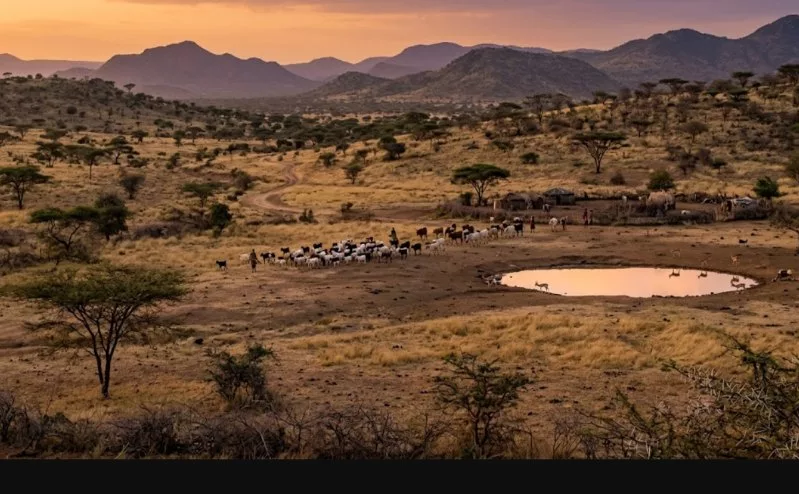
 AI generated image
This is the United Nations International Year of Rangelands and Pastoralists. In late July, government, counties, pastoralist organisations and development partners adopted a joint communique committing Kenya to rangeland restoration ahead of the global gathering of pastoralists in Mongolia. The commitments are sound. The diagnosis beneath them is not, and it was published in an American scientific journal in 1968.
That year, the ecologist Garrett Hardin asked his readers to imagine a pasture open to all: each herder takes the whole gain from adding an animal and carries only a fraction of the cost of the overgrazing, so the herds grow until the pasture collapses. Hardin called this the tragedy of the commons, and concluded that shared resources must be privatised or placed under coercive state control.
The idea reached African rangeland policy quickly and has never left. It underwrote the group ranch experiments, the destocking projects, and the durable assumption in Nairobi that the north is unmanaged space awaiting administration. Kenya's arid and semi-arid lands make up 89 per cent of the country's surface, carry 70 per cent of the national livestock herd, hold 90 per cent of its wildlife and are home to about a third of all Kenyans. They have been governed for 50 years on a diagnosis that does not fit them.
Hardin's error was definitional. He did not describe a ‘commons’. He described open access: a resource with no owner, no membership, no rules and no enforcement. Real commons are the opposite. Elinor Ostrom spent a career documenting fisheries, forests and pastures managed sustainably by their own users, without private title or state compulsion. She distilled the conditions for success into eight design principles, among them clear boundaries, locally adapted rules, graduated sanctions and recognition by higher authorities of the users' right to organise. The work won her the 2009 Nobel Prize in Economics, the first awarded to a woman. What determines collapse, she showed, is the quality of the governing institution.
Judged by that standard, the rangelands of Isiolo, Marsabit, Turkana, Garissa and West Pokot are not a warning. They are evidence for the defence. The Borana dheeda in Isiolo is a rangeland unit with defined seasonal grazing zones, separated wet and dry pastures and managed water points, presided over by a council of elders that regulates who grazes where and when, and sanctions those who do not comply. The Turkana adakar organises herding units and mobility across a landscape too variable to farm; Somali xeer governs water and pasture by negotiated agreement between lineages. These institutions track Ostrom's principles closely, not because pastoralists read her work, but because she was describing what people who depend on a shared resource reliably build.
None of that makes them untroubled. Herds have grown, populations have risen, rainfall patterns have become harder to read, and some councils of elders keep women and younger men out of decisions the Constitution says they must share. But those are arguments about the quality of an institution, which is exactly Ostrom's point. They are not arguments for removing rules and putting nothing in their place.
The real tragedy of northern Kenya is that these institutions were dismantled by policies that believed they were fixing them. Titling schemes created private parcels inside grazing systems that function only at scale, and subdivision followed. Boreholes were sunk as humanitarian and political goods without reference to grazing plans, turning seasonal pasture into year-round settlement and stripping the land within walking radius of the pump. Conservancy arrangements added a second layer of grazing rules that customary elders did not write and often do not recognise, a grievance that has since had to be argued in the Environment and Land Court. Fencing and enclosure privatised the wet season reserves that made dry season survival possible.
Every one of these interventions was aimed at an imagined open-access pasture. Each removed a rule from a working system and replaced it with nothing. The degradation that followed was read as confirmation of Hardin and used to justify more of the same. The cost is not only ecological: the last full assessment of a Kenyan drought put the loss at close to three percentage points of annual growth over three years, most of it in livestock.
This is not romantic, and it is not an argument for leaving the north alone. Governance capacity already exists in these counties, and the state's task is to recognise and reinforce it rather than substitute for it. Three things follow.
First, community land registration must be treated as the priority the law already says it is. Campaigners behind this year's Sajili Ardhi ya Jamii push count about 64 registered units out of an estimated 1,000 nationally, and put the cost of titling one community at as much as Sh20 million. That price, not community reluctance, is why the number barely moves. The Ministry of Lands and the counties holding unregistered community land in trust should be judged on delivering cheap, community-led mass registration.
Second, the Community Land Act already allows a registered community to set grazing conditions, down to the number of livestock and the rotation between sections. Two things keep that power inert: it vests only on registration, and it vests in a community land management committee rather than in the dheeda council or adakar that commands actual compliance. Recognising customary institutions as management organs within registered community land, able to enforce grazing by-laws and bound by the Constitution's inclusion requirements, would close that gap.
Third, no borehole, fence or enclosure in an ASAL county should be permitted without reference to an approved rangeland management plan. This needs no new statute. The Range Management and Pastoralism Strategy 2021-2031 already commits the government to such planning; what is missing is that the State Department for the ASALs, county water departments and their funders do not make an approved plan a condition of funding. Water infrastructure sited without grazing rules is not development. It is the manufacture of an open-access pasture where a governed one used to stand.
Hardin's herders had no rules. Ours did. We took them away, and then blamed them for the consequences.
Dr Ido is a governance, management and institutional development specialist with a focus on ASALs development. ([email protected])