
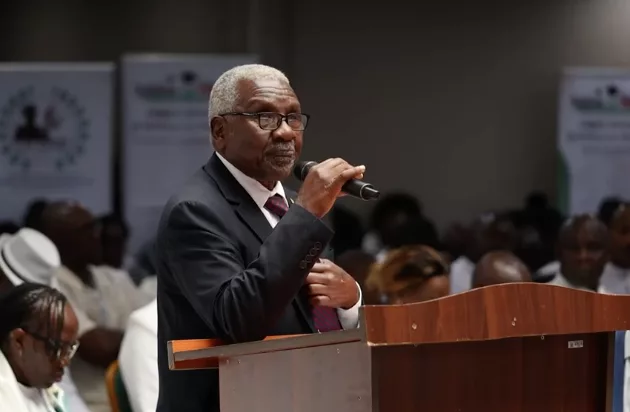
 University of Nairobi Council Chairperson Prof Chacha Nyaigoti Chacha speaks during the Jukwaa la Wasomi graduation ceremony for Certified Professional Mediators held at the Wangari Maathai Institute for Peace/SCREENGRAB
University of Nairobi Council Chairperson Prof Chacha Nyaigoti Chacha has called for sustained peace and dialogue in the country, saying institutions can only effectively execute their mandates in an environment of tranquillity.
Chacha said conflicts in learning institutions often begin with seemingly minor misunderstandings that, if not addressed early, can escalate into violence, destruction of property and loss of lives.
He was speaking during the Jukwaa la Wasomi graduation ceremony for Certified Professional Mediators held at the Wangari Maathai Institute for Peace.
Jukwaa la Wasomi is a government-backed, student-led national initiative that promotes mediation, preventive security and transformational leadership in universities and other tertiary institutions.
Chacha said the training of student leaders in conflict resolution was important in equipping them with skills to identify and address disputes before they escalate.
He said the skills would help create peaceful environments in institutions and enable universities and other learning institutions to focus on their core mandates.
“Student leadership has been trained on how to resolve conflict, create peace, an environment of tranquillity that is expected to be in an institution for it to execute its mandate,” Chacha said.
He emphasised that peace should not be viewed solely as an issue affecting institutions of higher learning, arguing that it cuts across all levels of education and society.
“Peace is a cross-cutting matter. It is not confined to higher education, secondary education or primary education. This country requires peace,” he said.
Chacha said Kenya had witnessed conflicts that began with minor disagreements before developing into serious incidents.
He cited situations in which students could approach school administrators with requests that are not granted, potentially creating tensions that escalate into destruction and violence.
“We have witnessed some conflicts, some of which started with a very little misunderstanding,” he said.
He said the failure to communicate or provide an opportunity for students to be heard could become a trigger for conflict.
According to Chacha, effective mediation requires institutions to create channels through which students and their leaders can raise concerns and receive explanations from administrators.
He said disagreements could sometimes be resolved through a simple conversation between students and institutional leaders before they developed into larger disputes.
“This is the essence of this training so that together we can understand that the threat of peace starts with misunderstanding, sometimes miscommunication, sometimes the denial of an opportunity to be heard,” Chacha said.
He said student leaders who approach university management with questions about decisions or services should be given an opportunity to engage with administrators.
Chacha said university vice-chancellors and other institutional leaders had an important role to play in managing such situations through dialogue.
“It would take a sober mind of a VC to explain but when that opportunity is denied, then we have conflict,” he said.
The council chair said the training of professional mediators and student leaders was therefore an important intervention in strengthening peaceful coexistence within learning institutions.
He said preventing conflict at an early stage was preferable to responding after disputes had escalated into violence.
The Jukwaa la Wasomi programme seeks to strengthen the capacity of students and university communities to participate in mediation, preventive security and leadership, with the broader objective of promoting peaceful institutions and a stable society.







