For Joyce Syombua and her two children, Shanice Maua and Prince Michael, October 2019 was supposed to be a chance to spend time with family.
But their journey to Nanyuki would end in tragedy, leaving three people dead and a former military officer at the centre of one of Kenya’s disturbing murder cases.
The man accused of killing them was Peter Mwaura Mugure, a former Kenya Air Force Major who was stationed at Laikipia Air Base.
What followed was a criminal investigation that uncovered a family dispute, disturbing evidence of premeditation, and an alleged attempt to conceal the killings.
Read Also
Years later, the case would reach a major turning point when the High Court found Mugure guilty of murdering Joyce and their two children.
The Dispute That Ended Up in Court
Before the murders, Mugure and Joyce were involved in a dispute concerning their children.
One central issue was paternity. Mugure had denied fathering Shanice and Prince, prompting proceedings at the Children’s Court.
A DNA test ordered by the court subsequently confirmed that he was their biological father.
The Children’s Court also ordered him to provide financial maintenance for the children.
According to the prosecution’s case, the dispute and the court proceedings formed part of the circumstances that preceded the killings.
However, it was the evidence presented during the murder trial that would ultimately determine Mugure’s criminal responsibility.
The October 2019 Visit to Nanyuki
The prosecution told the court that he invited Joyce and the children to visit him at the military installation.
Financial records presented during the trial showed that he sent Joyce money on October 22 and October 24 to facilitate their journey from Nairobi to Nanyuki.
The family arrived at the air base on October 25, 2019.
What should have been a family visit would become the final time Joyce and the children were seen alive.
The prosecution maintained that Mugure had already begun putting a plan into motion.
October 26: The Day Everything Changed
According to evidence presented in court, Mugure took the children away from the house on the morning of October 26, ostensibly to show them around the air base.
The prosecution said he killed them before later killing Joyce that evening.
Post-mortem examinations established that Joyce died from blunt force trauma to the head, while the children had been strangled.
Investigators would later establish that the killings had not been spontaneous.
Evidence showed that Mugure had visited a burial site three days earlier and arranged for a shallow grave to be dug.
That evidence became an important part of the prosecution’s argument that the murders had been planned.

The Bodies Were Hidden in a Car
One of the most disturbing parts of the case emerged through the testimony of Collins Pamba, who was working as a sanitary orderly at the officers’ mess.
Pamba told investigators that Mugure contacted him repeatedly before asking him to meet at the air base.
According to his account, he was taken into the staff quarters, where he discovered the bodies of the two children and Joyce.
He said Mugure threatened him and promised to help him secure military recruitment if he cooperated.
The bodies were subsequently loaded into Mugure’s Subaru Impreza and transported to a burial site near Thingithu Estate in Nanyuki.
Pamba testified that they buried the bodies in the shallow grave before returning to the base.
He also said he later cleaned Mugure’s house and vehicle and received KSh4,000.
Investigators subsequently recovered items, including a spade and a jembe, which forensic examination linked to soil samples from the burial site.
The Disappearance That Became a Murder Investigation
For weeks, the disappearance of Joyce and her children remained unresolved.
Investigators eventually questioned Pamba, who led them to the burial site on November 16, 2019.
The bodies were exhumed, and the investigation developed into a murder case.
Pamba initially faced murder charges alongside Mugure. He later entered into a plea bargain with the Office of the Director of Public Prosecutions.
The charges against him were substituted with the lesser offence of being an accessory after the fact to murder, allowing him to testify for the prosecution.
Mugure challenged the plea bargain, but the court rejected his argument, finding that the agreement was lawful.
The prosecution also relied on mobile phone records, forensic evidence, DNA results and witness testimony to reconstruct the events surrounding the killings.

The Court Delivers Its Verdict
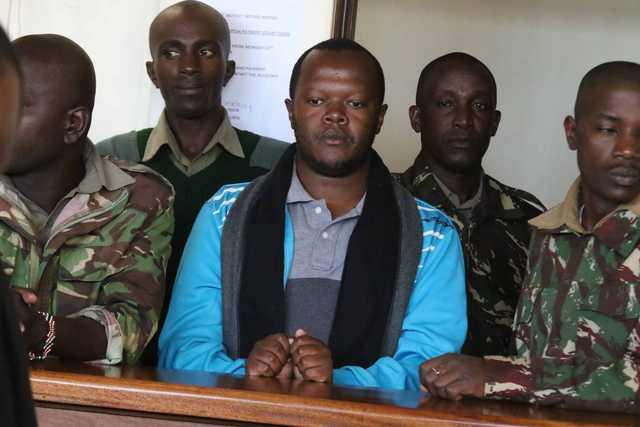
On July 10, 2026, the High Court found Mugure guilty of murdering Joyce, Shanice and Prince.
The court concluded that the prosecution had proved its case beyond reasonable doubt, relying on evidence that included the witness testimony, forensic findings and proof that the burial site had been prepared before the killings.
Four days later, on July 14, Justice Martin Muya sentenced Mugure to life imprisonment on all three counts.
The sentences were ordered to run concurrently.
The judge said Mugure had shown no remorse and described the murders as barbaric. The prosecution had sought the death penalty, but the court imposed life imprisonment after considering the circumstances of the case and the period Mugure had spent in custody.
Mugure Says He Will Appeal
Despite the conviction, Mugure maintained that he disagreed with the court’s findings.
His reported words included:
"Nevertheless, and with tremendous respect to the court, in principle I am unable to agree with the verdict."
He then clarified that he wanted to challenge only the convictions.
His statement marked another chapter in a case that had stretched across several years, from the disappearance of Joyce and her children in 2019 to the High Court’s decision in 2026.
For Joyce, Shanice and Prince, however, the outcome cannot restore the lives lost.
Their deaths remain at the centre of a case that exposed a family dispute, a carefully reconstructed prosecution account and the devastating consequences of violence within a family.
The legal proceedings have resulted in life sentences, while Mugure’s stated intention to appeal the convictions leaves the possibility of further court proceedings ahead.