

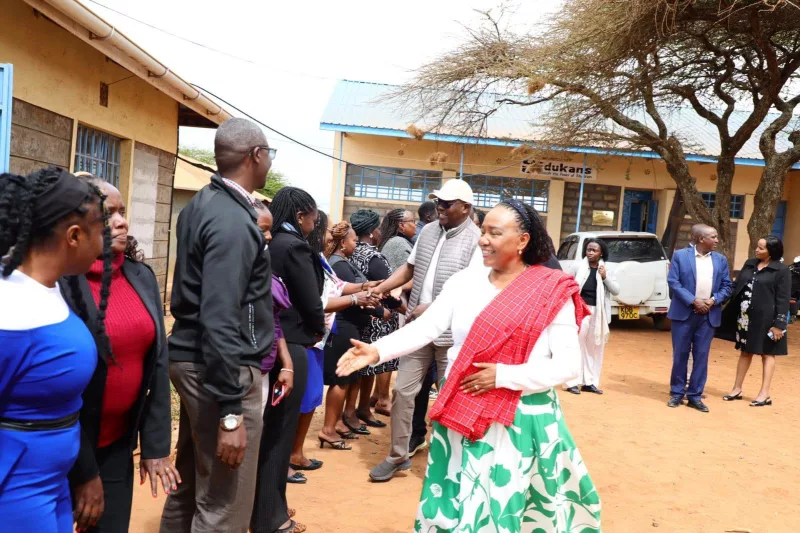
 Senate Standing Committee on Education led by Senator Betty Montet arrive at an ECDE centre during a fact-finding mission in Kajiado county on Friday, September 18. /PARLIAMENT
Kajiado County Government has been faulted for providing insufficient support to Early Childhood Development Education (ECDE) centres across the county.
The Senate Standing Committee on Education raised concerns after a tour of ECDE facilities revealed gaps in learning materials, staffing, nutrition, infrastructure and implementation of approved programmes.
The committee, chaired by Senator Betty Montet and deputised by vice chairperson Prof Margaret Kamar, undertook a fact-finding mission on Friday, September 18, to assess the state of ECDE and Vocational Training Institutions and establish the extent to which county interventions are benefiting learners.
In a statement after the visit, the committee said it had identified several areas requiring clarification and stronger county intervention to improve learning conditions in ECDE centres.
The senators, including John Kinyua, Johnes Mwaruma and Kanar Seki, began the visit with a courtesy call on Kajiado Governor Joseph Ole Lenku at the county headquarters in Kajiado Town.
They then inspected ECDE centres at Moipei and Ole Lenku Township, as well as Isinya Vocational Training Centre.
During the engagements, Mwaruma sought clarification on the provision of teaching and learning materials, asking whether the supplies were being provided by the county government, parents or development partners.
Montet also questioned the level of county investment in ECDE, noting that the function had been devolved and therefore required adequate budgetary support.
She sought to establish how funds allocated to the sector were being translated into services, learning materials and facilities for children.
Responding to the concerns, Kajiado County Executive Committee Member for Education Janet Sereu attributed delays in implementing some education programmes to lengthy procurement processes within the county government.
Sereu said the procedures had slowed planned interventions and delayed the delivery of some programmes to ECDE centres.
She, however, said the county was implementing its programmes within the established procurement framework.
She further disclosed that Kajiado has 626 ECDE centres across its wards, adding that Members of the County Assembly also play a significant role in their development.
The disclosure prompted the committee to seek clarity on the respective roles of the county executive and ward representatives in the development and support of ECDE centres.
The senators also questioned discrepancies between the number of ECDE teachers listed in a report submitted by the county government and the number reported to have been deployed to the centres they visited.
They called for the figures to be reconciled to establish the actual staffing position and determine whether the reported numbers accurately reflect the situation in the centres.
Nutrition and food provision also emerged as a major concern during the inspection.
Seki, who previously served as the county executive committee member for education, recalled that the county government provided porridge to ECDE learners during his tenure.
He noted that some of the centres visited currently rely on non-governmental organisations to provide porridge and questioned the sustainability of depending on external partners for the programme.
Seki also sought clarification on the county government's role in meeting the nutritional needs of ECDE learners.
Prof Kamar, meanwhile, raised concerns about overcrowded classrooms and inadequate playing grounds in some of the centres visited.
She said children needed adequate space not only for learning but also for play, stressing the importance of infrastructure that supports the holistic development of young learners.
Kinyua questioned how funds allocated to ECDE were being utilised, noting that although the county government sets aside resources for the sector each financial year, there was limited visible evidence of the investment during the committee's inspection.
The committee also sought explanations over learning materials that had reportedly been budgeted for in previous financial years but had not reached schools, despite county reports indicating that the supplies had been delivered.
The senators called for greater accountability in the procurement and distribution of learning materials to ensure that funds allocated to ECDE result in improved learning conditions for children.
At Isinya Vocational Training Centre, the committee turned its attention to youth skills development and implementation of the 2Jiajiri initiative, supported by KCB and the county government.
The senators sought information from the centre's management on how it benefits from the programme, including the respective roles and contributions of KCB and the county government in supporting youth skills development.
The committee also requested data on the number of primary and secondary schools and Vocational Training Institutions in Kajiado to assess whether existing institutions are adequately serving their respective catchment areas.
The senators further raised concerns over transition gaps in the education system, particularly the progression of learners from primary and secondary education to vocational training.
They emphasised the need for greater attention to both ECDE and Vocational Training Institutions as part of efforts to strengthen the education and skills development system.
The committee said its findings would form part of its report and guide further engagement with the county government on ECDE financing, staffing, learning materials, nutrition, infrastructure, procurement and vocational training.







