

 The judge observed that influence should not be confused with constitutional authority.
A High Court judge has declared unconstitutional a law restricting retired presidents from political party office, ruling that leaving the presidency does not strip a former head of state of the right to participate in Kenya’s political life.
Justice Bahati Mwamuye, in a judgment delivered on September 21, 2026, declared Section 6 of the Presidential Retirement Benefits Act unconstitutional and void in its entirety.
The provision barred retired presidents from holding office in any political party for more than six months after leaving office.
The ruling comes amid heightened political debate over alleged involvement by retired President Uhuru Kenyatta in active politics, with the Kenya Kwanza administration accusing him of sponsoring opposition against President William Ruto.
On September 14, Justice Lawrence Mugambi upheld the restriction under Section 6, ruling that retired presidents cannot hold formal political party office beyond six months after retirement.
Uhuru's office subsequently noted the decision, with the former president saying he would initiate arrangements to relinquish his chairmanship of the Jubilee Party.
Justice Mwamuye's judgment, however, goes further by declaring the statutory restriction unconstitutional, while drawing a distinction between the authority of a former president and his or her continuing political influence as a private citizen.
“The former President does not become a constitutionally diminished citizen merely because he or she previously occupied the highest elective office in the Republic,” the judge said.
The case was filed by Sheria Mtaani and Shadrack Wambui at the Kiambu Law Courts, challenging Sections 4 and 6 of the Act.
The petitioners argued that Section 4, which allowed Parliament to withhold, reduce or withdraw a retired president’s benefits in specified circumstances, violated Article 151(3) of the Constitution.
The article provides that retirement benefits payable to a former president and former deputy president, together with their facilities and privileges, shall not be varied to their disadvantage during their lifetime.
They also argued that Section 6 unlawfully restricted political rights guaranteed under Article 38 by linking continued enjoyment of retirement benefits or lack thereof to political conduct.
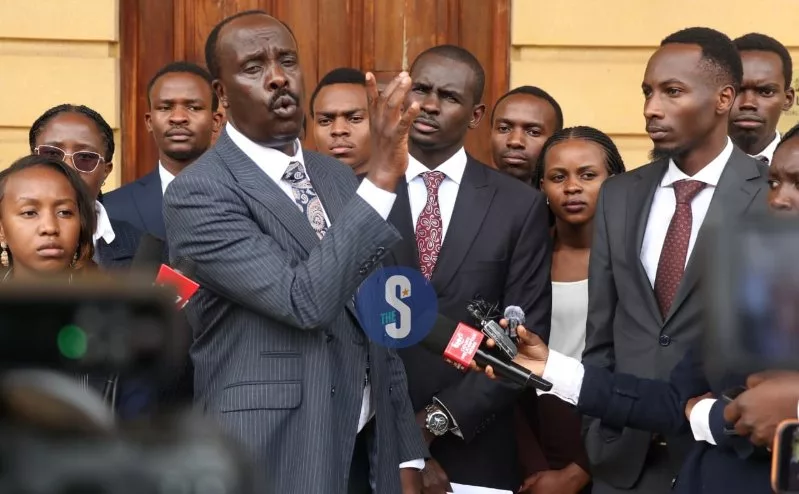 Lawyers Danstan Omari, Shadrack Wambui and Jeff Kangethe address the press after the Kiambu High Court barred Parliament from reducing the benefits of retired presidents at Milimani law courts, Nairobi, September 21, 2026. /LEAH MUKANGAI
The petitioners sought declarations that Sections 4 and 6 were unconstitutional, orders quashing any proceedings undertaken under the provisions and a permanent prohibition against processes aimed at reviewing, reducing or altering a former president’s retirement benefits.
The Senate, National Assembly and Attorney General opposed the petition, arguing that it was premature and speculative because no parliamentary decision had been made to withdraw a former president’s benefits.
They maintained that Parliament had constitutional authority to legislate on retirement benefits and that the provisions were subject to the Constitution.
The Senate argued that the court should not interfere with parliamentary proceedings before an actual decision had been made, while the National Assembly maintained that the two-thirds threshold required under Section 4 provided a safeguard against arbitrary action.
The Attorney General similarly argued that Article 151(3) did not create an absolute and unconditional entitlement and that Parliament could regulate retirement benefits within constitutional limits.
Justice Mwamuye rejected the argument that the petition was premature, holding that Sections 4 and 6 were existing laws whose constitutionality could be challenged without waiting for Parliament to act under them.
On retirement benefits, the judge said Article 151(3) was “an express and absolute protection” and did not permit Parliament to create conditions through ordinary legislation that could ultimately defeat the constitutional guarantee.
He declared Sections 4(1), 4(2) and 4(3) unconstitutional, null and void, while leaving Section 4(4) untouched because it had not been challenged.
The judge also found the mechanism under Section 4 inconsistent with Articles 40 and 47, as well as the principles of natural justice, because it lacked adequate procedural safeguards for a former president facing deprivation of benefits.
On political participation, Justice Mwamuye noted that Section 6 did not prohibit a retired president from being a party member, expressing political opinions, campaigning for a political cause or participating in public political discourse.
Section 6 of the Presidential Retirement Benefits Act specifically prohibited holding party office beyond six months.
But Justice Mwamuye found the restriction inconsistent with Article 38 of the Constitution.
“A retired President remains a citizen. Retirement from office ends the office; it does not end the person,” he said.
The judge observed that influence should not be confused with constitutional authority.
“Influence is not office. Influence is not executive authority. Influence is not a constitutional disability,” he said.
He added that a former president could remain influential even without holding a formal party position, meaning that restricting party office did not necessarily address the concern of political influence.
Justice Mwamuye consequently prohibited the respondents from enforcing Section 6 and from relying on the unconstitutional portions of Section 4 to disadvantage a former president’s protected retirement benefits.
He declined to issue certiorari — an order for a higher court to hear the appeal — because there was no completed decision before the court capable of being quashed.
The judge ordered each party to bear its own costs, citing the public-interest nature of the litigation.
The judgment was delivered virtually on September 21.







