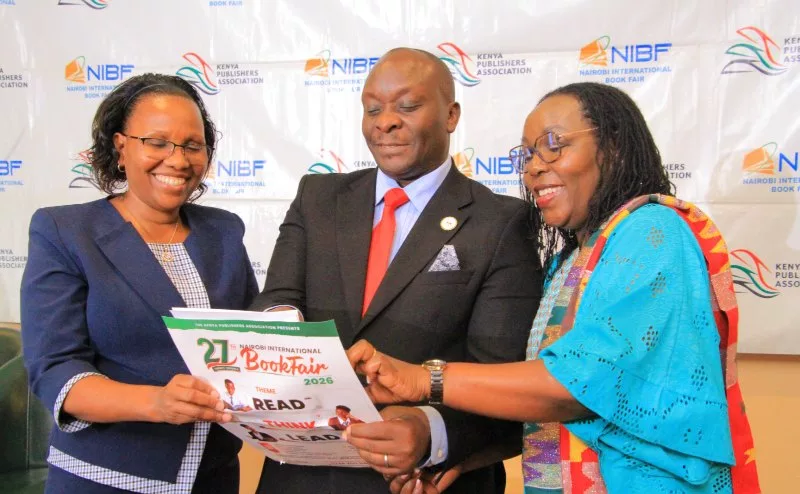
 Nairobi International Book Fair chairperson Mary Maina, Kenya Publishers Association chairman Musyoki Muli and Bookmark Publishers managing director Agatha Karani during a media briefing today /EZEKIEL AMING'A
The Kenya Publishers Association has urged the government to release accurate data of Grade 11 enrolment to ensure production and distribution of learning materials and also clear the Sh7 billion pending bills.
The association says the data, which should be provided according to school, pathway and learning area will ensure efficient production and distribution of learning materials.
“This information will enable publishers to determine print quantities and allow printers to order paper, ink, and other inputs in good time,” chairman Musyoki Muli said.
“Reliable data is essential to preventing shortages, reducing wastage and ensuring every learner receives the required materials.”
They say they need the information as early as October for timely production and distribution of next year's books.
Early this month MPs summoned top officials of the Kenya Institute of Curriculum Development (KICD) to explain the discrepancies in textbook distribution to public secondary schools.
This is after it emerged that some schools received hundreds of books beyond their requirements.
The committee also observed that other institutions, particularly those in marginalised and far-flung areas, continued to face shortages.
Publishers say accurate provision of data will not only ensure equal distribution of textbooks but will also help them cut production and supply costs.
“Imagine producing and distributing insufficient and having to go back to do the job all over again. That’s quite expensive,” Muli said.
On pending bills, Muli said many publishers owe money to printers, authors, editors and financial institutions following the long-outstanding bills owed by government since early 2025.
“Most printers and distibutors have indicated that they cannot undertake further work without substantial settlement of the outstanding balances,” Muli said.
The pending bills, coupled with piracy and misuse of AI by some authors and editors are some of the factors threatening the publishing business.
Lucas Wafula, MD Booklist, said they have however come up with mechanisms to detect AI generated materials and have consequently dealt with them.
“Our editors are well-trained and can easily detect AI. But I must say that AI is a big threat to our work,” he said.
The association announced the Nairobi International Book Fair set to take place at the Sarit Centre from Wednesday this week to Sunday.
Under the theme Read, Think, Lead, the expo is set to draw exhibitors from China, Turkiye, Egypt, South Africa and Zimbabwe.
Chairperson of the book fair, Mary Maina, says they are targeting to attract at least 60,000, including children and young readers.
Last year, the book fair attracted 36,247 visitors.
“This year’s fair will therefore look beyond traditional exhibition of books… It will be an opportunity to meet authors, discover new stories, participate in reading activities and meet the people behind the books they read – writers, illustrators, editors, publishers and booksellers,” Maina said.
Three outstanding books have also been shortlisted for the 2026 Jomo Kenyatta Prize for Literature in the English Adult Category.
The books include Nandi Bear by Abenea Ndago, published by Nsemia Inc. Publishers, Clan of Warriors by Ken N Kamoche, published by East African Educational Publishers and Old Money by Charles Chanchori, published by Oxford University Press East Africa.
The winner and runners-up will be announced during the official closing ceremony and a cash reward of Sh150,000 will be given to the winner.
“Following careful consideration, the panel of judges, the KPA Council and the awards subcommittee concluded that the number of entries received in these categories was too low to support a sufficiently competitive fair and meaningful adjudication process,” Agatha Karani, MD Bookmark Africa said.