
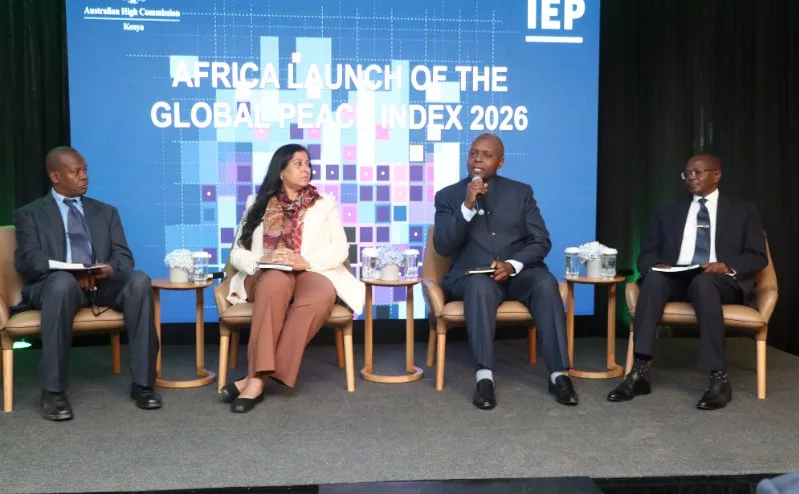
The Institute for Economics and Peace, supported by the Australian High Commission in Nairobi, launched the 20th anniversary edition on Thursday, ranking 163 countries and territories.
Kenya ranked 132nd, an improvement on 2025, in the 2026 Global Peace Index, with its stability increasingly tied to developments beyond its borders.
Acting Australian High Commissioner Andrew Barnes said: “In an increasingly interconnected world, events in one part of the globe can have consequences far beyond national borders.”
IEP manager Ari Nola Elizabeth Knight said more needs to be done.
“Globally, last year Kenya ranked 127th, so clearly Kenya has dropped around five levels.”
Regionally, she said Kenya remained at the top among East African countries.
“If you’re looking at it from a regional lens, then it does not mean that we need to relax. It means that we need to up our game to tackle the various institutional, the attitude aspect, the structural aspect to sustain this peace.”
The global findings are severe. Peacefulness fell in 99 countries in 2026, the most in the Index’s 20-year history.
There are 119 countries less peaceful than in 2008.
The report records 117 million forcibly displaced people, roughly one in every 67 people on earth, with the Horn of Africa—Sudan, Ethiopia, Eritrea, South Sudan and Somalia—functioning as an interlocked conflict system.
Steve Killelea, IEP founder and executive chairman, said: “IEP’s research shows the Horn of Africa... now functions as one interlocked conflict system, and Kenya’s stability is increasingly tied to trade and debt exposure flowing from that system.”
Those regional dynamics carry direct human rights consequences: mass displacement, compromised access to food and securityand growing pressure on refugee-hosting states. The report also exposes the erosion of human oversight in warfare.
AI-enabled targeting has compressed decision times to as little as five seconds, while in Gaza algorithmic systems compressed human review to roughly 20 seconds per strike.
Systems flagging tens of thousands of individuals operated with known error rates, including a 10 per cent error rate, contributing to civilian casualties and serious violations of international humanitarian law and the right to life.
Drone strike events increased 115-fold between 2018 and 2025, with at least 565 state and non-state armed groups carrying out attacks.
Civilian suffering is measurable. Deaths from internal conflicts have risen more than sixfold since 2008, reaching more than 181,000 in the past year. Twenty countries recorded 1,000 or more conflict deaths in a single year, including Sudan, Ukraine, the Democratic Republic of Congo and Israel/Palestine.
Violent demonstrations have deteriorated by 68.3 per cent since 2008, and political instability has worsened sharply in several democracies, including a 38.5 per cent increase in the United States.
Illicit economies are also expanding: the drug economy in Myanmar quadrupled to more than $59 billion, tied to human trafficking, forced labour, extortion and breakdowns in the rule of law.
The failure of peace processes prolongs these abuses. State-based conflicts ending in formal peace agreements have plummeted from 23 per cent in the 1970s to roughly four per cent, depriving populations of structural rights, governance and long-term security.
To enable the country'scontinued peace, the civic space ilshould be protected.
Barnes, highlighted “a vibrant, strong civil society” as “one of Kenya’s strong points”.
He warned that it must not be taken for granted.
The gains are therefore real but precarious. With the 2027 election, regional exposure and human rights pressures will test whether peace is sustained through institutions, civic freedom and peacebuilding rather than armouries alone.
“Without peace and stability, you can’t have economic development,” Barnes said.
Young people entering the workforce “deserve and they want a future, a secure future, and without peace and stability, they can’t get it.”







