

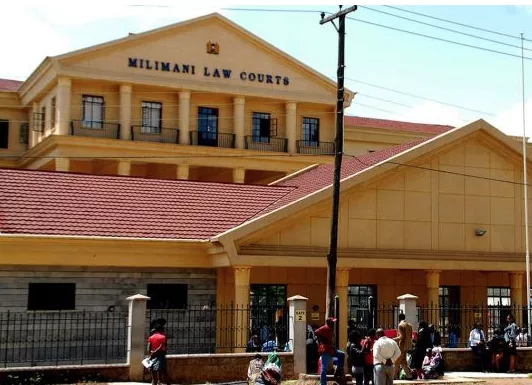
 Milimani Law Courts, Nairobi/FILE
The High Court has dismissed a preliminary objection by the Law Society of Kenya (LSK) seeking to have a petition challenging its targeted court boycott struck out, allowing the case to proceed to determination on its merits.
Justice David Mburu ruled that LSK’s internal dispute-resolution mechanisms could not adequately address the constitutional and public-interest questions raised by advocate Adrian Kamotho Njenga.
The judge said the dispute went beyond an ordinary disagreement between an advocate and the professional body because it raised questions concerning advocates, litigants, court users, judges, judicial officers and the independence of the Judiciary.
The ruling was delivered virtually in Nairobi on Thursday, September 17.
“The Respondent’s Preliminary Objection dated 31st July 2026 is hereby dismissed,” Justice Mburu ordered.
He directed that the petition and a Notice of Motion dated July 24 proceed to determination on their respective merits, with costs of the preliminary objection to abide the outcome of the petition.
The case arose from LSK’s decision in July to undertake a nationwide boycott, followed by an indefinite targeted boycott of proceedings before specified judges and judicial officers.
According to the petition, the nationwide boycott was held on July 22, while the targeted boycott began on July 23 and was intended to continue indefinitely.
The petitioner said LSK had directed advocates not to participate in fresh hearings, part-heard matters or new applications before judges and judicial officers on its targeted list.
He further said advocates had been directed to seek transfers, recusals or adjournments in cases before the affected judicial officers.
The petition challenged, among other issues, LSK’s authority to prescribe the judicial functions that targeted judges could undertake and what the petitioner described as threats of action against advocates or judicial officers who declined to facilitate the boycott.
The petitioner argued that the boycott threatened access to justice, legal representation and fair hearing rights, particularly in criminal and time-sensitive proceedings.
He also contended that LSK’s internal mechanisms under Regulations 95 and 96 of the Law Society of Kenya (General) Regulations, 2020 could not resolve the constitutional questions raised or grant the remedies sought.
LSK, however, argued that the petition was premature because the dispute should first have gone through negotiation, conciliation, mediation or arbitration provided under the regulations.
The Society maintained that the challenged decisions arose from resolutions and policy directives made in the exercise of its statutory and governance functions. It also argued that the petitioner had failed to demonstrate actual prejudice to a specific litigant, advocate or court user.
LSK further submitted that the court should balance judicial independence with constitutional freedoms enjoyed by advocates and their representative body, including freedom of association, assembly, demonstration, picketing and collective action.
The Society asked the court to uphold its preliminary objection and strike out or dismiss the petition and application.
Justice Mburu agreed that the doctrine of exhaustion was a legitimate jurisdictional issue capable of being raised through a preliminary objection. However, he found that it did not bar the petition in the circumstances of the case.
The judge noted that Regulations 95 and 96 provide mechanisms for resolving certain disputes involving the Society, including negotiation, conciliation, mediation and arbitration.
However, he found that the dispute was not confined to the relationship between LSK and one of its members.
“The Petition, as pleaded, does not merely concern the Petitioner's individual rights as a member of the Law Society of Kenya,” the judge said, noting that it challenged directives allegedly affecting “advocates, litigants, court users, judges and judicial officers” and raised questions concerning judicial independence and the administration of justice.
Justice Mburu also considered the scope of the arbitration mechanism under Regulation 96, which covers disputes relating to the exercise of LSK’s mandate or management of its affairs and disputes concerning the rights of members against other members or the Council.
He noted that there was no evidence of a registered dispute between the petitioner and LSK and that the case involved external parties, including judges, judicial officers and the Judicial Service Commission.
“It therefore is not only a dispute between the Petitioner and Respondent,” the judge said.
The court further held that exhaustion of alternative remedies is not an absolute requirement where the alternative mechanism is inadequate or ineffective in addressing the dispute.
Justice Mburu said the petition raised constitutional and public-law questions, including issues that fell within the High Court’s constitutional jurisdiction.
He also noted that the petition sought constitutional and public-law remedies, including declarations and conservatory orders, which the petitioner argued could not be granted by an arbitrator under Regulation 96.
“I am persuaded, in the circumstances of this case, that the dispute as pleaded transcends an ordinary internal disagreement between a member and the Law Society of Kenya,” he ruled.
He added that the questions required interpretation of the Constitution and determination of whether constitutional rights and freedoms had been violated, denied, infringed or threatened.
“I therefore find that the existence of the dispute-resolution mechanisms under Regulations 95 and 96 does not, in the particular circumstances of this case, oust or defer the jurisdiction of this Court under Articles 22, 23 and 165 of the Constitution.”
Justice Mburu also rejected LSK’s other grounds for the preliminary objection, including arguments based on constitutional avoidance, institutional autonomy and non-justiciability.
He said determining whether LSK’s actions amounted merely to internal policy decisions or were inconsistent with the Constitution would require examination of the substance and effect of the challenged resolutions and communications.
Those questions, he ruled, could not be conclusively determined at the preliminary stage without considering the merits of the petition.
The court similarly declined to determine at the preliminary stage whether the petitioner had met the threshold for conservatory orders.
Justice Mburu said questions on whether there was a prima facie case, real prejudice, a risk that the petition would be rendered nugatory and whether public interest favoured interim relief required consideration of evidence and judicial discretion.
“The Application for conservatory orders must stand or fall upon its own merits after consideration of the relevant evidence and applicable principles,” he said.
The ruling therefore does not determine whether LSK’s targeted boycott was lawful or unconstitutional.
Instead, it allows the petition challenging the boycott and the application for conservatory orders to proceed to determination on their respective merits.







