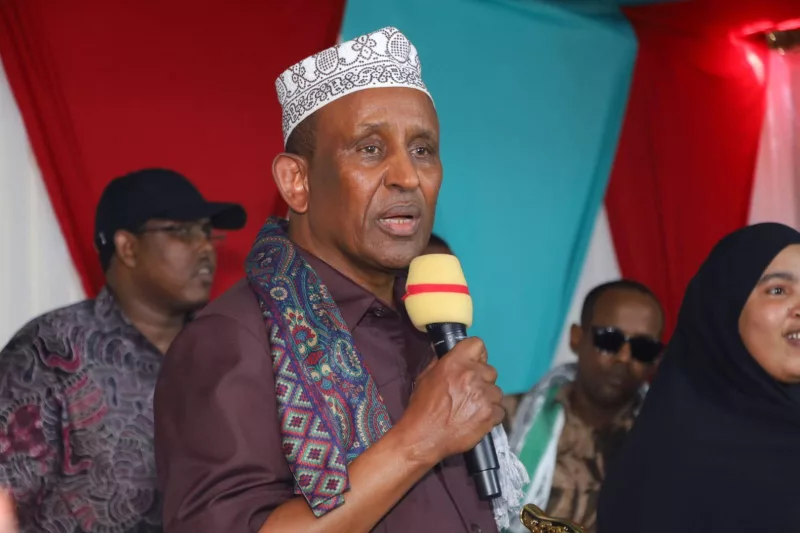
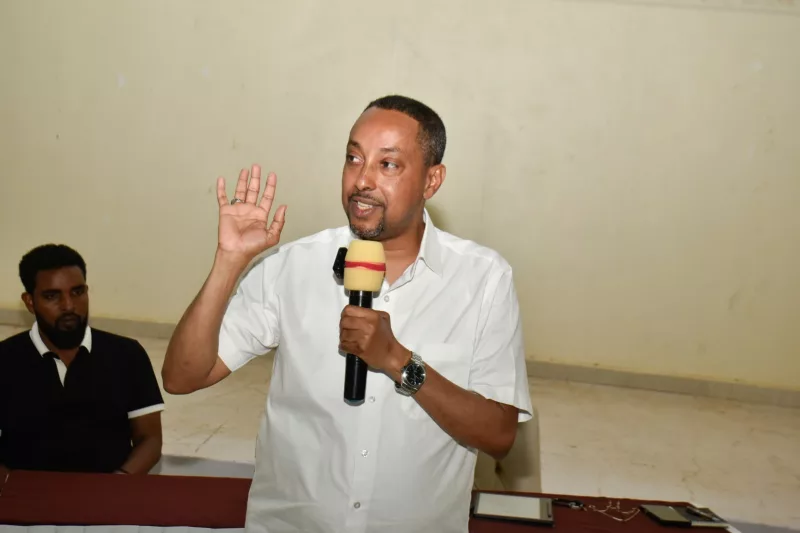
 Garissa
residents, local administrators and human rights activists in a peaceful
procession in Garissa town to
commemorate the International Day of Identity./STEPHEN ASTARIKO
The long waiting period before Garissa applicants eventually get their ID cards could undermine gains made following the abolition of the vetting requirement, activists have said.
President William Ruto last year abolished the vetting requirement for ID applicants.
The activists say the directive has significantly eased access to the crucial documents but noted delay obstacles in processing the cards.
They spoke during a press briefing in Garissa town after joining hundreds of residents and administrators in a peaceful procession to commemorate the International Day of Identity.
The event was organised by Haki Na Sheria, a Garissa-based NGO that advocates for citizenship and identity rights.
Barre Aden, the organiSation’s programme manager, said the removal of vetting had been an important step towards addressing historical injustices experienced by residents of Northern Kenya.
“We really
appreciate the efforts made by the government in removing the vetting
requirement. At least now, things are moving forward,” he said.
“However, we are now concerned about delays in processing and issuing the documents, as well as the limited number of registration and collection centers across this vast county. Those are the two main challenges that we face as a region,” he said.
President William Ruto abolished the vetting requirement in February 2024, removing an additional layer of scrutiny that had subjected most applicants from Northeastern Kenya to a process not ordinarily faced by other Kenyans.
Before the changes, applicants were required to appear before vetting committees, produce additional documentation and meet extra conditions before being issued with national identity cards.
Aden called on the government to further decentralise identity registration and issuance services, noting that only Garissa and Ijara sub-counties currently have fully functional offices.
“Garissa county is very vast. We need more offices so that people can easily access these services,” he said.
He said
the delays were particularly worrying as the country moves closer to the next
general election, with many young people seeking identity cards to enable them
to register as voters.
“It can take almost six to seven months for an ID card to be issued. We therefore urge the government to fast-track the issuance of identity cards so that people can exercise their democratic right to vote,” he said.
Fatuma Ahmed also complained about the delay.
“We have an issue with the duration it takes to process the identity cards. It is taking too long for applicants to get the documents, and this is an issue we want the government to swiftly address,” she said.
“If we are talking about easing the process, then let it be clear that there is no more suffering, so that we can truly enjoy our rights.”
Human rights defender Noor
Bashir appealed to officers at the national
headquarters to speed up the processing and issuance of the documents.
“We have seen cases where officers say they have almost 500 clients who have been listed to receive IDs within a period of one month. However, the biggest problem is when it comes to processing the document,” he said.
“We acknowledge the gains made, but it is important that we point out areas of concern so that going forward this can be corrected so that the process does not result in prolonged waiting periods.”
Mohamed Mohamud, the assistant county commissioner in charge of Huduma Centre in Garissa, said the abolition of vetting had resulted in a significant increase in the number of people applying for IDs.
“Since the
removal of the vetting exercise, we have had a very positive response. There
has been an increase in the number of clients seeking the documents,” Mohamud said.
He said the government had also introduced live-capture units in all sub-counties, a technological system intended to improve the quality and accuracy of data captured during the registration process.
According to Mohamud, the surge in applications has also contributed to a backlog of 4,110 identity cards currently awaiting collection at the Garissa Huduma Centre.
He said the National Government Administration Officers structure, including chiefs, was being used to ensure the documents reach their rightful owners.
“We are making use of the NGAO structure, including chiefs, to redistribute these IDs. We are also sharing information by sending messages to applicants so that they can visit the Huduma Centre and collect their identity cards,” he said.
He attributed the backlog partly to the increased number of applications following the removal of vetting, but said efforts were underway to clear it.
“The feedback has been very positive. The chiefs have been doing a marvelous job in ensuring that the IDs reach their rightful owners. It is not just about ensuring that the IDs reach their owners; the owners are also using those IDs to register as voters,” he said.
He urged residents of Garissa and Northern Kenya to acquire and use their identity documents, saying an ID card was essential not only for identification but also for accessing government services and participating in civic processes.
The abolition of vetting was followed by new registration guidelines gazetted by the Ministry of Interior.
Under the new process, applicants are required to provide proof of citizenship, including a birth certificate and a parent's identity card, as well as a letter of introduction from the chief.
Parents are also required to appear in person to provide a thumbprint on the application form, with the chief expected to undertake further verification.
The application is subsequently subjected to additional verification by the Directorate of Criminal Investigations and the National Intelligence Service before an identity card is issued.
Ends………….
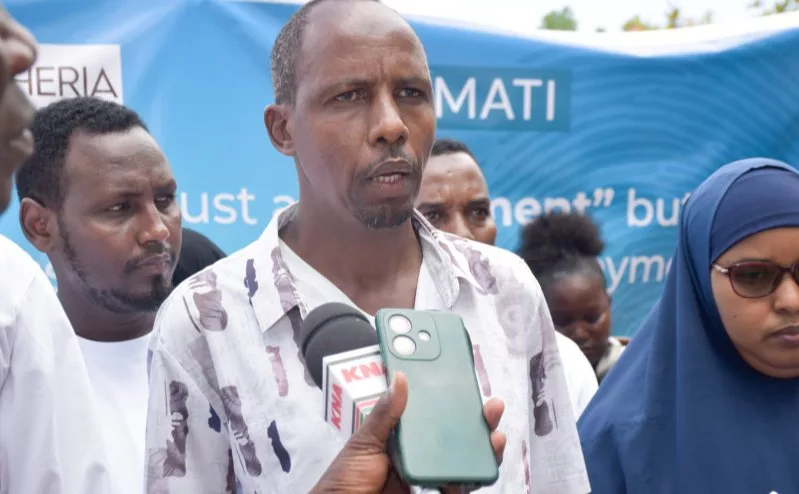 Barre
Aden, Haki Na Sheria organization’s programme manager speaking to the press./STEPHEN
ASTARIKO
 Fatuma
Ahmed Bathi, a Garissa human rights activist speaking to the press./STEPHEN
ASTARIKO
 Mohamed Mohamud, Assistant County Commissioner in charge of Huduma
Centre, Garissa.