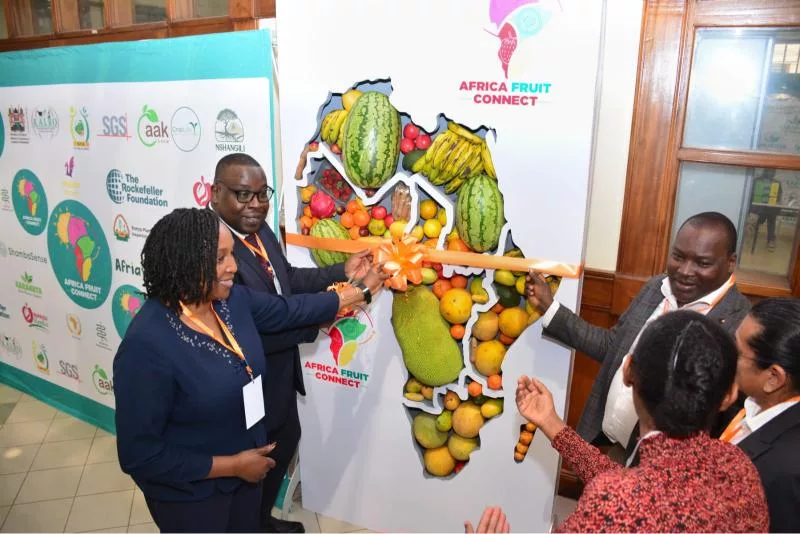
 An expo at KICC in Nairobi. /Jacktone Lawi
Horticulture industry players across East Africa are seeking stronger regional coordination to tackle high logistics costs, border delays and other barriers that are limiting the movement and competitiveness of fresh produce.
Industry leaders, government officials, private-sector players and development partners will meet in Nairobi on September 22–23 for a regional dialogue on horticultural logistics and trade facilitation.
The meeting will also mark the launch of the Horticulture Council of Eastern Africa (HoCEA), a private-sector-led regional body.
The new council is expected to give horticulture businesses a common platform to engage governments and regional institutions on challenges affecting trade, market access and investment.
“The process is intended to strengthen collaboration between government, industry and regional institutions and create clearer pathways for addressing challenges that cannot be resolved by individual businesses or countries acting alone,” said the interim chair of HoCEA and chief executive of the Tanzania Horticultural Association Jacqueline Mkindi.
The sector continues to face high freight costs, inadequate cold-chain facilities and weak systems for collecting produce from farms, according to the organisers.
Other challenges include fragmented digital trade processes, delays at ports and border points, inconsistent sanitary and phytosanitary requirements and certification procedures, as well as limited use of opportunities created by the African Continental Free Trade Area.
The problems are also being felt by smallholder farmers, women and youth, small businesses and logistics providers, rather than only large exporters.
The Nairobi meeting will focus on four areas, trade logistics and cold-chain systems, digital trade and smart corridors, sanitary and phytosanitary measures and non-tariff barriers, and access to African markets under AfCFTA.
Participants will examine how transport and storage systems can be improved for products that require fast movement from farms to consumers.
They will also look at the role of digital systems in reducing transaction costs and improving the flow of information during cross-border trade.
Sanitary and phytosanitary requirements will be another area of discussion, with participants expected to examine how certification and other procedures can be made more efficient while maintaining required standards.
The organisers want the meeting to produce concrete actions rather than another list of challenges.
The first day will focus on identifying and validating the main constraints, possible investments and interventions. The second day will seek to turn these priorities into policy and investment commitments.
The discussions are expected to result in a Nairobi Communiqué outlining priority actions, responsible institutions and timelines. The launch of HoCEA will then set out the council's immediate priorities and a 90-day action plan.
HoCEA is working with national horticulture associations across Eastern Africa with support from TradeMark Africa (TMA).
The council is intended to strengthen coordination among national associations and provide the industry with a regional platform for advocacy, market access and engagement with policymakers.
For exporters, more predictable logistics and efficient border processes could help reduce delays and costs in moving perishable produce to regional and international markets.
The initiative comes as producers and exporters face changing market requirements, rising logistics pressures and growing opportunities within African markets.
The Nairobi dialogue will bring together government agencies, logistics companies, technology firms, regional bodies, development partners and horticulture associations.
The organisers said the focus will be on connecting discussions with decision-making and implementation, particularly on problems that cannot be addressed by individual businesses or countries acting alone.