

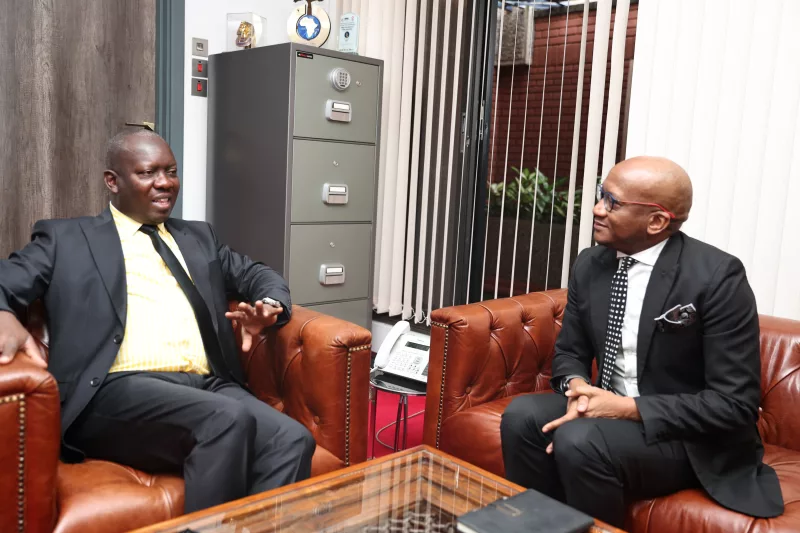
 DPP Renson Ingonga in a meeting with Special Director of Public Prosecutions of South Africa Mthunzi Mhaga in Nairobi, September 16, 2026. /ODPP
Kenya and South Africa have moved to strengthen cooperation in tackling transnational crime and facilitating mutual legal assistance and extradition for efficient administration of justice.
It follows two days of engagements between senior prosecutorial officials from the two countries on the importance of enhanced mutual legal assistance to effectively respond to increasingly complex criminal activities.
On Thursday, Director of Public Prosecutions Renson Ingonga held talks with South Africa’s Special Director of Public Prosecutions and Head of Legal Affairs Division, Mthunzi Mhaga, to explore ways of deepening collaboration between the two prosecution authorities.
The meeting built on deliberations held on Wednesday, when the Office of the Director of Public Prosecutions (ODPP), together with the Office of the Solicitor General, hosted the South African National Prosecuting Authority (NPA) delegation for a comparative knowledge-sharing engagement on civil litigation arising from prosecutorial decisions.
The latest discussions broadened the focus to emerging and transnational crimes, mutual legal assistance and extradition, as well as strengthening prosecutors’ capacity to handle increasingly complex criminal activities.
Ingonga emphasised the need for stronger institutional linkages and continued exchange of knowledge, expertise and best practices between the two jurisdictions.
"The meeting provided an opportunity for the two senior prosecutorial officials to discuss matters of mutual interest and explore avenues for strengthening cooperation," a statement from the DPP's office said.
The engagement also highlighted the importance of enhanced collaboration among African prosecution authorities in responding to crimes that cross national borders.
Wednesday’s meeting at the Solicitor General’s Office in Nairobi examined how Kenya and South Africa manage civil litigation arising from prosecutorial functions, including claims of malicious prosecution and unlawful detention.
Officials also discussed decision-to-charge processes, interlocutory applications, alternative dispute resolution, early settlement and measures to minimise litigation risks and costs to the State.
"Participants deliberated on the importance of well-documented, evidence-based prosecutorial decisions and effective coordination among prosecutors, investigators and civil litigation counsel in mitigating potential civil liability," the statement added.
The Kenyan delegation outlined the country’s constitutional and institutional framework governing prosecution and civil litigation, including the establishment of the ODPP Civil Litigation Unit in 2024 and its coordination with the Office of the Attorney General and Solicitor General on matters arising from prosecutorial functions.
The South African delegation shared its experience through the NPA’s Legal Affairs Division, which provides legal support and manages civil litigation involving the authority.
The delegation highlighted measures for managing litigation risks, including prosecutor training, root-cause analysis of acquittals, legal drafting programmes and early assessment of claims.
The two sides identified areas for continued institutional cooperation, including joint training on malicious prosecution, unlawful detention, decision-to-charge standards, interlocutory applications, trial advocacy and legal drafting.
The engagements reaffirmed the commitment of the Kenyan and South African prosecution authorities to deepening bilateral and continental cooperation in support of the rule of law and access to justice.







