

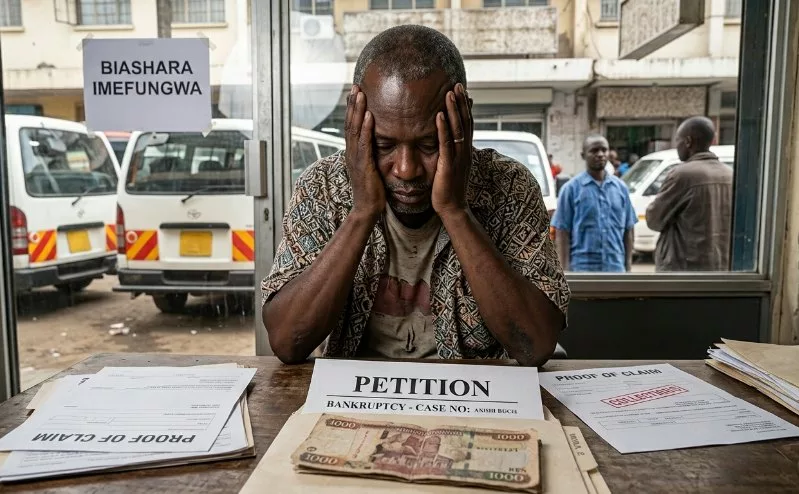
 AI-GENERATED IMAGE
The High Court's decision to declare siblings Marianne Nyokabi Kamotho and David Waweru Kamotho bankrupt over unpaid legal fees has brought renewed attention to what bankruptcy means for an individual in Kenya.
The siblings were facing outstanding legal fees of Sh4.83 million arising from a long-running dispute over the estate of their late father, former Cabinet minister John Joseph Kamotho. Nyokabi's outstanding balance was Sh3.74 million, while Waweru owed Sh1.09 million.
The court's orders mean the matter is no longer simply about an unpaid debt. Bankruptcy sets in motion a legal process through which a person's assets, debts and dealings with creditors are managed under the Insolvency Act.
So, what exactly happens when a Kenyan court declares someone bankrupt?
Kenya's insolvency law sets out how people who cannot repay their debts can be declared bankrupt, what happens to their property and how creditors may recover their money.
Bankruptcy does not mean that a person is automatically sent to prison or loses everything they own. It is a legal process for dealing with debts that a person cannot pay.
The process is governed by the Insolvency Act, 2015, which provides for bankruptcy, debt repayment arrangements and the management of a debtor's property.
What law governs bankruptcy in Kenya?
The main law is the Insolvency Act, 2015 (No. 18 of 2015). It sets out how individuals and companies that cannot pay their debts are handled.
The Act replaced much of the previous bankruptcy and insolvency framework. It covers personal bankruptcy, company liquidation and other ways of dealing with financial distress.
The process is also guided by the Insolvency Regulations, 2016, which provide procedures and forms used in insolvency cases.
Kenya Law, the official publisher of Kenyan laws and court decisions, makes the Act and relevant court rulings available online.
How does a person become bankrupt?
Bankruptcy is a legal process for individuals. A company facing financial problems is generally dealt with through a different process, such as liquidation or administration.
Under Section 32 of the Insolvency Act, a person who cannot pay their debts may apply to the court to be declared bankrupt.
The law also allows creditors to ask the court to declare a debtor bankrupt. A creditor must follow the legal requirements and provide evidence to support the application.
A person does not become bankrupt simply because they have defaulted on a loan or received a demand letter from a bank.
The court must consider the relevant legal requirements before making a bankruptcy order.
What happens when the court declares someone bankrupt?
A bankruptcy order has major financial and legal consequences. It changes how the person's debts and property are handled.
1. A trustee takes charge of the bankrupt person's estate
Once a bankruptcy order is made, the person's property that falls within the bankruptcy estate is placed under the legal process for dealing with their debts.
A trustee is responsible for managing the estate. The Official Receiver may be appointed to perform this role.
The trustee's work includes identifying the person's assets, dealing with creditors and distributing money recovered from the estate in accordance with the law.
The aim is to ensure that the person's available property is handled through a lawful process rather than individual creditors pursuing separate recoveries.
2. The person's property may be sold to pay creditors
Bankruptcy can result in the sale of assets belonging to the debtor.
The trustee identifies property that forms part of the bankruptcy estate and determines how it should be dealt with under the Act.
Money recovered may then be distributed among creditors according to the legal order of priority.
However, bankruptcy does not automatically mean that every item a person owns will be taken away. The law provides for how property is treated, and the position depends on the type of asset and the circumstances.
3. Creditors must follow the bankruptcy process
When a person is declared bankrupt, creditors generally have to pursue their claims through the insolvency process.
They may be required to submit details of the money owed to them so that their claims can be considered.
The trustee manages the process of dealing with the estate and distributing available funds.
This does not necessarily mean that every creditor will recover the full amount owed. If the estate does not have enough money, creditors may receive only part of their claims, depending on the applicable priorities.
4. The bankrupt person faces restrictions
Bankruptcy can affect a person's ability to manage their financial affairs.
The Insolvency Act contains restrictions and obligations that apply to bankrupt individuals. These include requirements relating to the disclosure of their financial position and the management of property.
A person who has been declared bankrupt should therefore understand the conditions imposed by the law and any specific court orders made in their case.
Bankruptcy is not simply a declaration that someone has debts. It is a legal status with consequences that may continue beyond the date of the court order.
Does bankruptcy mean someone will go to jail?
No. Bankruptcy itself is not a prison sentence.
The purpose of the bankruptcy process is to deal with debts and the debtor's available property.
However, bankruptcy proceedings can involve investigations into a person's financial affairs. Dishonest conduct, concealment of assets or failure to comply with legal obligations may raise separate legal issues.
The circumstances of each case matter. A person should not assume that being unable to repay a loan automatically amounts to a criminal offence.
Can someone apply to be declared bankrupt?
Yes.
Section 32 of the Insolvency Act allows a debtor to apply to court for an order declaring them bankrupt.
This provides a legal route for a person who is unable to meet their financial obligations to seek a formal resolution of their debts.
In In re James Maina Kabatha (Debtor/Applicant), the High Court discussed the purpose of bankruptcy protection and the need for an individual seeking it to act in good faith and disclose their financial information.
Kenya Law
The ruling illustrates that bankruptcy protection is not simply a way to avoid paying debts. The court process requires honesty and proper disclosure.
Can a bankrupt person ever be free of bankruptcy?
Yes. The law provides for discharge from bankruptcy.
Discharge is the legal process through which a person is released from the status of bankruptcy, subject to the applicable law and any conditions or exceptions.
It is important to distinguish discharge from the sale of property or the distribution of money to creditors. These are separate parts of the insolvency process.
The precise effect of discharge depends on the provisions of the Act and the circumstances of the individual case. Not every obligation is necessarily treated in the same way.
Is bankruptcy the only option for someone who cannot pay debts?
No.
Kenya's insolvency framework provides other ways of dealing with financial difficulties.
The Business Registration Service lists options including individual voluntary arrangements and summary instalment orders, alongside bankruptcy services.
Business Registration Service
These options may allow a person to address their debts without going through the same process as bankruptcy. Their availability depends on the circumstances and the relevant legal requirements.
A person facing financial difficulties may therefore need to understand the available options before deciding which legal route to pursue.







