
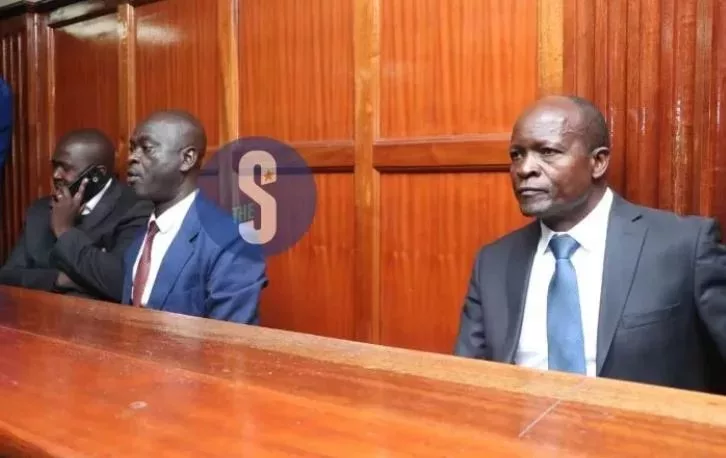
The High Court at Milimani is set to hear mitigation submissions from former Migori Governor Okoth Obado and his two co-accused today.
This comes before determining the sentence to be imposed following their conviction for the murder of university student Sharon Otieno.
Obado, Michael Juma Oyamo and Caspal Ajwang Obiero are expected to address the court on circumstances they want considered before sentencing in the case that has taken nearly eight years to conclude.
The prosecution's case resulted in the conviction of the three men after the court found that the evidence presented established a link between them and Sharon's killing.
Obado, who is 64, has asked the court to consider a lenient sentence, citing his age, health status and the length of time the case has taken.
In his pre-sentence report, the former governor maintained that he did not murder Sharon or participate in her killing.
He attributed his predicament to political woes and what he described as machinations intended to damage his character.
Despite denying responsibility for the offence, Obado acknowledged the tragic outcome and expressed a desire to reconcile with Sharon's family.
He has asked the court to consider a non-custodial sentence, pointing to his personal circumstances and the period he has spent facing the case.
Oyamo, who served as Obado's personal assistant, also expressed regret following his conviction.
The pre-sentence report indicated that Oyamo reflected on what it described as his misplaced sense of loyalty to his immediate boss and his failure to appreciate the consequences of his actions.
Oyamo said he was saddened by Sharon's death and stated that, had he known how events would unfold, he would have advised her differently in an effort to save her life and that of her unborn child.
Obiero, who worked with the Migori County Government, denied participating in Sharon's murder.
His motor vehicle was, however, cited in the pre-sentence report as having facilitated the transportation of persons identified in the case to and from the scene of the crime.
Obiero acknowledged the pain suffered by Sharon's family and expressed regret over the incident and its consequences.
The court will also consider the impact of the murder on Sharon's family as it determines an appropriate sentence.
In their victim impact statement, Sharon's relatives told the court that they had endured significant financial and emotional difficulties since her death on September 3, 2018.
The family said it had spent about Sh1.2 million attending court proceedings and a further Sh3.5 million on funeral expenses.
They told the court they had been forced to sell a one-acre piece of family land and a cow to meet the financial burden arising from the case and funeral arrangements.
The family also sought compensation, saying it lacked the means to meet immediate and future obligations, including supporting Sharon's children, siblings and ageing parents.
Sharon was 26 and seven months pregnant when she was killed.
She was a second-year student at Rongo University pursuing a diploma in Medical Records.
She left behind children who are now aged between nine and 12.
The family told the court that while they had forgiven the person concerned, they still wanted punishment imposed for the offence.
The court directed that the victim impact statement be shared with all parties before they file their respective submissions on mitigation and sentencing.
Sharon's body was found in a thicket near Kodera Forest in Homa Bay County in September 2018, after she was allegedly abducted alongside Nation Media Group journalist Barrack Oduor.
Oduor escaped by jumping from the moving vehicle.
In convicting the three men, Justice Githua found that the prosecution had established an unbroken chain of circumstantial evidence linking them to Sharon's killing.
The mitigation hearing marks the final stage before the court delivers it's final verdict.







