

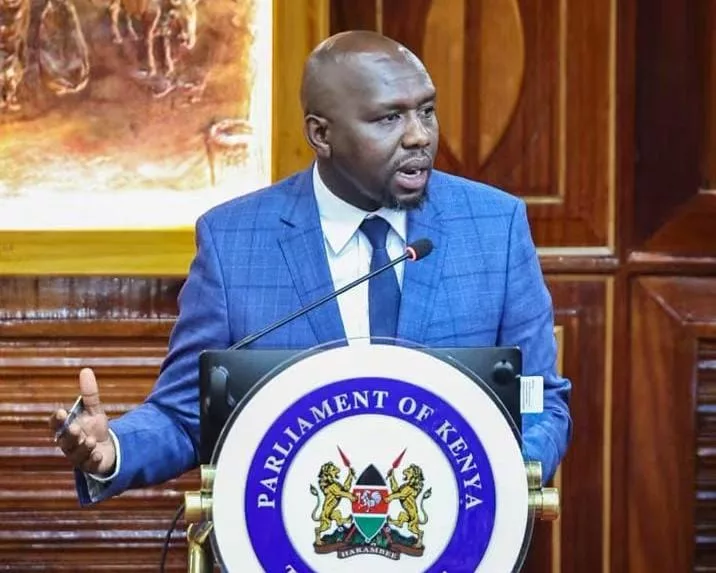
 Interior Cabinet Secretary Kipchumba Murkomen when he appeared before Senate on September 16, 2026/MINA
More than 121,000 youths have been jailed in Kenya since 2022, with nearly 12,000 imprisoned for offences linked to criminal gangs, violent extremism and political goonism, Interior Cabinet Secretary Kipchumba Murkomen has disclosed.
Murkomen said a total of 121,870 youths had been incarcerated in correctional facilities across the country between 2022 and 2026, with males accounting for 109,745 and females 12,125.
Responding to questions by Nyandarua Senator John Methu when he appeared Wednesday on the Senate plenary, Murkomen said the number of youths incarcerated peaked at 34,776 in 2024, comprising 31,862 males and 2,914 females.
The figures show that 23,676 youths were incarcerated in 2022, followed by 31,331 in 2023, 34,776 in 2024, 23,961 in 2025 and 8,126 in 2026.
“The total number of youths incarcerated in correctional facilities across the country between the year 2022 and 2026 is 121,870,” Murkomen said in his response to the Senate.
The data presented to the House showed significant variations across counties.
Nyeri recorded the highest number at 9,194, followed by Nairobi with 8,344 and Kakamega with 7,438.
Murang’a recorded 5,852 incarcerated youths, while Meru had 5,361, Machakos 5,261, Kericho 5,078 and Embu 4,616.
Other counties with high numbers included Kitui with 4,253, Migori with 4,196, Kisumu with 3,923 and Tharaka Nithi with 3,734.
At the lower end, Wajir recorded 46 youths, Lamu 66, Mandera 73, Samburu 138, Isiolo 177 and Garissa 238.
Murkomen said 11,824 youths had been imprisoned for offences relating to criminal gang activities, violent extremism and political goonism.
Of these, 9,959 were jailed for criminal gang activities, including 9,816 males and 143 females. Another 676 were imprisoned for violent extremism, while 1,189 were jailed for political goonism.
“The total number of youths imprisoned for these offences stands at 11,824,” Murkomen said.
He said sentences imposed by courts varied depending on the gravity of the offences, ranging from two days to indefinite sentences, including life imprisonment and the death penalty where applicable under the law.
The average definite custodial sentence imposed on youth offenders was approximately four and a half years, according to the Cabinet secretary.
Murkomen also told senators that the Kenya Prisons Service had expanded rehabilitation and reintegration programmes targeting young offenders, with 4,610 youths having successfully completed such programmes since 2022.
The programmes include counselling and psychosocial support, formal education, vocational and technical training, creative arts and tailoring, sports and recreational activities, mental health support and specialised treatment programmes.
Skills offered include welding and fabrication, carpentry and joinery, electrical installation, masonry and plumbing, motor vehicle mechanics, coding and robotics, gaming and animation, as well as fashion and textile design.
“Upon successful completion of training programmes, inmates are awarded nationally recognised certifications to support reintegration and employment opportunities upon release,” Murkomen said.
The certifications include Kenya National Examinations Council certificates, National Industrial Training Authority certificates, TVET trade certificates, digital literacy and technology certificates and certificates for behavioural and life-skills programmes.
The government, Murkomen said, was also implementing measures outside correctional facilities to prevent young people from engaging in crime.
These include county action plans on preventing and countering violent extremism, youth mentorship, community dialogue, religious engagement, online counter-radicalisation campaigns and rehabilitation and reintegration of returnees.
The government has also expanded youth empowerment programmes, including the Youth Enterprise Development Fund, Ajira Digital Programme, Kenya Youth Employment and Opportunities Project, Climate Workx and the National Youth Opportunities Towards Advancement programme.
Murkomen said increased access to vocational training and intensified operations against criminal gangs, drug trafficking networks and organised criminal groups were also part of the response.
“The government recognises that youth involvement in crime is driven by a combination of economic, social, behavioural and security-related factors,” he said.
He said the interventions therefore focused not only on enforcement but also on prevention, rehabilitation, skills development, environmental engagement and socio-economic empowerment.







