
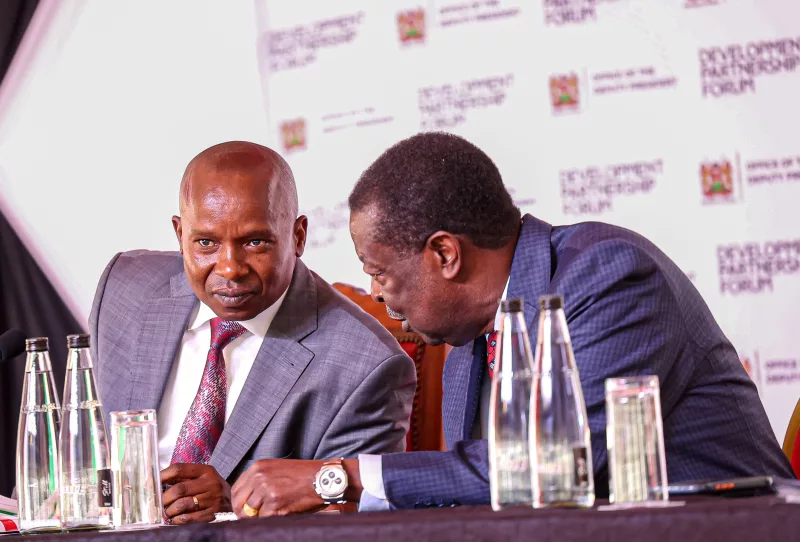
 Deputy President Kithure Kindiki and Prime Cabinet Secretary Musalia Mudavadi at the 15th Development Partnership Forum (DPF), held at his official residence in Karen, Nairobi/DPCS
Deputy President Kithure Kindiki has called on development partners to redirect existing humanitarian and social protection funding towards preparations for the forecast El Niño rains.
He said early intervention will save lives and reduce the cost of responding to disasters.
Kindiki urged development partners to consider flexible reprogramming of existing humanitarian, resilience and social protection financing to support anticipatory action ahead of the October-November-December (OND) rainfall season.
He also called on partners to work with the National Treasury and the National Disaster Management Authority to fast-track additional resources that may be needed as the weather situation develops.
“Prevention will always be more cost-effective and more humane than response,” Kindiki said.
The Deputy President spoke on Wednesday during the 15th Development Partnership Forum (DPF), held at his official residence in Karen, Nairobi.
The forum brought together Prime Cabinet Secretary Musalia Mudavadi, Council of Governors chair Ahmed Abdullahi, governors, ambassadors and high commissioners, as well as heads of bilateral and multilateral development agencies.
Representatives of civil society organisations and the private sector also attended the meeting, which focused on youth and development but also addressed the emerging climate threat.
Kindiki said the forecast El Niño-induced rains required urgent coordination among government agencies, counties, development partners and humanitarian organisations.
“No discussion of development cooperation in Kenya today would be complete without addressing an immediate and pressing risk posed by the forecast El Niño-induced short rains,” he said.
He recalled the devastation caused by the 1997-98 El Niño rains, which resulted in loss of human, livestock and wildlife lives, extensive flooding, damage to transport infrastructure and destruction of crops.
According to Kindiki, the Kenya Meteorological Department has indicated a high probability of 80 per cent and above of a very strong El Niño event during the OND season, with the rains expected to persist into early 2027.
He said the potential scale of the disaster warranted a coordinated response rather than waiting for flooding and other impacts to occur.
The Kenya Red Cross estimates that 46 of the country's 47 counties are at risk, he said.
“This is not only a weather forecast matter, but one that calls for a well-coordinated plan of action amongst all stakeholders to confront the adverse effects of this phenomenon,” Kindiki said.
He noted that some development partners had already responded to the threat by engaging government agencies, including the National Drought Management Authority (NDMA), on preparedness measures.
“Given the potential impact of the rains and building on this initiative by development partners, the government will convene a structured Government-Partners meeting to assess preparedness, agree on priority interventions and coordinate available support,” he said.
The government has also activated a multi-agency El Niño preparedness and response framework through the National Disaster Management Unit and National Disaster Operations Centre, working with county governments, the Kenya Red Cross Society and humanitarian partners.
The framework includes early warning, contingency planning, resource mobilisation, coordinated response and recovery measures.







