
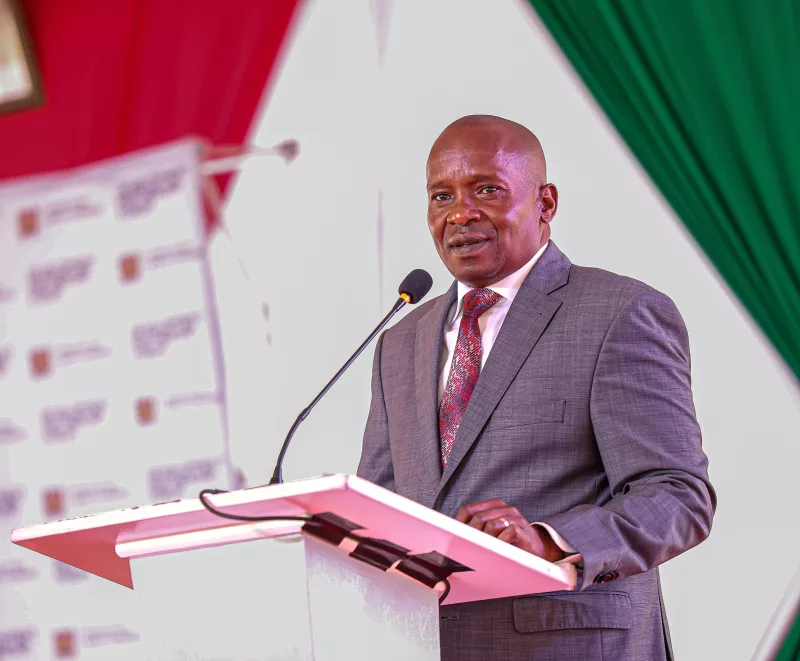
Deputy President Kithure Kindiki has called on government agencies to make youth employment a measurable priority by incorporating clear targets into their annual performance contracts and sector plans.
Kindiki said Ministries, Departments and Agencies (MDAs) should particularly focus on sectors with potential to create large numbers of jobs for young people, including agriculture, manufacturing, the digital economy, tourism and the blue economy.
He also urged development partners and the private sector to work with the government in financing and designing programmes targeting young people.
“At the same time, I call upon development partners and the private sector to co-finance and co-design youth programmes, provide market access and mentorship to youth-led MSMEs, and support youth employment interventions,” Kindiki said.
The Deputy President spoke on Wednesday during the 15th Development Partnership Forum (DPF), held at his official residence in Karen, Nairobi.
The forum brought together Prime Cabinet Secretary Musalia Mudavadi, Council of Governors chair Ahmed Abdullahi, governors, ambassadors and high commissioners, as well as heads of bilateral and multilateral development agencies.
Representatives from civil society organisations and the private sector also attended the meeting, which focused on youth and development.
Kindiki said Kenya’s youthful population should be viewed as a key driver of economic transformation rather than simply as beneficiaries of government and donor programmes.
“Kenya is a youthful nation, and our young people are not merely beneficiaries of development programmes; they are central actors in the transformation of our economy and society,” he said.
He said development partnerships should result in tangible opportunities for young Kenyans through employment, entrepreneurship, skills development, access to finance, innovation and participation in the digital economy.
Kindiki pointed to the National Youth Opportunities Towards Advancement Project (NYOTA) as an example of how government priorities and development partner support could be combined to reach young people at scale.
He said the programme, which provides business start-up capital, skills training, mentorship and market linkages to vulnerable youth, had reached close to one million young people in its first phase.
NYOTA is now being expanded to target two million young people through additional financing from the World Bank and the Kenyan government, he said.
Kindiki also cited the Kenya Jobs and Economic Transformation (KJET) project as part of the government’s efforts to expand employment opportunities.
He said KJET, together with NYOTA, is projected to support nearly two million young Kenyans.
Other initiatives highlighted included Kazi kwa Ground, Kazi Majuu, Kazi Mtandaoni, affordable housing, Vijana Baharini and expanded enrolment in Technical and Vocational Education and Training institutions.
The Deputy President, however, raised concern over the gap between development assistance committed by partners and funds actually disbursed and absorbed by implementing government agencies and county governments.
“As we focus on the impact of Official Development Assistance, we must question how efficiently we absorb and utilise ODA,” Kindiki said.
He said the persistent gap between committed resources and funds disbursed and absorbed remained a concern that the Development Partnership Forum had repeatedly raised.
Kindiki called for greater efficiency in the utilisation of development assistance to ensure that resources intended for development programmes translate into tangible results for Kenyans, particularly young people.







