

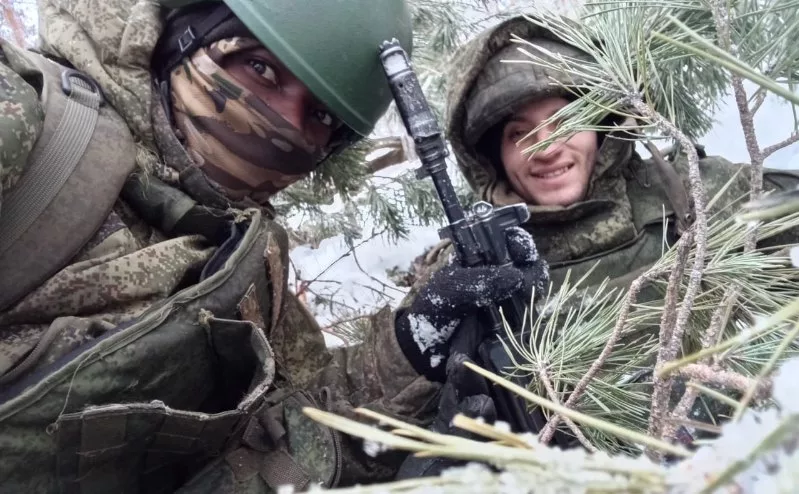
 Kenyan Rodgers Ouma Ahenda (left) in Russian military regalia/ HANDOUT
Lawrence Kirui's last message was short, almost casual—but it would become the line his family would replay endlessly.
“I have been deployed to the frontline.”
He sent the message to his fiancée on December 5, last week weeks after travelling to Russia believing he was taking up an ordinary job. Since then, his phone has remained silent.
For his sister, Sharon Chepkorir, the silence has been more painful than any official explanation.
Every call to government offices has produced more questions, while the family remains unsure whether Kirui is alive, wounded, missing, or trapped in a war he never understood he was joining.
In Busia, Juma William and his family are living through a similar nightmare.
His younger brother, Rodgers Ahenda, left Kenya on November 16 last year after being promised opportunities abroad.
“Rodgers was a first-year student at the Kisumu National Polytechnic… We only received information (about joining the Russian military) when he was already there," Juma said.
The last time the family heard from him was January 4, when he said he was being taken to the frontline.
They later discovered through photographs sent by a friend that Ahenda had ended up in the Russian military.
“We received pictures (in military regalia) from his friend,” Juma said.The two families, separated by distance but united by fear, are now demanding answers over the fate of their loved ones — and accusing the government of leaving them to navigate a maze of silence, conflicting figures and vague assurances.
“We just want the questions answered,” Chepkorir says.
Their anguish is at the centre of a petition by families of more than 841 Kenyans allegedly recruited into the Russian military, many of whom were reportedly lured by promises of civilian jobs before being drawn into the Russia-Ukraine war.
On Tuesday, the petitioners appeared before the joint Senate Security and Labour committees.
However, the meeting adjourned abruptly after top state officers who had been invited to the meeting failed to show up.
Foreign Affairs Cabinet Secretary Musalia Mudavadi, Labour Cabinet Secretary Alfred Mutua and Attorney General Dorcas Oduor had been invited to explain the fate of Kenyans trapped in the Russian military and Ukrainian prisons.
“A judge, in this case the Senate, will not hear the plaintiff in the absence of the defendant yet the defendant should be present so that, if there are any questions that we are raising, then the petitioners will be able to hear the answers,” Murang’a Senator Joe Nyutu said.
Co-chairs Isiolo Senator Fatuma Dullo (Security Committee chairperson) and Julius Murgor (Labour Committee chairperson) adjourned the meeting to September 29.
According to a detailed submission filed before the joint committee, the families say many of the recruits were lured by promises of civilian jobs as security guards, factory workers, construction workers, drivers, drone technicians, painters and logistics personnel, with attractive salaries and bonuses.
Instead, they were enlisted into the Russian armed forces, made to sign contracts in Russian and sent for brief military training before deployment to active conflict zones.
Chepkorir alleged her brother, Kirui, was initially issued with a tourist invitation to Russia, rather than being openly informed that he was travelling to join a foreign military.
“He was given a letter of invitation for a tourist visit in Russia. When he arrived there, things changed,” she claimed.
According to her, Kirui spent about two weeks in a hotel before being taken for training.
“He seemed to be saying, ‘All is well, all is well,’ until he was taken,” she said.
The families are also questioning the government’s insistence that the contracts signed by the recruits were valid.
Chepkorir says the documents were written in Russian, a language the recruits did not understand.
“Why is the CS in Kenya insisting on valid contracts signed, yet first of all, the contracts are in the Russian language?” she asked.
“You cannot then say, ‘I signed a contract knowingly’ or understood what it was. It is a Russian contract.”
She also questioned why Kenyan authorities would defend the validity of contracts allegedly entered into contrary to Kenyan law.
“If Kenyan nationals cannot be enlisted in foreign militaries, then why is the Cabinet Secretary and the PS (Principal Secretary) insisting on the validity of contracts that were signed contrary to the provisions of Kenyan law?” she said.
The families say their attempts to obtain help have yielded little concrete information.
Chepkorir said her mother and other relatives had repeatedly contacted the State Department for Diaspora Affairs, including through emails and meetings.
At one meeting in Upper Hill, she said, the family expected answers but instead encountered warnings.
“We had a meeting at the offices in Upper Hill in either July or August, where we didn’t get any information but threats,” she said.
The petition says families have faced an inadequate, fragmented and opaque state response, including delayed replies, verbal briefings without written documentation, lack of case reference numbers and no designated liaison officer to provide regular updates.
The submission states that the affected Kenyans include those killed in combat, injured and hospitalised, missing in action, held in Ukraine, incommunicado for more than six months and those whose deaths remain unconfirmed.
It says the families’ own register of about 841 affected persons is significantly higher than the 291 recruits accounted for by the Foreign Affairs Ministry as of May.
The petitioners are asking the Senate to establish a verified national register, create a family liaison mechanism, intensify diplomatic engagement with Russia, Ukraine and the International Committee of the Red Cross and facilitate the release and repatriation of Kenyans.
They also want returnees treated as possible victims of trafficking, coercion or deception before any prosecution decision is made.
INSTANT ANALYSIS
The accounts expose a troubling gap between recruitment promises and the reality Kenyan nationals face in Russia’s war. Allegations of deception, opaque government responses and conflicting casualty figures deepen families’ anguish. The Senate’s delayed hearing risks reinforcing perceptions of official indifference. Beyond locating missing Kenyans, the government faces scrutiny over recruitment networks, accountability, diplomatic intervention and possible trafficking.







