

 Stakeholders at the close of the two-day National Stakeholders Conference on Peaceful 2027 General Election dubbed Amani Conference, September 15, 2026. /NCIC
Stakeholders drawn from political parties, government, security agencies, religious organisations, civil society, youth groups, the transport sector and other sections of society have committed to working for peaceful and violence-free 2027 elections.
The commitment was made Tuesday at the close of the two-day National Stakeholders Conference on Peaceful 2027 General Election, dubbed Amani Conference.
It was convened by the National Cohesion and Integration Commission (NCIC) in partnership with various state and non-state actors.
 National Cohesion and Integration Commission chairman Bishop Kepha Omae reads the joint communique at the close of the two-day National Stakeholders Conference on Peaceful 2027 General Election dubbed Amani Conference, September 15, 2026. /NCIC
The stakeholders pledged to reject violence, intimidation, hate speech, ethnic mobilisation and other forms of political incitement, while promoting dialogue, tolerance and inclusive participation throughout the electoral period.

The conference comes as the country increasingly takes on an election mood ahead of the 2027 General Election, although the official campaign period set by the Independent Electoral and Boundaries Commission (IEBC) is due to begin on May 29, 2027.
It also comes amid growing concern over the use of goons and political violence during political activities as the country heads into the electioneering period.
 Stakeholders at the close of the two-day National Stakeholders Conference on Peaceful 2027 General Election dubbed Amani Conference, September 15, 2026. /NCIC
Political party leaders committed to running peaceful campaigns, while pledging to campaign on issues rather than personal attacks.
“We, political party leaders, commit to say no to violence, intimidation, ethnic mobilisation, hate speech and the use of goons without hesitation,” the communiqué states.
The leaders also committed to work with electoral, security, cohesion and peace structures to promote fair and peaceful campaigns and elections.
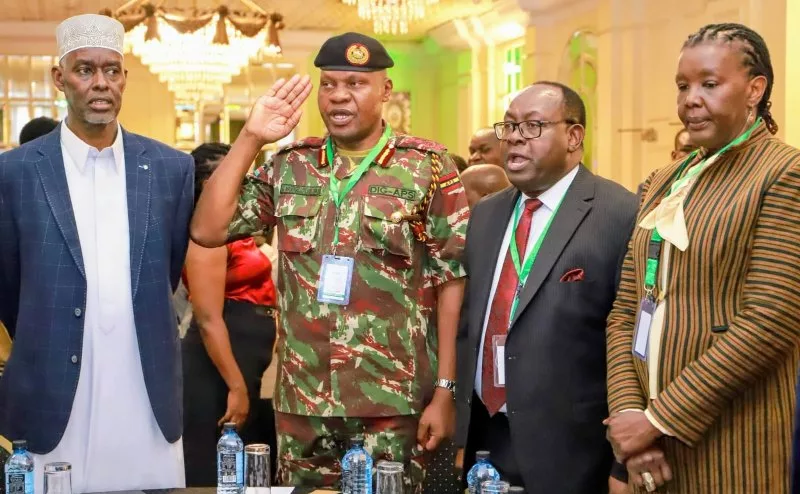 National Cohesion and Integration Commission chairman Bishop Kepha Omae (2nd from right) with DIG Gilbert Masengeli and other stakeholders at the close of the two-day National Stakeholders Conference on Peaceful 2027 General Election dubbed Amani Conference, September 15, 2026. /NCIC
Religious leaders and faith-based organisations pledged to move beyond declarations of peace and take practical action by mediating disputes, providing early warning and supporting timely responses to emerging tensions.
They also committed to keeping places of worship free from hate speech, incitement and partisan political mobilisation, while sustaining coordinated campaigns promoting tolerance and peaceful coexistence.
The Inter-Religious Council of Kenya further pledged to strengthen an interfaith early warning and early response mechanism to enable religious leaders to act before tensions escalate into violence.
 National Cohesion and Integration Commission chairman Bishop Kepha Omae with DIG Gilbert Masengeli and other stakeholders at the close of the two-day National Stakeholders Conference on Peaceful 2027 General Election dubbed Amani Conference, September 15, 2026. /NCIC
Youth organisations committed to using their influence responsibly by choosing dialogue over intimidation, ethnic mobilisation and violence, while taking part in peacebuilding, civic education, digital literacy and early-warning initiatives both online and offline.
“We, the young people of Kenya, commit to choose peace over violence, dialogue over intimidation, ethnic mobilisation or the pull towards goonism,” the communiqué says.
The boda boda and matatu sector pledged not to allow its members or stages to be used as instruments of political violence or intimidation and committed to report signs of planned violence, incitement or mobilisation to relevant authorities and peace structures.
 National Cohesion and Integration Commission chairman Bishop Kepha Omae (2nd from right) with DIG Gilbert Masengeli at the close of the two-day National Stakeholders Conference on Peaceful 2027 General Election dubbed Amani Conference, September 15, 2026. /NCIC
The sector also committed to maintaining peaceful and professional operations during the campaign and election period, including safely transporting voters, candidates and election officials.
Civil society organisations, development partners and community structures pledged to support peace committees, local mediators and early-warning mechanisms, while promoting civic education, peace messaging and conflict-sensitive programmes throughout the electoral cycle.
They also committed to support evidence-based monitoring of peace, cohesion and electoral risks and promote the participation and protection of women, children, persons with disabilities and marginalised communities.
Government and security agencies, meanwhile, pledged to protect citizens' rights during the electoral period and maintain impartiality in the discharge of their duties.
“We, the government and security agencies of the Republic of Kenya, commit to protect every citizen's right to campaign, assemble and vote in an environment that is safe, free and peaceful,” the communiqué states.
The agencies also committed to work with NCIC, county peace structures and communities to identify and respond to warning signs before tensions escalate, while protecting vulnerable groups from intimidation and harm.
They further pledged to remain accountable to the public and open to oversight.
The stakeholders said their shared vision is for a 2027 election that is peaceful, accountable and inclusive, with meaningful participation by women, youth, persons with disabilities and other under-represented groups.
In their rallying call, the conference organisers urged Kenyans to resolve political differences through dialogue, the constitution and the law and reject violence, intimidation and division as tools of political engagement.
They also called on the media, digital platforms and content creators to verify information before sharing it and reject hate speech, ethnic contempt and content intended to divide Kenyans.
“Peace is not the responsibility of any single institution. It begins with each of us at individual level, in our homes, our workplaces, our communities and in the way we speak to and about one another,” the stakeholders said.
They urged all state and non-state actors to translate the commitments into action at national, county and grassroots levels, calling on every Kenyan to become an ambassador of peace as the country moves towards the 2027 polls.







