 National Treasury PS Chris Kiptoo /HANDOUT
There is a dangerous tendency to speak about forests as though they belong only to environmentalists. Forests are not distant green spaces existing outside the economy. They are among the most productive natural assets upon which human civilisation depends. They regulate water, protect soils, store carbon, sustain biodiversity, moderate climate, support agriculture and create livelihoods. When a forest disappears, therefore, society does not merely lose trees. It loses an economic asset, a water reservoir, a climate regulator and opportunities for generations yet unborn.
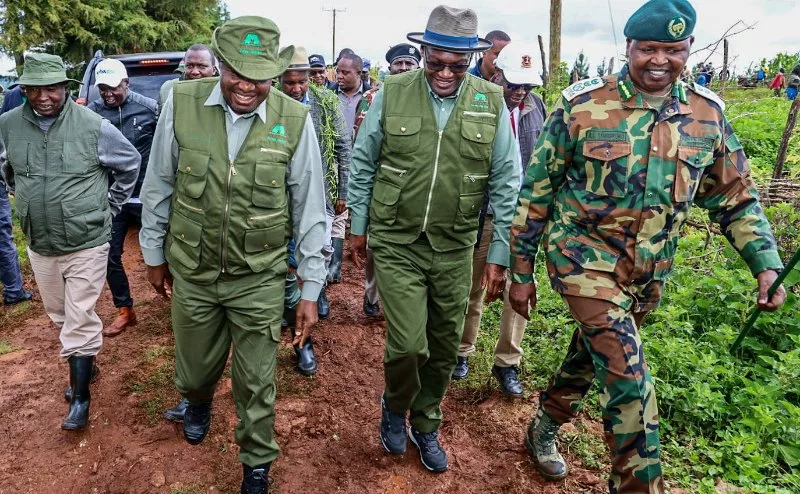
This is why the story emerging from Kaptagat deserves to be examined beyond the familiar language of tree planting and environmental conservation. The Kaptagat Integrated Conservation Programme (KICP) represents a potentially important example of what happens when conservation is understood as a long-term investment in people, landscapes and economic resilience. Its reported restoration of approximately 3,523.7 hectares across the Kaptagat landscape, alongside the development of a 273-kilometre Kenya Forest Service electric fence, is substantial. But the more important question is whether these interventions can ultimately transform the relationship between the forest and the communities living around it.
International experience suggests that they can. From Nepal's community forestry model to Costa Rica's payment for ecosystem services, China's Loess Plateau restoration and the Atlantic Forest restoration initiatives in South America, one lesson repeatedly emerges: conservation succeeds most sustainably when local communities cease to be spectators and become owners, beneficiaries and custodians of the restoration process. The world's strongest restoration programmes increasingly recognise that a hungry household cannot be expected to protect an ecosystem indefinitely unless conservation is connected to a viable livelihood. That principle is particularly relevant to Kaptagat.
The programme's philosophy, reflected through its broad pillars of Pesa Mfukoni, Kawi Safi Nyumbani, Maji Nyumbani and Mazingira Safi, offers a more sophisticated proposition than simply planting trees. It recognises that environmental sustainability begins at household level. People require incomes. Families require reliable energy. Communities require secure water. Farmers require productive enterprises. Young people require opportunities. And all these needs are ultimately connected to the health of the landscape. This is where Kaptagat begins to resemble the emerging global concept of a forest economy.
A forest economy does not mean exploiting forests for timber until nothing remains. It means recognising forests as natural capital whose ecological functions can generate sustained economic and social value without destroying the asset itself. In Kaptagat, this could mean strengthening enterprises such as dairy, beekeeping, agroforestry, coffee, avocado and other sustainable value chains while simultaneously protecting the forest and its water catchments.
The reported dairy interventions, including breeding, veterinary support, milk marketing and the innovative concept of a “cow hotel”, are particularly significant when viewed through this lens. They provide farmers with alternatives to environmentally destructive livelihood practices. A household that can generate dependable income from productive livestock, honey, agroforestry or other enterprises has a stronger economic reason to protect the surrounding ecosystem.
The same principle applies to energy. Cleaner household energy reduces pressure on forests for fuelwood. Water conservation protects both household welfare and agricultural productivity. Agroforestry can generate food, fodder, timber and income while strengthening soils and biodiversity. What appears to be a collection of individual projects can therefore become one integrated landscape strategy.
Yet Kaptagat must not measure its success simply by the number of seedlings planted or kilometres of fencing constructed. Those are important outputs, but they are not the final measure of conservation.
The real questions are more demanding. How many planted trees survive after five, ten or twenty years? Are degraded areas genuinely recovering? Are springs and rivers becoming more secure? Is biodiversity returning? Are households earning more? Are women and young people benefiting? Are local institutions strong enough to continue the work when external financing declines? Is conservation producing measurable economic value for communities? These are the questions that distinguish a conservation campaign from a conservation institution.
The 273-kilometre electric fence is an important protective investment, but no fence can substitute for community ownership. Infrastructure can establish a boundary; it cannot create a conservation ethic. The long-term security of Kaptagat will ultimately depend upon whether communities regard the forest as a source of shared prosperity rather than an obstacle to development.
This is precisely where some of the world's best practices offer guidance. Nepal demonstrates the importance of community institutions and benefit-sharing. Costa Rica demonstrates that ecosystem services can acquire economic value. China's Loess Plateau demonstrates that ecological restoration can be combined with poverty reduction and landscape management. The Atlantic Forest experience demonstrates the power of large-scale partnerships involving governments, communities, civil society and private actors. Kaptagat can draw from all four lessons while developing its own Kenyan model.
The next phase should therefore move deliberately towards establishing a Kaptagat Forest Economy and Conservation Observatory capable of measuring ecological and socioeconomic outcomes. Restoration should be independently monitored. Survival rates should be published. Water and biodiversity indicators should be tracked. Household income changes should be measured. Carbon and other ecosystem-service opportunities should be explored responsibly. Youth, persons with disabilities and women's enterprises should be linked to markets rather than merely supported through short-term projects. And communities should have a meaningful voice in determining how conservation benefits are distributed.
This is also where government, corporations, development partners, research institutions and conservation organisations have an opportunity to move beyond conventional corporate social responsibility. Kaptagat could become a living laboratory demonstrating that environmental restoration can simultaneously deliver climate resilience, water security, biodiversity protection, rural employment and inclusive economic growth.
So, is Kaptagat's conservation effort beneficial or an exercise in futility? The evidence and the underlying model suggest that it is neither futile nor guaranteed to succeed. It is a valuable investment whose ultimate return will depend on what happens next. The hectares restored are important. The fence is important. The trees are important. But the decisive achievement will be whether Kaptagat can build institutions, livelihoods and economic incentives strong enough to ensure that the restoration survives political cycles, funding cycles and generations.
If today's children inherit deeper forests, cleaner water, richer biodiversity, productive farms, stronger household incomes and a community that understands conservation as both a responsibility and an economic opportunity, then Kaptagat will have demonstrated one of the most important truths of our time: protecting nature is not a sacrifice made by society for the environment; it is an investment society makes in its own survival and prosperity.
Kaptagat should therefore not be judged merely as a tree-planting initiative. It should be judged as an emerging experiment in natural-capital development—a proposition that Kenya can conserve its landscapes while simultaneously improving the lives of the people who depend upon them.
The opportunity now is to make Kaptagat a model whose greatest export is not timber, but knowledge: proof that when communities, government, conservationists and the private sector work around one landscape and one long-term vision, restoration can become an engine of prosperity.
And perhaps that is the most important lesson Kaptagat can offer Kenya: a forest that benefits nobody will eventually struggle to find defenders; a forest that sustains its people can become the strongest form of conservation imaginable and Kaptagat is moving determinately towards that.