

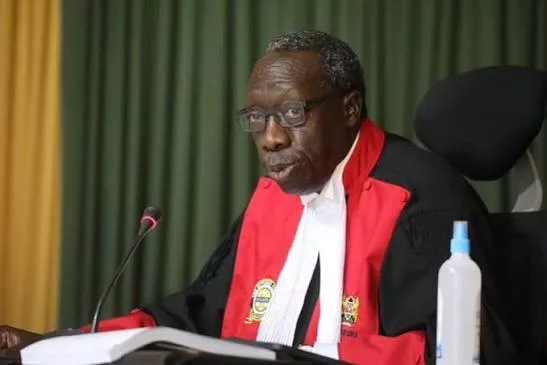
Supreme Court Judge William Ouko has warned that Kenya’s electoral institutions must command public confidence ahead of the 2027 General Election to prevent presidential election disputes from spilling into political confrontation.
Justice Ouko said the country’s experience before the 2010 Constitution showed that when electoral grievances could not be resolved through credible, independent and timely institutions, disputes over political power risked threatening national stability.
He said the Supreme Court’s exclusive original jurisdiction over presidential election petitions was deliberately created to ensure that challenges to the presidential mandate are resolved through law rather than political contestation.
“The legitimacy of the outcome is ultimately determined through law rather than political contestation,” Justice Ouko said.
He was delivering a lecture titled ‘The Constitutional Architecture of Presidential Election Dispute Resolution in Kenya’ at the Catholic University of Eastern Africa (CUEA).
The lecture comes as political parties and leaders position themselves for the 2027 presidential contest, with questions surrounding electoral credibility, institutional independence and the peaceful transfer of power expected to remain central to the national debate.
Justice Ouko said the establishment of the Supreme Court under the 2010 Constitution must be understood against Kenya’s history of contested elections and weaknesses in the mechanisms used to resolve electoral disputes.
He cited the 1997 presidential election petition, which was dismissed for want of personal service upon the incumbent President, as an example of how procedural technicalities could prevent substantive electoral grievances from being effectively addressed.
The disputed 2007 presidential election and the post-election violence that followed, he said, brought the consequences of institutional mistrust into sharper focus.
The Independent Review Commission, commonly known as the Kriegler Commission, identified serious concerns about public confidence in electoral and judicial institutions, including allegations of inefficiency, incompetence and corruption within the Judiciary.
Justice Ouko said the experience demonstrated that electoral credibility depended not only on how elections were conducted, but also on whether disputes arising from them could be resolved by institutions perceived as independent, impartial and capable of delivering timely justice.
“The experience following the 2007 General Elections demonstrated the profound consequences that may arise where disputes concerning the exercise of political power cannot be resolved through institutions that are perceived to be credible, independent, impartial and capable of delivering timely justice,” he said.
He said the Constitution’s decision to give the Supreme Court exclusive original jurisdiction over presidential election disputes was a deliberate response to that history.
Unlike ordinary electoral contests, he said, a presidential election determines the holder of the country’s highest elective office and affects the legitimacy of the national government.
“Consequently, challenges to the presidential election require a forum possessing both constitutional authority and institutional finality,” Justice Ouko said.
He said the Court’s role was not simply to settle disputes between rival candidates, but to protect the sovereign will of the electorate while upholding constitutionalism, the rule of law and electoral integrity.
The judge also highlighted the strict constitutional timelines governing presidential election petitions.
Under Article 140, a petition challenging the election of the President-elect must be filed within seven days of the declaration of results and heard and determined by the Supreme Court within 14 days of filing.
The decision is final, while a fresh election must be held within 60 days if the election is invalidated.
Justice Ouko said the timelines were intended to prevent prolonged uncertainty over the presidential mandate and ensure continuity of constitutional government.
“The fourteen-day period is therefore more than a procedural deadline; it is a constitutional imperative,” he said.
He, however, cautioned that the requirement for speed should not compromise fairness.
“Expedition, however, must not be conflated with haste,” he said, adding that the Court must balance the constitutional demand for speed with fair hearing, substantive justice and due process.
Justice Ouko said the compressed timeline required firm case management, including strict control of pleadings, evidence, interlocutory applications and oral submissions.
He also warned that presidential election petitions could not be sustained by generalised allegations, however serious, without cogent and credible evidence.
He said the legal burden of proof remains with the petitioner, who must establish the grounds on which an election is challenged.
The evidential burden, however, may shift between the parties as the case progresses.
“The outcome of a case depends on the strength, accuracy and reliability of evidence,” he said.
“In an adversarial court system like ours, the courts and Judges are ‘blind’, in the sense that they do not carry out any investigative roles or gather evidence on behalf of the parties before them. They depend on and determine disputes from what parties present.”
Justice Ouko said the law did not require every electoral irregularity or infraction to result in the nullification of an election.
A petitioner must demonstrate that the irregularities were sufficiently serious to affect the result or fundamentally undermine the integrity of the election.
“Not every irregularity, not every infraction of the law is enough to nullify an election,” he said, citing the Supreme Court’s established jurisprudence.
He said the Court must examine not only whether irregularities occurred, but also whether they were of such a nature or magnitude that no reasonable tribunal could uphold the election.
Justice Ouko said the 2010 Constitution had not created a perfect electoral or judicial system, but had provided a framework within which a more credible system of electoral justice could evolve.
“Our jurisprudence must therefore be understood not as a finished product, but as an evolving inheritance that we have a responsibility to develop with fidelity to the Constitution and sensitivity to the lessons of our past,” he said.
He said Kenya had made significant progress but still faced the enduring task of ensuring that electoral disputes strengthened, rather than weakened, the constitutional order.
“Kenya may not yet be a perfect democracy, but the distance travelled is significant,” Justice Ouko said.







