 Plant health innovation / Agatha Ngotho
 Plant health innovation / Agatha Ngotho
 Ian Amani Jefwa, executive chairman of Agrimedic East Africa /AGATHA NGOTHO
A new plant-growth technology is being tested in Kenya as researchers and farmers grapple with declining soil fertility, rising input costs, and increasingly erratic weather that are threatening crop yields.
Scientists have developed a mineral-based foliar product, called Plantos Verde, and trials conducted with the Kenya Agricultural and Livestock Research Organisation (KALRO) have shown improvements in a number of crop growth indicators.
The development comes even as research shows Kenya's soil fertility problem is much broader than simply the amount of fertiliser farmers apply.
A KALRO study of soils from 13 counties found nitrogen, phosphorus, and zinc deficiencies in most of the soils assessed. The study, covering samples from the Coast, Eastern, Rift Valley, and Western regions, also found an average soil pH of 5.96, highlighting the widespread challenge of soil acidity.
Kalro researchers have warned that declining soil fertility is contributing to low crop yields, with nutrient removal through harvesting, inadequate replenishment, soil acidity, and continuous cultivation among the challenges facing farmers.
The organisation's soil fertility research also shows that potassium deficiency is emerging as a problem in intensively cultivated smallholder farms, while deficiencies in nitrogen, organic carbon, and zinc have also been recorded in selected Kenyan soils.
According to Ian Amani Jefwa, the executive chairman of Agrimedic East Africa, which is distributing the product in the region, the technology is intended to help plants make better use of available nutrients rather than simply adding more fertiliser.
“We don't need more land, we just need more outputs from what we have,” Jefwa said during the launch at Kalro branch in Kabete.
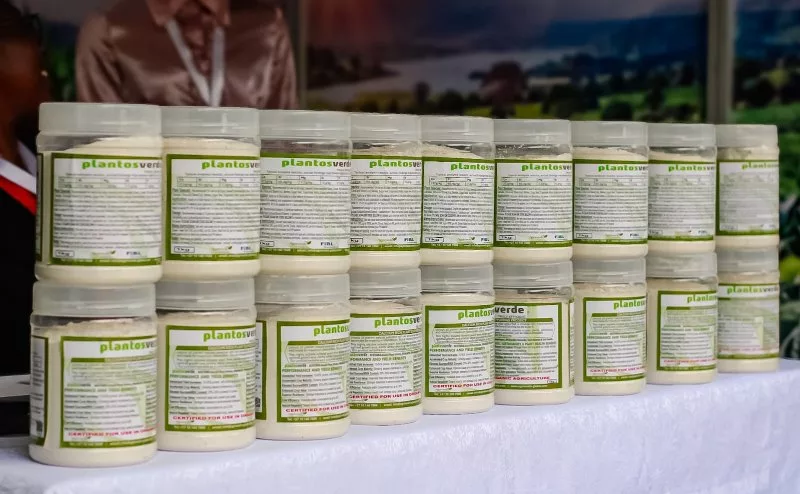
The product is a mineral powder made from calcium carbonate and 15 other minerals and is applied as a foliar spray.
Henry Potgieter, an agronomist with Plantos Verde's global team, said the recommended application is 10 grams per litre of water.
He said the technology had been tested on more than 40 crops globally over a period of more than 18 years.
In Kenya, the developers said trials involving Irish potatoes, sweet potatoes, carrots, barley, lemons, and avocados had been conducted with Kalro.
Data presented during the launch showed a 35.5 per cent increase in the number of Irish potato tubers per plant in one trial, while barley recorded a 38.5 per cent increase in the number of grains. Carrots were reported to be 19 per cent taller than untreated plants.
The presentation also reported a 33.3 per cent increase in seed potato storage roots, a 33.6 per cent increase in lemon leaf width, and a 7.3 per cent increase in avocado length.
Potgieter said Irish potato plants were eight centimetres taller by the end of the trial on 13 August 2026, while seed potatoes recorded a seven-centimetre increase.
Jefwa said the company was also reporting potential reductions in synthetic fertiliser use of up to 30 per cent and reductions in pesticide and fungicide use under certain conditions.
“We present these not as promises that every farmer will achieve the same numbers,” he said, adding that further field evaluation was necessary.
Cost will also be an important consideration for farmers. Potgieter put the estimated cost of using the product at about Sh15,000 per hectare per season, based on an application of 12kg per hectare.
For farmers already struggling with expensive inputs, the question will be whether the additional cost translates into higher yields or better returns.
Kalro's wider soil-health research suggests there is no single solution to Kenya's soil fertility problems. Its work on integrated soil fertility management promotes combining mineral fertilisers with locally available soil amendments, organic matter, improved seed, crop rotation, and other agronomic practices.
Kalro has also found that soil degradation is associated with nutrient mining, acidity, erosion, leaching, poor tillage, and loss of organic matter. Corrective measures therefore need to address the condition of the soil rather than focus only on crop nutrition.
Researchers have similarly warned that applying inorganic fertiliser alone may not restore soils where organic matter is low.
A Kalro study on changes in soil conditions and maize yields found that declining soil organic matter, soil nutrients, and available moisture are among the biggest threats to sustainable crop production.
It cautioned against focusing only on chemical soil fertility while neglecting the physical and biological condition of soils.
This makes independent testing of new agricultural inputs particularly important.
Jefwa said farmers should not accept new technologies simply because they are marketed well.
“Do not take our word for it. Ask the hard questions. Demand the data,” he told farmers and other stakeholders.
Jefwa said the product is not intended to replace good agronomic practices or conventional fertiliser altogether, but to complement existing production systems.
Instant analysis:
As Kenya seeks to increase food production on increasingly pressured land, technologies that improve nutrient-use efficiency may have a role to play. But Kalro's evidence on soil fertility also points to the need for a broader approach involving soil testing, balanced nutrient application, organic matter management, appropriate fertiliser use, and improved agronomic practices. The new technology therefore enters a market where the need is clear, but where farmers will need evidence of consistent results before committing scarce resources to another farm input.