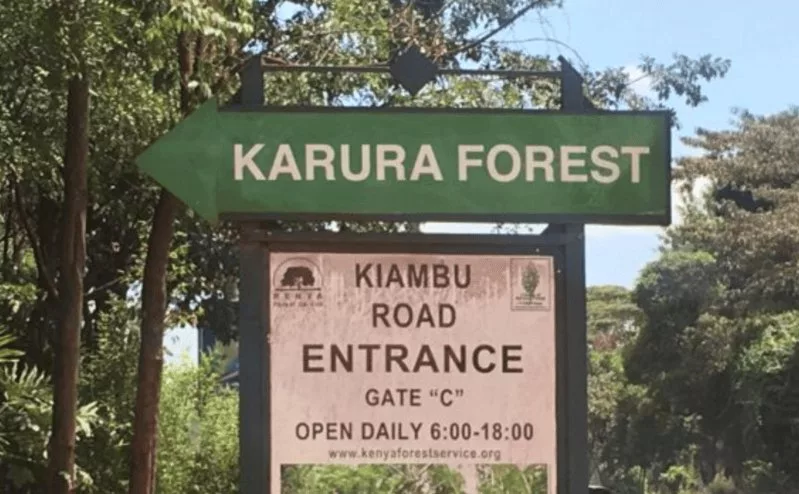
KFS said the gold club has encroached into the gazetted area of Karura Forest by approximately 54 acres.
“Karura Forest was surveyed in the early 1920s with the survey being registered in 1923. The forest covering approximately 2,573 acres was declared as a reserve vide Proclamation No. 44 of 1932,” KFS says.
Like all the other forests that were gazetted prior to independence, Karura was declared a Central Forest vide Legal Notice No. 174 of May 20, 1964.
“Muthaiga Golf club claims ownership of LR No. 13134/3 which encroaches onto Karura Forest by 54 acres,” KFS says.
Muthaiga Golf Club chairman Dennis Mwirigi informed members that the agency had taken over access to the affected section, prompting the club to temporarily restrict members from using the holes.
“We wish to inform you that the Kenya Forest Service (KFS) has invaded the course and taken over access to the Front Nine, from Hole No. 2 through to Hole No. 9. KFS is purporting that this section of the course falls within Karura Forest,” Mwirigi said.
He said the club’s board was working to resolve the dispute.
“The board is seized of the matter and is trying their level best to resolve the situation as urgently as possible,” he said.
Mwirigi added that the Front Nine would remain unavailable to members until further notice, while clarifying that the driving range and parking area were not affected.
In order to address the dispute, KFS on Tuesday said it had called for a meeting with Golf Club management.
“Owing to the difference in ownership positions between the two entities, a meeting will be held at KFS headquarters aimed at seeking an amicable solution,” KFS said.
It was not immediately clear when the meeting was to be held.
The
dispute has raised questions over the precise boundary between the golf club’s
property and the gazetted forest, with the meeting expected to
focus on ownership records, survey boundaries and the status of the contested
land.
Encroachment on the forest resource is not new.
Authorities have in the recent past been battling to recover encroached parts of the resource through revocation of some of the titles it deemed to have been irregularly acquired.
Last
year, the Environment and Land Court ordered the
revocation of a title deed for land within Karura Forest, ruling that the
property was illegally alienated from public ownership.
The court found that the 17.5 acre parcel was part of protected forest and institutional land and should revert to the government.
The court also ordered that the land be restored to the state and placed under the care of the Kenya Forest Service (KFS) and the National Land Commission (NLC) for environmental rehabilitation.
The orders also included a permanent injunction restraining any individual or entity from developing or occupying the contested parcel.
The case, filed by the then Kenya Anti-Corruption Commission (KACC), the predecessor to the Ethics and Anti-Corruption Commission (EACC), in 2007, sought to reclaim the land after investigations revealed that it had been unlawfully excised from forest reserve land and allocated to private individuals in the 1990s.
The EACC argued that the allocation contravened the constitution and environmental laws protecting public forests.
Justice Mwangi emphasised that forest land is public property held in trust for the people of Kenya and cannot be converted to private ownership without compliance with the law.
Karura Forest contains
nearly all the 605 species of wildlife found in Nairobi including three types
of antelope.
The resource is managed by the Kenya Forest Service in partnership with Friends of Karura Community Forest Association.
Attractions within the forest include mammals such as Harvey’s Duiker, Grimm’s Duiker, Bushbucks, Bush pigs, Genet Cats, Civets, Bush babies, Porcupines, Syke’s Monkeys, Ground Squirrel, Hares and the Epauletted-bat.
Reptiles include pythons, green snakes and monitor lizards.
It is home to about 200 species of birds including Ayres Hawk-eagle, the African Crowned Eagle, the Silvery-cheeked Hornbill, the Hartlaub’s Turaco, the Narina Trogon, Owls, Crested Cranes, Sparrows, Doves, Weavers and Vultures.
Butterflies such as African Queen and Desmond’s Green Banded Swallowtail are also found in the forest.
Plants in Karura Forest, plantations cover 632 hectares with species such as Araucaria cunninghamii, Eucalyptus saligna, E. globula, Grevillea robusta, Cupressus torulosa and Cupressus lusitanica.
The indigenous trees cover 260 hectares with species being found including Olea europeae subsp. auspidata, Croton megalocarpus, Warburgia ugandensis (Muthiga), Brachyleana huillensis (Muhugu), Uvaridendron anisatum, Markhamia lutea, Vepris nobilis, Juniperus procera (Cedar), Craebean brownii, Newtonia buchananii, Salvadora persica, Ficus thonningii, Trichilia emetica, Calondendrum capense and Dombeya goetzenii.
Shrubs and other plants are also found in the forest.
Other important attractions that visitors to Karura Forest one can enjoy include Mau Mau caves, scenic waterfalls and rivers, picnic sites, marked walking trails, small wetlands that are habitats for birds, the incinerator formerly used by Central Bank of Kenya to burn old currency notes and the area about which the late Professor Wangari Maathai carried out a campaign against illegal acquisition of forest land.
Activities that can be undertaken in the forest include forest walks, forest drives, bird watching, butterfly watching, cycling, running and picnicking.
KFS says it is committed to strengthening the protection and security of Kenya’s forest resources through enhanced prevention, surveillance, intelligence and risk mitigation.
The commitment was made during the closure of a two-day Protection and Security Senior Officers’ Workshop at the KFS Mau Conservancy Headquarters in Nakuru, attended by Regional Commandants from KFS conservancies.
Chief Conservator of Forests (CCF) Alex Lemarkoko urged officers to prioritise prevention, surveillance, accountability and risk mitigation in safeguarding forest resources.
“Protection and security has a lot to do with the protection of our forests. Lead by example, take responsibility, and place greater emphasis on prevention, surveillance and risk-mitigation measures,” said the CCF.