

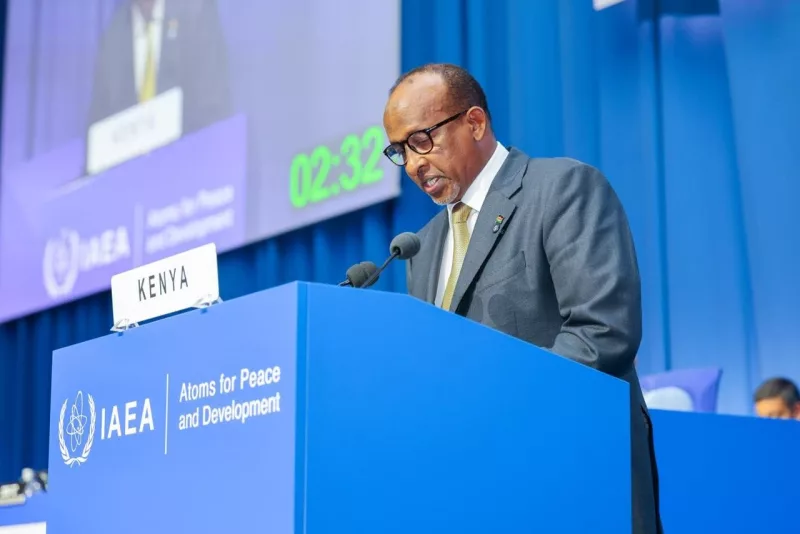
 Health Cabinet Secretary Aden Duale when he presented Kenya's statement at the 70th International Atomic Energy Agency (IAEA) General Conference in Vienna on September 14 /COURTESY
Kenya has taken its nuclear safety assurances to the international stage as the government pushes ahead with plans to build the country's first nuclear power plant in Siaya County.
Health Cabinet Secretary Aden Duale presented Kenya's national statement at the 70th International Atomic Energy Agency (IAEA) General Conference in Vienna, Austria, where he reaffirmed the country's commitment to nuclear safety, non-proliferation and international safeguards.
Duale said Kenya was making progress towards construction of the proposed Sh500 billion plant, with groundbreaking targeted for 2027 and connection to the national grid by 2034.
The project is expected to generate between 2,000- 5,000MW of electricity, with the government positioning nuclear power as a major source of reliable energy for industrialisation.
The safety message comes as Kenya prepares to move into a more critical phase of its nuclear programme, with the government expected to meet regulatory, technical, environmental and community-engagement requirements before construction can begin.
Nuclear Power and Energy Agency (Nupea) CEO Justus Wabuyabo said Kenya was committed to following the IAEA's Phase 2 Milestone Approach in developing the project.
“As the implementing agency, the Nuclear Power and Energy Agency (NuPEA) stands fully aligned with the President's vision for energy security for our country,” Wabuyabo said.
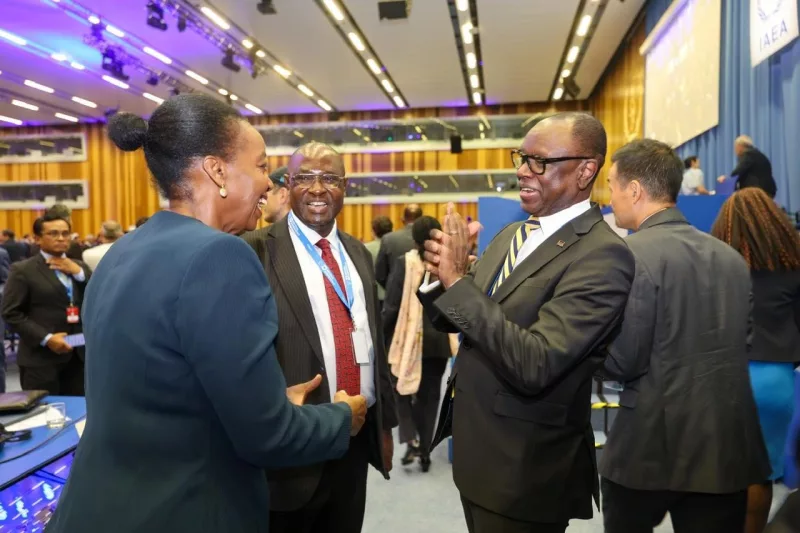 Executive Director at the UNODC and director general of the United Nations Office in Vienna Monica Juma (left), NUPEA CEO Justus Wabuyabo and Kenya's ambassador to Austria Edwin Afande during the ongoing 70th International Atomic Energy Agency (IAEA) General Conference in Austria on September 14 /COURTESY
He said the proposed Siaya plant would provide dependable baseload electricity needed to support Kenya's industrial ambitions.
“The development of Kenya's first-ever nuclear energy infrastructure in Siaya County which is targeted for a 2027 groundbreaking and grid connectivity by 2034 is a profound step toward scaling Kenya's generation capability to power the industrial nodes embedded in our Vision 2030 goals,” he said.
Wabuyabo said nuclear power should be viewed not only through the lens of climate change but also as an industrial requirement for a growing economy.
“Transitioning to nuclear power as a dependable, zero-emission baseload source is no longer just a climate objective, it is a firm industrial imperative,” he said.
He said the project could help stabilise the national grid, reduce long-term manufacturing costs and create thousands of highly skilled engineering and construction jobs.
But Wabuyabo acknowledged the public interest surrounding large infrastructure projects and pledged greater transparency as Kenya advances the nuclear programme.
“In adherence to Phase 2 of the IAEA Milestone Approach, NuPEA remains unwavering in its commitment to strict compliance with international legal, safety, and regulatory safeguards,” he said.
He also promised evidence-based engagement with communities and other stakeholders to address concerns and counter misinformation surrounding nuclear energy.
Duale said Kenya was also advancing plans for a nuclear research reactor while finalising key international nuclear safety agreements.
 Nupea CEO Justus Wabuyabo during the ongoing 70th International Atomic Energy Agency (IAEA) General Conference in Vienna /COURTESY
He told the conference that Kenya's nuclear ambitions extended beyond electricity generation, highlighting the use of nuclear science in healthcare and food production.
In healthcare, he said two IAEA-donated linear accelerators commissioned in Nakuru and Mombasa in May were now treating up to 150 patients daily.
The government is also establishing six additional regional cancer centres, Duale said.
He added that the Social Health Authority (SHA) provides coverage for primary cancer screening and specialised oncology care to more than 32 million enrolled Kenyans.
On agriculture, Duale highlighted Kenya's partnership with the IAEA through the Atoms4Food initiative, which he said had helped improve crop yields and reduce fertiliser costs by 20 per cent.
Kenya is also establishing a Centre of Excellence in Food and Agriculture to promote the use of nuclear science in the sector.
Duale said Kenya remained committed to nuclear safety, non-proliferation and international cooperation to harness nuclear science and technology for sustainable development.
“I reaffirmed our commitment to nuclear safety and non-proliferation while underscoring our strengthened regulatory capacity as a driver of Kenya’s sustainable development,” he said.
President William Ruto has repeatedly backed nuclear power as part of his long-term strategy to increase Kenya's electricity generation capacity.
During his development tour of Nyanza Monday, Ruto said the government had resolved to establish the nuclear plant in Siaya, with a projected capacity of between 2,000MW and 5,000MW.
The IAEA conference provided Kenya with an opportunity to reaffirm its nuclear ambitions while addressing one of the key concerns surrounding the project, ensuring that expansion of nuclear energy is accompanied by stringent safety, regulatory and public participation measures.







