

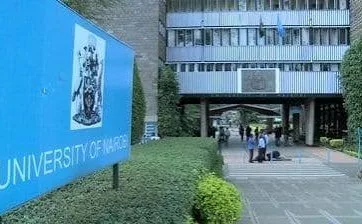
 The University of Nairobi/HANDOUT
President William Ruto’s reforms in higher education have failed to pull public universities out of the financial crisis that has dogged the institutions for decades.
The development came amid a report revealing the institutions’ combined debt is now approaching Sh70 billion.
The new report shows that despite the government’s much-hyped reforms in the sector, public universities continue to sink deeper into debt, raising questions over whether the changes have addressed the financial problems threatening the institutions.
The Budget Implementation Review Report for the year ended June 30, 2025, shows public universities have accumulated debts amounting to Sh69.23 billion.
According to the report released by Controller of Budget Margaret Nyakang’o, the University of Nairobi, Kenyatta University, Jomo Kenyatta University of Agriculture and Technology and Moi University are among institutions carrying the heaviest debt burdens.
The University of Nairobi tops the list with Sh16.43 billion, followed by Kenyatta University with Sh13.93 billion, Jomo Kenyatta University of Agriculture and Technology at Sh10.97 billion and Moi University at Sh10.11 billion.
Egerton University has accumulated debts amounting to Sh8.38 billion, while Multimedia University of Kenya owes Sh2.53 billion and Maasai Mara University Sh1.09 billion.
Other institutions with significant debts include Tom Mboya University at Sh960.61 million, Kisii University at Sh860.05 million and Jaramogi Oginga Odinga University of Science and Technology at Sh803.87 million.
The report further lists the University of Kabianga with Sh576.57 million in debt, Murang’a University of Technology Sh715.84 million, Kibabii University Sh504.85 million and Laikipia University Sh360.90 million.
Others are Taita Taveta University Sh292.94 million, University of Eldoret Sh22.88 million and Meru University of Science and Technology Sh113.72 million.
The Controller of Budget said the government should settle verified pending bills to ease pressure on public institutions.
“The Controller of Budget appreciates the government’s efforts in verifying the pending bills and recommends settlement of the verified pending bills on a first-in, first-out basis by ensuring they are budgeted in line with Regulation 56(2b) of the PFM (National Government) Regulations 2015,” the report says.
The continued accumulation of debt comes against the backdrop of President Ruto’s push to overhaul university funding, with the new model initially presented as a solution to the financial problems bedevilling institutions.
Ruto had strongly criticised the previous system, arguing it had contributed to the accumulation of huge debts by universities.
“It is not right to continue with a model that has created huge debts. That is why I am deliberate, intentional and focussed on making sure we have a model that does not take our university education where it was,” Ruto had said.
The President, however, has since changed course, announcing the government is moving towards a new model under which all university students will receive full state funding.
“Going forward, any student, so long as they have passed their examinations and they have been placed in a college or university, will get full funding for their higher education. It will be the choice for parents if they want to pay,” Ruto said.
The new funding model is expected to take effect once Parliament passes proposed amendments to laws governing higher education, replacing the current system.
The shift marks a departure from the existing funding model, which provides financial support based on students’ levels of need under the Variable Scholarship and Loan Funding Model.
Under the proposed arrangement, the government will shoulder the cost of higher education for all students admitted to public universities and colleges, with parents only contributing voluntarily if they wish.
Ruto has urged MPs to fast-track amendments to the Higher Education Loans Board Act to enable the new funding model to take effect from the September 2026 intake.
The President said the move was necessary to guarantee equal access to quality education, arguing that education remains a key driver of social mobility.
“Countries that are ahead of us had high-quality education. Education was a central pillar. My team tells me that education makes us equal and has no equal. That is where we are taking this,” he said.
He said the current system had forced students from disadvantaged families to abandon courses of their choice because they could not raise the required household contribution.
“I want to implore Parliament to expedite amendments to the Higher Education Loans Board so that beginning September we can make sure that any child who qualifies for medicine does not fail to study medicine because their parents cannot afford to pay the household contribution,” Ruto reiterated.
INSTANT ANALYSIS
The report exposes a deepening financial crisis in public universities, undermining President William Ruto’s claim that his funding reforms will rescue the sector. With debts nearing Sh70 billion, the figures suggest the previous model failed to address structural funding gaps. Ruto’s U-turn towards full government funding therefore comes under scrutiny, particularly as the state already faces mounting fiscal pressures. The key question is whether the proposed model will genuinely eliminate university debts or merely transfer the financial burden to taxpayers.







