
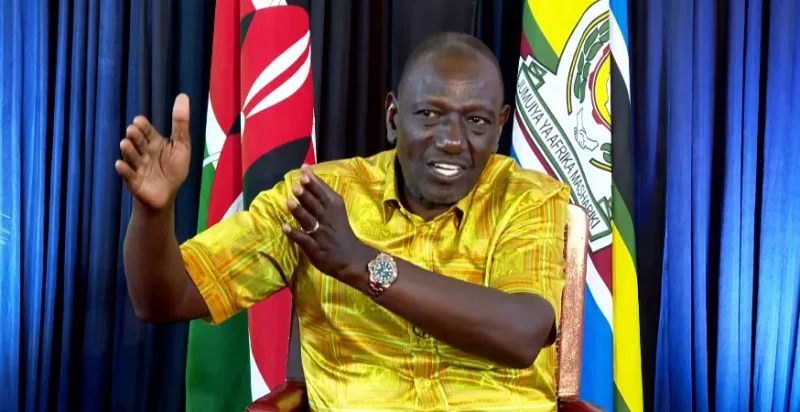
 President William Ruto speaking during a media engagement in Kisumu on September 14, 2026 / Screengrab
President William Ruto has claimed that the Jubilee administration abandoned its affordable housing programme after facing public opposition, despite housing being one of the government's Big Four Agenda priorities.
Speaking during a media engagement at Kisumu State Lodge on Monday, Ruto said former President Uhuru Kenyatta told him to drop the programme after Kenyans raised concerns over its implementation.
“I remember President Uhuru Kenyatta telling me, ‘My friend, this noise. Why are people making noise? Let's forget about this programme. After all, you have a house; I have a house. So why are we allowing people to make noise at us?’”
Ruto said the experience influenced his decision to revive the programme after he became president, arguing that affordable housing could transform Kenya's economy and urban development.
He said housing was included in both his political manifestos, first when he was in ODM and later under the Kenya Kwanza coalition.
Ruto also defended the housing levy, saying both the Azimio and Kenya Kwanza manifestos proposed a levy, although the Kenya Kwanza manifesto did not specify a percentage.
He said the programme faced opposition from the public and political actors, including protests and court challenges, but he remained committed to implementing it.
The President outlined four reasons he considers affordable housing important, starting with urban planning.
He said 60 per cent of Kenyans are expected to live in urban areas by 2050, creating a need for planned and organised cities rather than the expansion of informal settlements.
“It is either they are going to live in planned, organised cities, or they are going to live in slums. That's the choice we have,” Ruto said.
He also said the programme was creating jobs and supporting a wider construction industry. According to Ruto, about 1.1 million people are currently working in the housing programme, including carpenters, electricians, tilers and engineers.
He said affordable housing had also stimulated industries involved in producing cement, steel, glass, doors and other construction materials.
Ruto argued that the programme could help curb the fragmentation of agricultural land as urban populations grow.
He said uncontrolled subdivision of agricultural land for housing could threaten food security by reducing the land available for farming.
The President also credited affordable housing projects with changing the skylines of several Kenyan towns.
He cited Kisumu, Nanyuki, Nyeri, Eldoret, Kericho, Mombasa, Kakamega, Bomet, Bungoma and Vihiga as some of the areas where the government is implementing housing or smart-city projects.
“As I drove from the airport, looking at Kisumu, the skyline, I mean, it was phenomenal,” Ruto said, attributing the changes in part to the affordable housing programme.







