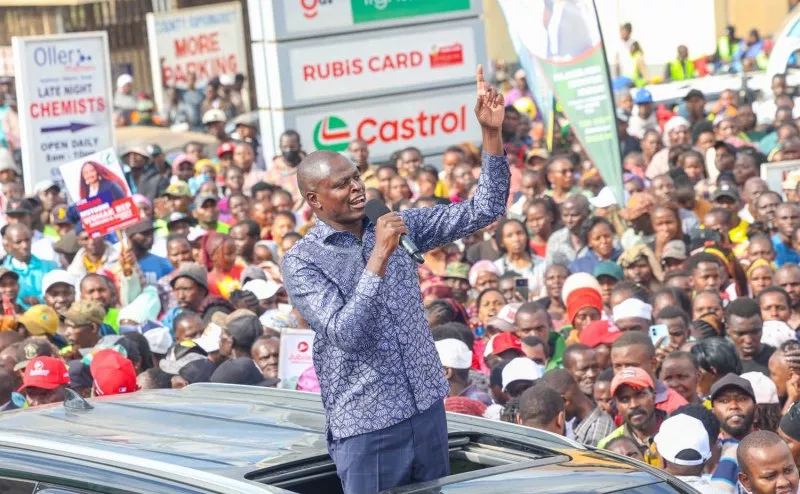
In politics, perception often becomes reality long before facts catch up. Few Kenyan politicians today embody this uncomfortable truth more than Kiharu MP Ndindi Nyoro.
Once celebrated as President William Ruto's most brilliant protégé from the Mt Kenya region, Nyoro now finds himself in a peculiar position.
He is no longer viewed as a reliable ally of the Kenya Kwanza administration, yet many Kenyans remain unconvinced that he is a genuine opponent of the regime. He occupies an increasingly crowded political space between government and opposition, and that ambiguity is fuelling suspicion.
The questions are growing louder. Why has Nyoro chosen to chart an independent political path at a time when opposition forces are attempting to consolidate? Why launch a new political vehicle when Rigathi Gachagua's influence and the Democracy for the Citizens Party (DCP) have already gained significant traction across sections of the Mt Kenya region? Is he positioning himself as an alternative voice, or is he fragmenting an already fragile opposition front? These questions are not evidence of wrongdoing. They are, however, legitimate political concerns.
Part of the scepticism arises from Nyoro's record during pivotal political moments. During the impeachment process against former Deputy President Rigathi Gachagua, he avoided taking a clear position and abstained.
During the heated debate and vote surrounding the controversial Finance Bill, 2026, critics argue that he was conspicuously absent when many Kenyans expected leadership and clarity. At the height of the Gen Z-led protests that shook the political establishment, Nyoro was not among the most visible voices defending the concerns raised by young demonstrators.
For a politician often praised for his courage, intellect and mastery of economic issues, these moments are hard to explain away. Politics is ultimately judged not by speeches but by choices made at critical crossroads. Many Kenyans are therefore asking whether Nyoro's carefully crafted image as an independent thinker is matched by an equally courageous willingness to take political risks.
His supporters offer a different perspective. They argue that Nyoro represents something increasingly rare in Kenya: a politician unwilling to be captured by either side. They point to his economic critiques of government policy and his refusal to follow political factions blindly.
In their view, strategic restraint should not be mistaken for cowardice, and political independence should not automatically invite accusations of betrayal. Yet therein lies the problem.
In a political environment defined by clear alignments, neutrality often looks indistinguishable from opportunism. The longer Nyoro remains difficult to place, the more room he creates for speculation about his true loyalties.
Is he a reformer building a long-term presidential project? Is he a bridge between competing political camps? Or is he, as some critics allege, part of a broader strategy designed to weaken opposition cohesion from within? No verifiable evidence has emerged to support such claims, but their persistence speaks to a credibility challenge that Nyoro cannot afford to ignore.
Kenyan politics has produced many leaders who have mastered the art of saying the right things while avoiding the consequences of acting on them. Voters have become increasingly distrustful of politicians who appear to stand everywhere and nowhere at the same time.
That is why the burden now rests squarely on Ndindi Nyoro. He cannot rely indefinitely on eloquent economic analyses, carefully calibrated statements, and political ambiguity.
Kenyans want clarity. They want to know what he stands for, who he stands with, and what kind of country he hopes to build.
Until those questions are answered convincingly, suspicion will remain his constant companion. Fairly or unfairly, many will continue to view him not as a decisive political actor but as a man playing a deeper game whose true objectives remain hidden from public view.
In politics, ambiguity can be a useful strategy. But it can also become a trap. Ndindi Nyoro may soon discover that the longer he keeps Kenyans guessing, the more they will write their own conclusions.