
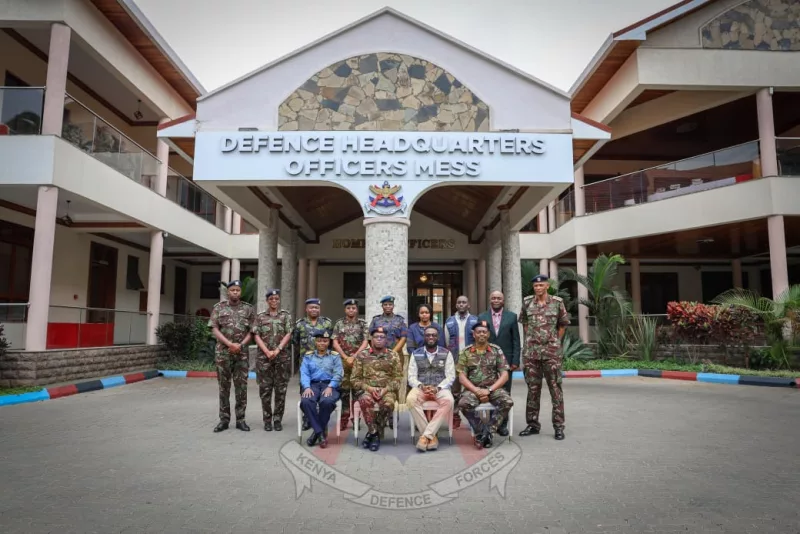
 KDF and WHO leaders pose for a photo after partnering to strengthen emergency medical preparedness ahead of rains.
The Kenya Defence Forces (KDF) has partnered with the World Health Organization (WHO) to strengthen emergency medical preparedness ahead of the October-November-December 2026 rainfall season.
The partnership seeks to enhance Kenya’s readiness to respond to flooding, landslides and other weather-related emergencies that may require rapid deployment of medical teams and resources.
With technical support from WHO, KDF recently conducted an Emergency Medical Team (EMT) preparedness exercise to assess its readiness for rapid deployment during major emergencies.
The exercise brought together strategic planning, specialised technical expertise and realistic operational scenarios to test existing response arrangements and strengthen coordination among agencies involved in emergency medical response.
It assessed the readiness of medical teams, activation and deployment procedures, resource requirements and the availability of essential medical supplies.
Participants also worked through potential public health scenarios and developed practical pre-deployment frameworks to help medical teams transition quickly from standby to field operations.
The programme is also aimed at strengthening civil-military coordination while identifying operational gaps that could affect emergency response, particularly where disasters place pressure on civilian health systems.
Speaking on behalf of the Director of Medical Services, Major General (Dr) Francis Kuria, the Chief of Clinical Support Services, Brigadier (Dr) David Kimeli Chepsiror, said KDF remained prepared to provide critical support during major emergencies.
He said KDF operates within the broader national emergency response architecture but remains ready to provide additional capabilities when civilian response systems require support.
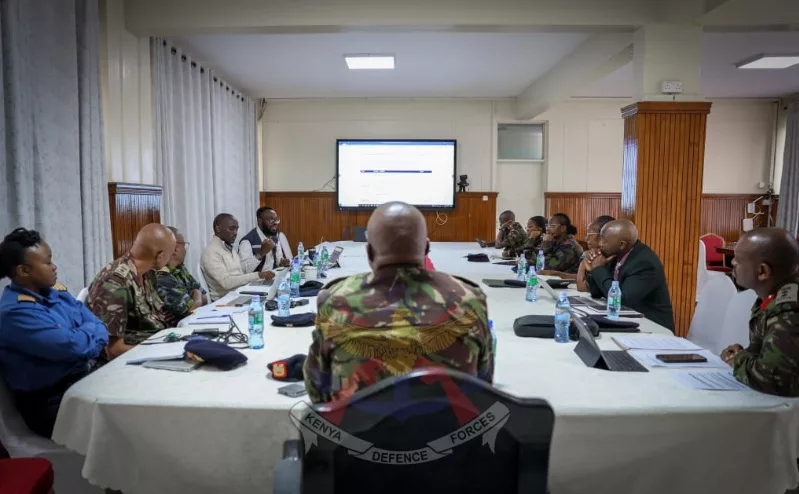
WHO Kenya Team Lead for Emergency Preparedness and Response, Dr Livinus Martins Chibueze, stressed the importance of testing response systems before emergencies occur.
He said preparedness exercises allow response teams to assess operational systems, work through complex scenarios, strengthen coordination and identify gaps that could undermine an effective response during an actual emergency.
The joint exercise is expected to strengthen Kenya’s capacity to deploy trained personnel, medical supplies and other resources quickly when emergencies occur, while reinforcing civil-military and multi-agency cooperation in disaster response.
Kenya is set for an enhanced October-November-December short rains season with the latest forecast projecting above-average downpours and isolated storms in much of the country.
The Kenya Meteorological Service Authority said the OND 2026 rains are expected to be fairly to well distributed across several parts of the country, with the exception of Turkana and Samburu where distribution is forecast to be poor to fair.
“This season will be marked by prolonged wet spells and occasional isolated storms over several parts of the country,” Kenya Met said.
The outlook shows above-average rainfall in 43 counties, including Baringo, Bomet, Bungoma, Busia, Embu, Garissa, Homa Bay, Isiolo, Kajiado, Kakamega, Kericho, Kiambu, Kilifi, Kirinyaga, Kisii, Kisumu, Kitui, Kwale, Laikipia, Lamu, Machakos, Makueni, Mandera, Meru, Mombasa, Nairobi, Nakuru, Nandi, Narok, Nyamira, Nyandarua, Nyeri, Siaya, Taita-Taveta, Tana River, Tharaka-Nithi, Trans Nzoia, Uasin Gishu and Vihiga, as well as much of West Pokot, Samburu and Marsabit.







