

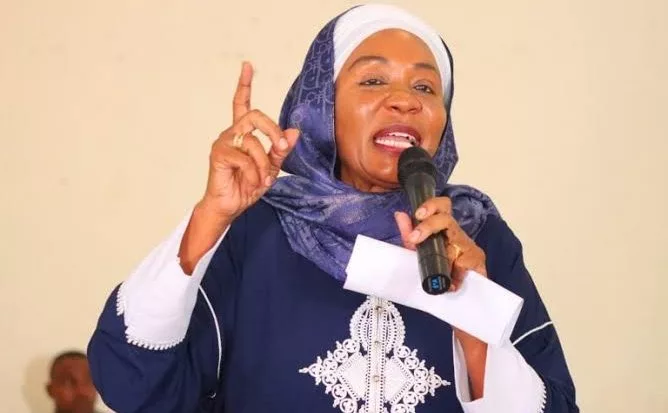
Nominated Senator Hamida Kibwana /HANDOUT
Parliament is pushing for a nationwide transition to clean cooking as new data shows about 69 per cent of Kenyan households still primarily rely on traditional, polluting fuels such as firewood.
The Senate has been told the Kenya National Cooking Transition Strategy Action Plan identifies widespread use of polluting fuels as a major health, environmental and economic challenge requiring urgent government intervention.
Citing the plan, Nominated Senator Hamida Kibwana, who is leading the push for transition to clean cooking, said about 90 per cent of institutions in the country cook with firewood.
A typical primary school consumes between 64 and 164 tonnes of firewood annually, depending on stove efficiency.
She said clean-cooking access remains sharply unequal, standing at 71.5 per cent in urban areas compared with only 11.1 per cent in rural Kenya.
“The plan estimates full implementation of clean cooking strategy in the country could avert more than 26,500 deaths annually from household air pollution,” Kibwana said.
She spoke during a breakfast meeting for senators on advancing parliamentary action for universal access to clean cooking in Kenya.
Kibwana, who has sponsored a motion seeking to mainstream clean cooking into national financing frameworks, said a successful transition could save households about 790 hours annually and prevent unsustainable wood harvesting equivalent to roughly 466,543 hectares (1,152,852 acres).
She urged the government to use results-based and blended financing models to reduce investment risks and make clean cooking solutions affordable to low-income households.
“The key question is therefore not whether one fuel should replace every other fuel, it is whether Kenya has an affordable, safe, reliable and measurable pathway for different households and institutions and whether public finance and regulation are aligned to deliver it,” she said.
Kibwana warned that simply providing households with clean cooking appliances would not guarantee a transition, noting that many families continue to combine clean and traditional fuels when electricity, refills or suitable appliances are unaffordable or unreliable.
She also cautioned that an improved stove is not automatically clean for health, saying performance and emissions standards must be enforced in line with Kenyan and World Health Organization standards.
Kenya Parliamentary Caucus on Climate Change chairperson Moses Kajwang’ challenged the National Treasury and climate-change partners to disclose how much public money is supporting the clean-cooking agenda.
“The National Treasury needs to explain which interventions need grants or subsidy, which can attract commercial capital, and what must be de-risked and how will climate-finance benefits be measured and verified,” he said.
Kajwang’ also urged the Ministry of Energy and Petroleum to provide an updated national baseline showing clean-cooking access by county, rural and urban areas, income levels and gender vulnerability.
He said the ministry should also disclose milestones under the National Cooking Transition Strategy that should have been achieved by September 2026 and whether implementation is ahead or behind schedule.
Nominated Senator Esther Okenyuri called for measures to lower the cost of clean cooking equipment while supporting local manufacturing.
She challenged the Ministry of Trade to explain what tax, standards, testing, local-content and procurement measures could accelerate production and distribution.
Nominated Senator Tabitha Mutinda said clean cooking was also a women's welfare issue, given the time spent collecting firewood and the health risks associated with indoor air pollution.
“We cannot expect our citizens to drop the firewood when the clean alternative remains fiscally out of reach,” Mutinda said, calling for zero-rating of clean cooking stoves and liquefied petroleum gas.
Mombasa Senator Mohammed Faki questioned how the government would make clean cooking affordable, noting that firewood remains freely available in many rural areas.
Embu Senator Alexander Mundigi called for greater public sensitisation through schools and the media.







