

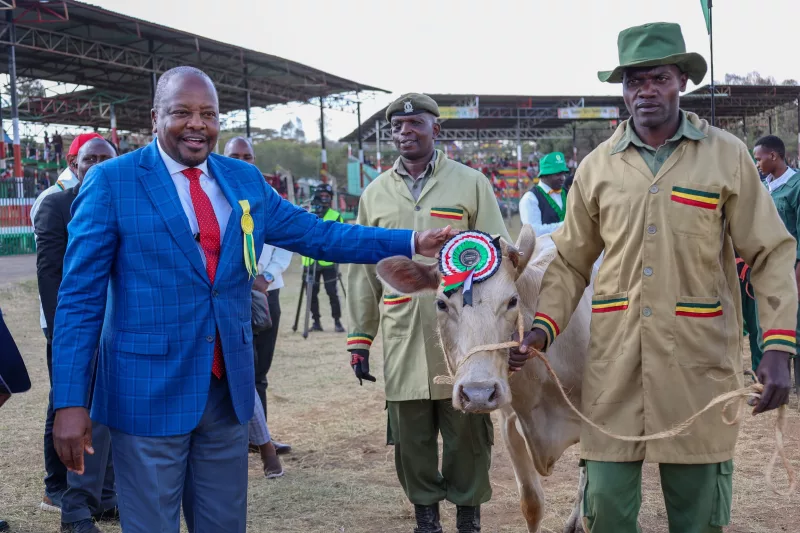
 Agriculture Cabinet Secretary Mutahi Kagwe during the official opening of the Central Kenya National Show 2026 in Nyeri/COURTESY
Every cow, sheep and goat in Kenya will be required to carry an Animal Identification and Traceability (ANITRAC) tag as the government steps up efforts to curb cattle rustling and improve livestock disease surveillance.
Agriculture Cabinet Secretary Mutahi Kagwe said the technology would give every animal a unique identity, making it easier to trace livestock along the value chain and difficult for stolen animals to be moved or sold without detection.
Kagwe said every cow would be fitted with a distinctive yellow ANITRAC ear tag, warning livestock thieves against attempts to remove the identifiers.
He said people found with animals whose ears had been cut off to remove the tags should explain themselves to the police.
“Every cow will have a yellow ANITRAC tag. If you are found with cattle without the tag, you must explain to the police,” Kagwe said.
“If somebody has cattle whose ears have been cut off, the police should arrest that person,” he added.
The CS spoke during the official opening of the Central Kenya National Show 2026 in Nyeri, where he said the tagging programme would also strengthen disease control, food safety and Kenya’s ability to access premium domestic and international livestock markets.
The rollout comes alongside the national livestock vaccination campaign, under which more than 20 million cattle, sheep and goats have so far been vaccinated across the country.
Kagwe said ANITRAC would help Kenya meet international requirements on animal origin, health, food safety and traceability, while enabling authorities to follow livestock from farms to markets and processing facilities.
He also announced increased government support for avocado and macadamia farmers through improved planting materials, extension services, aggregation, certification and access to markets.
Kagwe warned farmers against harvesting and selling immature avocado and macadamia, saying the practice was hurting Kenya’s reputation in international markets and denying farmers better returns.
“A farmer who sells a quality product into a well-organised market should earn more than a farmer who is forced to sell early to a middleman,” he said.
The CS said the Government would strengthen aggregation and certification while promoting local processing to retain more jobs and value in producing counties.
On tea, Kagwe said the Tea Levy Regulations, 2026, which took effect on May 1, provide for a 0.8 per cent levy on tea exports.
He said the funds would support tea infrastructure, including feeder roads and buying centres, while helping protect Kenyan tea from unfair competition and promote value addition.
Kagwe said the Government wanted farmers to see tangible benefits through better roads, efficient buying centres, stronger markets and improved returns.
He said Kenya must increasingly move from bulk tea exports towards branding, packaging, blending and other forms of value addition.
On coffee, Kagwe said implementation of the Coffee Act, 2026 had entered the operational stage following the establishment of the Coffee Board of Kenya and the Coffee Research and Training Institute.
He said the reforms should deliver better returns to farmers through transparent systems, quality planting materials, research and extension services, stronger cooperatives and access to high-value markets.







