
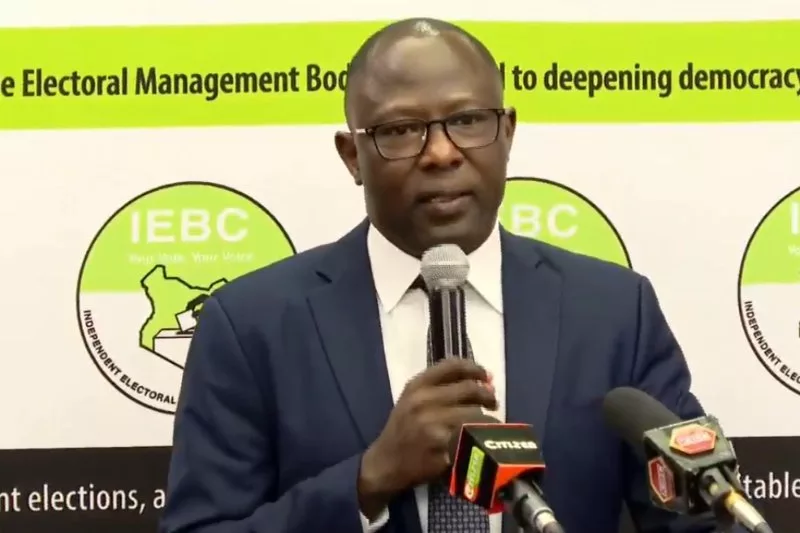
 IEBC Chair Ethekon Edung/HANDOUT
The High Court has temporarily halted further steps in a tender by the Independent Electoral and Boundaries Commission (IEBC) for the supply of ballot papers and other election materials after a bidder challenged the procurement requirements.
Justice William Musyoka, sitting in the Judicial Review Division at the Milimani Law Courts, granted a stay of the tender process following an application by Oilmax Ventures Limited.
The company has challenged a decision by the Public Procurement Administrative Review Board (PPARB) concerning IEBC Tender No. IEBC/OIT/02/2026–2027 for the supply and delivery of ballot papers, tactile folders, the register of voters and statutory election result declaration forms for the forthcoming General Election.
In directions issued on September 7, 2026, Justice Musyoka certified the matter as urgent and directed that it be heard during the ongoing High Court recess.
The judge also granted Oilmax Ventures three days to file and serve its substantive motion, giving the respondents and interested parties seven days to respond.
The case is filed against the IEBC and its accounting officer. The Public Procurement Administrative Review Board (PPARB) and Oilmax director Mohammed Ali are listed as interested parties.
“In the meantime, there shall be a stay, in terms of prayer 5 of the ex parte chamber summons for leave, dated 7th September 2026,” the court directed.
The order effectively pauses further steps in the procurement pending the determination of the judicial review proceedings.
Oilmax moved to court after the PPARB dismissed its request for review in a decision delivered on September 3, 2026.
While dismissing the bidder’s request on the substantive issues, the Board directed IEBC to clarify or amend the tender document on the acceptable form of tender security and extended the tender submission and opening deadline by at least seven days.
Oilmax, however, argues that several qualification requirements contained in the tender document unfairly restrict competition.
According to the company, the requirements on similar experience, financial capacity and financial capability could limit the pool of eligible bidders to as few as two identified international suppliers.
The applicant has particularly challenged a requirement under the similar experience criteria that effectively requires a bidder to have previously supplied at least 150 million security ballot papers under a single contract within the preceding five years.
Oilmax argues that the requirement creates an overly narrow qualification threshold and limits the number of companies capable of participating in the tender.
The company has also raised concerns over what it considers an inconsistency between the restrictive experience requirement and the tender’s 40 per cent local content and local participation requirement.
It argues that while the tender requires local participation, the qualification criteria effectively favour a limited number of foreign suppliers, making it difficult for local entities to qualify.
The bidder has asked the High Court to quash the PPARB decision to the extent that it upheld the disputed requirements.
It is also seeking an order prohibiting IEBC from proceeding with the tender using the challenged criteria and an order compelling the electoral commission to reformulate the requirements.
Oilmax argues that the procurement process should comply with Article 227 of the Constitution and the Public Procurement and Asset Disposal Act.
The case will now proceed through the judicial review process, with the respondents and interested parties expected to file their responses before the next mention on October 7, 2026.







