
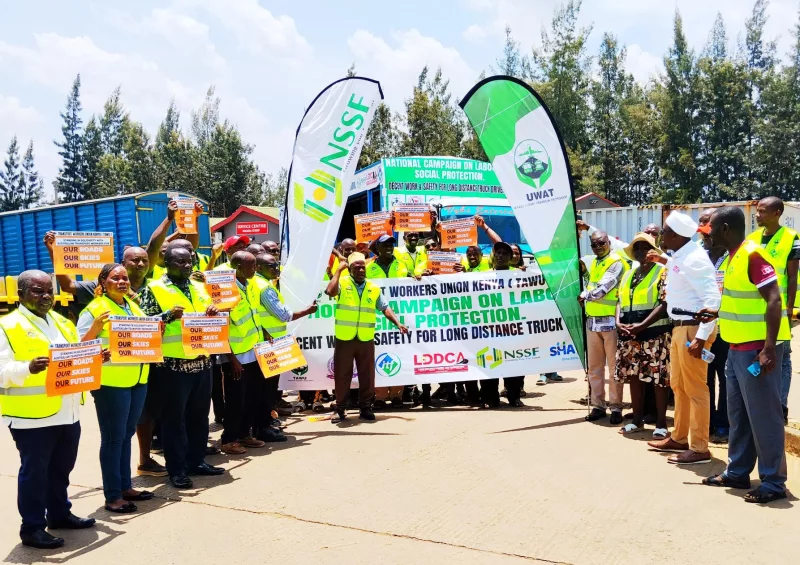
Truck drivers and union leaders from across the East African Community gathered at the Malaba border to launch a national labour rights awareness campaign, demanding action on minimum wages, social security enrolment, and cross-border security.
Nicholas Otieno, General Secretary of the Transport and Allied Workers Union-Kenya (TAWU), led the charge, calling for sectoral collective bargaining agreements to establish minimum wages for drivers.
Under Kenya's new wage directive effective May 2026, drivers of heavy commercial vehicles in major cities are entitled to a minimum of Sh40,724 per month.
However, Mwatela Sudi, Chair of the Kenya Long Distance Trailers Association, revealed that drivers currently earn only Sh20,000 to Sh25,000 on average, well below the legal threshold.
Sudi said most drivers are paid through MPESA without formal contracts, leaving them vulnerable to summary dismissal with no recourse.
"The Ministry of Labour hardly conducts inspections to verify what employers pay truck drivers," he said.
Otieno introduced attendees to the National Social Security Fund (NSSF) and the Social Health Authority (SHA), urging drivers to enrol.
However, the informal nature of trucking employment presents significant barriers. NSSF coverage stands at only 17 per cent of Kenya's working population, according to ILO data. SHA covers approximately 54 per cent of the population.
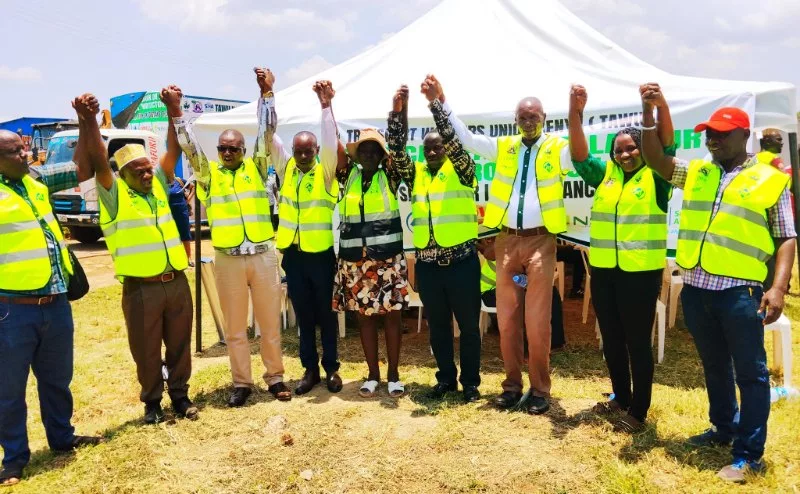
Peter Mbindi, a truck driver, estimated 90 per cent of drivers are not paying taxes, and many work for decades without any retirement benefits.
"The ministry should insist that all transport vehicle owners employ on legal grounds—that way we can pay for SHA health and NSSF social covers," he said.
Otieno revealed that 47 roadblocks previously existed between Mombasa and Malaba, and an agreement with the Transport Cabinet Secretary reduced them to 15.
However, government data shows 22 to 27 active police roadblocks remain along the corridor-far exceeding the regional target of fewer than five. This has pushed transit time from Mombasa to Malaba to 76-80 hours, nearly double the expected 36-48 hours.
TAWU called on President William Ruto to intervene in the insecurity facing drivers in South Sudan and Congo.
The Kenya Long Distance Truck Drivers Union has recorded over 60 incidents of attacks, assaults, extortion, and maiming this year alone. At least 10 foreign truck drivers have been killed in South Sudan since 2021, with more than 33 cases of gunshot wounds or permanent injuries.
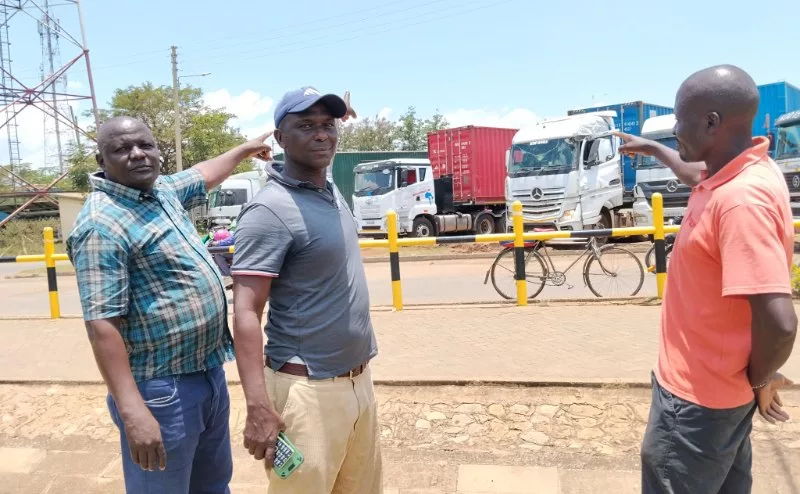
Drivers lose at least US$500 (approximately Sh64,650) in illegal payments while travelling the 125-kilometre stretch between Aru Junction and Nesitu in South Sudan . Earlier this month, a Kenyan driver known as Mzee Malalo was brutally attacked in South Sudan and evacuated to Uganda for treatment.
Denis Oloro, National Chairman of the Amalgamated Transport and General Workers Union (Uganda), said both unions are affiliated with the International Transport Workers Federation and share the same challenges along the Northern Corridor. He called for drivers to join unions for a stronger collective voice.







