
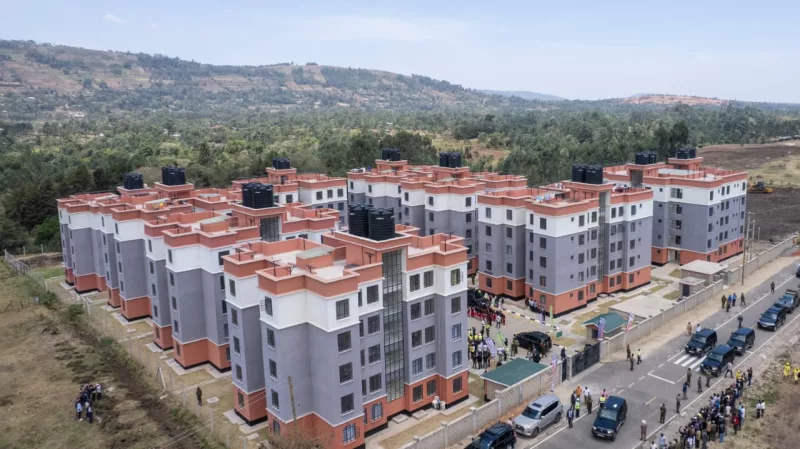
 Affordable housing units in Bomet county./PCS
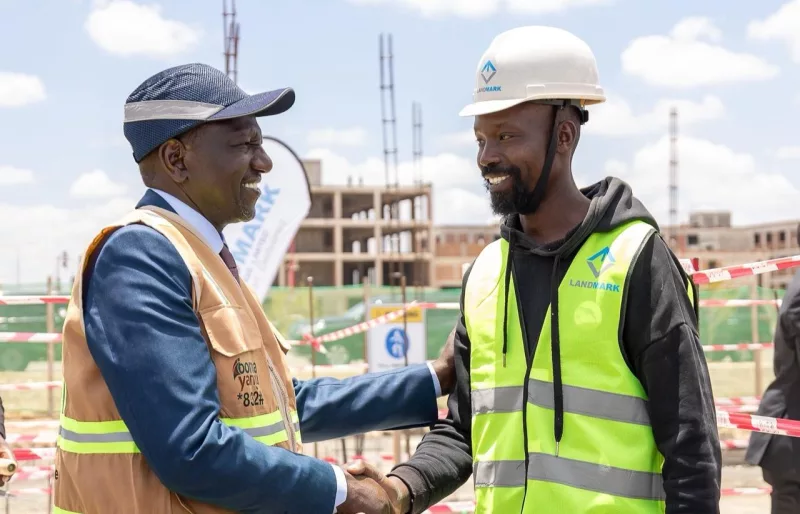 President William Ruto interacting with a construction worker at Konza Technopolis on October 13, 2025 / PCS
Four years into President William Ruto’s administration, the government’s Affordable Housing Programme has expanded across the country, with projects targeting the housing deficit and providing homes for Kenyans, including residents of informal settlements.
The programme received a major policy milestone on March 19, 2024, when President William Ruto signed the Affordable Housing Act into law, creating a legal framework to guide its implementation and financing.
The government says the programme is designed to address a national housing deficit estimated at more than two million units, with demand growing by approximately 200,000 units annually, particularly in urban centres.
To address the gap, the government has set a target of constructing between 200,000 and 250,000 housing units each year, with a long-term goal of delivering up to one million homes over five years.
Progress has been recorded across several counties, although the pace of construction differs from one location to another.
As of March, in Kisumu, the Lumumba affordable housing project was at 56 per cent completion, while more than 9,000 housing units were under construction across the county.
In Migori, the Mabera affordable housing project was nearing completion at 98 per cent as of March 2026, while projects in Homa Bay had already been fully completed.
In Siaya, construction was underway on 3,832 housing units, with progress ranging between 10 and 37 per cent across the various sites.
Kisii had 2,116 units under development, with most projects recording between 10 and 40 per cent completion.
Nyamira remains at an early stage, with projects recording between two and four per cent progress.
Nationally, approximately 8,800 affordable housing units had been completed and handed over to buyers by March 2026. The pace of completion increased from about 1,655 units in 2024 to more than 6,700 in 2025.
The figures, however, remain below the President’s original target of delivering 250,000 housing units annually.
The government says construction has gained momentum, with between 214,000 and 277,000 additional units currently under construction across all 47 counties.
The developments include social housing units, standard affordable homes and more than 73,000 university student accommodation beds.
The administration has also presented the housing programme as a major employment generator.
According to the Presidency, the construction programme has created more than 1.1 million direct and indirect jobs. The opportunities have included young people, mechanics, engineers, plumbers and construction workers.
The nationwide construction programme has also created demand for building materials, transport services, skilled labour and other services linked to the construction sector.
The government therefore says the programme extends beyond the construction of houses to creating an ecosystem around the building sector.
Interest in the programme has also been significant. More than 1.3 million people have registered on the Boma Yangu platform to express interest in owning homes under the programme.
For residents of informal settlements, the housing projects have brought the question of access and affordability into sharper focus, particularly as the government seeks to increase homeownership among low-income households.
To make homeownership more accessible, the government reduced the required upfront deposit from 10 per cent to five per cent.
It has also introduced payment restructuring measures aimed at assisting low-income buyers who experience financial difficulties in meeting their obligations.
The adjustments are intended to address affordability and make it easier for people to meet their housing payments.
The housing levy, however, remains a point of political disagreement.
Opposition politicians have repeatedly called for the abolition of the 1.5 per cent levy, arguing that it reduces workers’ disposable income without guaranteeing that contributors will ultimately secure homes.
President Ruto has rejected those calls, maintaining that scrapping the levy would undermine one of his administration’s major transformation programmes.
“We still have politicians who think you can make populist comments, saying they are going to stop the affordable housing levy to protect the payslips of people,” Ruto has said.
The President has also defended the programme against political criticism, arguing that the government must remain focused on its long-term development agenda.
“No amount of noise or opposition will derail our transformation agenda. We remain committed to delivering the Affordable Housing Programme,” Ruto said.
Opposition leaders have maintained that they would scrap the levy if they form the next government after the 2027 General Election.
The political dispute over the levy has become part of the wider debate surrounding the Affordable Housing Programme.
Lawmakers have raised concerns over procurement processes, delays in project implementation, the capacity of local contractors and stalled construction sites in some regions.
Questions have also emerged over whether the rapid expansion of the programme can be matched by adequate oversight and transparency in the use of billions of shillings collected from workers and employers.
As the programme enters its fourth year under the Ruto administration, projects continue to advance at different stages across the country, with thousands of units completed, others under construction and additional developments at various stages of implementation.
The government’s stated objective remains to increase the supply of affordable and social housing, reduce the national housing deficit and make homeownership more accessible through lower deposits and flexible payment arrangements.
The Kenya Kwanza government spent Sh122 billion on its affordable housing flagship project in 2025-26 but delivered less than half of its target, a new report has found.
According to the Controller of Budget’s National Government Budget Implementation Review Report for FY2025-26, the affordable housing sub-programme had a revised allocation of Sh124 billion during the year.
Out of this, it spent Sh122.18 billion, representing a 99 per cent absorption rate.
Of this, development expenditure accounted for Sh120.18 billion, while Sh2 billion went to recurrent expenditure.







