

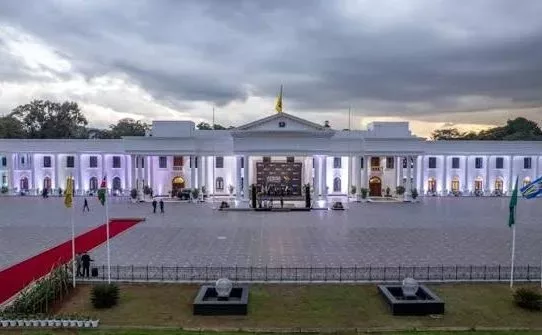
 State House /FILE
In her latest report on government spending for the financial year ended June 30, 2026, Nyakang’o flagged billions of shillings classified as “other expenses”, with agencies failing to provide adequate details on what the money was used for.
Of the Sh160 billion, Sh104.84 billion was incurred under recurrent expenditure, while Sh55.01 billion was spent under development expenditure.
“Other expenses amounted to Sh104.85 billion, representing five per cent of the gross recurrent expenditure,” the report states.
The State Department for Internal Security and National Administration, the National Police Service, the National Treasury and State House emerged among the biggest spenders under the opaque budget line.
The State Department for Internal Security spent Sh24.09 billion under “other expenses”.
Of this, Sh21.53 billion was listed as expenditure on “security operations”, without details on the nature of the operations.
The National Police Service spent Sh16.02 billion under the same category, with Sh11.39 billion going to “security operations".
At the National Treasury, Sh15.87 billion was classified as “other expenses”, including Sh12.62 billion spent on security operations.
It remains unclear how Treasury was involved in security operations.
State House, meanwhile, spent Sh6.73 billion under confidential spending, adding to scrutiny over the rising cost of running the presidency.
State House has previously come under criticism over increased spending, with its budget rising from Sh12 billion in the previous financial year to Sh18 billion in the 2025-26 financial year.
The Executive Office of the President spent Sh1.91 billion under “other expenses”, including Sh1.26 billion on security operations.
The Office of the Deputy President spent a further Sh1.78 billion under the same broad expenditure category.
Confidential expenditure is normally allowed in national budgeting to allow security agencies to spend on sensitive security or intelligence operations that should not be disclosed to the public.
However, the Auditor-General has previously warned of potential abuse with ministries that are not engaged in security issues also incurring confidential expenditure.
Confidential expenditure is often criticised because it limits transparency and accountability in the management of public funds.
Since the details of such expenditure are kept secret, members of the public may not know how government money is being used.
Busia Senator and veteran public-interest litigant Okiya Omtatah described the spending as “budgeted corruption”, arguing that public money must be tied to clearly defined programmes.
“It is budgeted corruption. That is how they are stealing our money. We have a programme-based budget and anything that has not been defined in the budget is money that is added onto the budget and that is corruption,” Omtatah said.
Human rights defender Suba Churchill said expenditure that is not clearly defined undermines the principles governing the management of public resources.
“There is a need for a thorough scrutiny of how these funds are spent. We know there are some budget lines for some agencies that fall under confidential votes, but this should not be abused,” he said.
The report also exposes large sums spent by other state institutions without adequate breakdowns. The spending is also classified as ‘other expenses’.
The National Assembly spent Sh3.99 billion on constituency office expenses but did not provide details of how the money was spent.
The Independent Electoral and Boundaries Commission spent Sh2.97 billion on legal dues, arbitration and compensation without giving particulars of the expenditure.
The National Land Commission spent another Sh1.99 billion on legal dues, arbitration and compensation, also under the broad expenditure classification.
The State Department for Basic Education spent Sh10.50 billion on school examinations and invigilation without providing a detailed breakdown of the expenditure.
Other departments and agencies also recorded significant spending under the “other expenses” category.
The State Department for Immigration and Citizen Services spent Sh2.56 billion, while the State Department of Wildlife spent Sh1.07 billion.
The Judiciary spent Sh1.13 billion, the State Department of Special Programmes spent Sh666.92 million, while the State Department of Correctional Services spent Sh504.70 million.
The figures point to a wider problem in the management of public finances, where large sums can be channelled through broad budget lines without sufficient information for taxpayers and oversight institutions to establish precisely how the money was used.
The Controller of Budget also flagged similar concerns in development spending.
Under the development budget, “other expenses” amounted to Sh55.51 billion, representing seven per cent of total gross development expenditure.
The State Department for Immigration and Citizen Services accounted for a significant portion of the expenditure.
Its spending included Sh6.8 billion for supplies for the production of identity card materials and Sh4.9 billion for contracted technical services.
The State Department for Technical, Vocational Education and Training also recorded Sh2.4 billion under the category for the acquisition of furniture and general equipment.
INSTANT ANALYSIS
The revelations come amid growing scrutiny of government expenditure, particularly spending that is classified in ways that make it difficult for Parliament, auditors and the public to determine the specific purpose of the funds. While some expenditure, particularly security-related operations, may legitimately require confidentiality, the scale of the spending raises questions about the balance between protecting sensitive information and ensuring accountability for public resources. The report places the spotlight squarely on government institutions to explain how billions of shillings were spent and whether the expenditure delivered value to taxpayers.







