

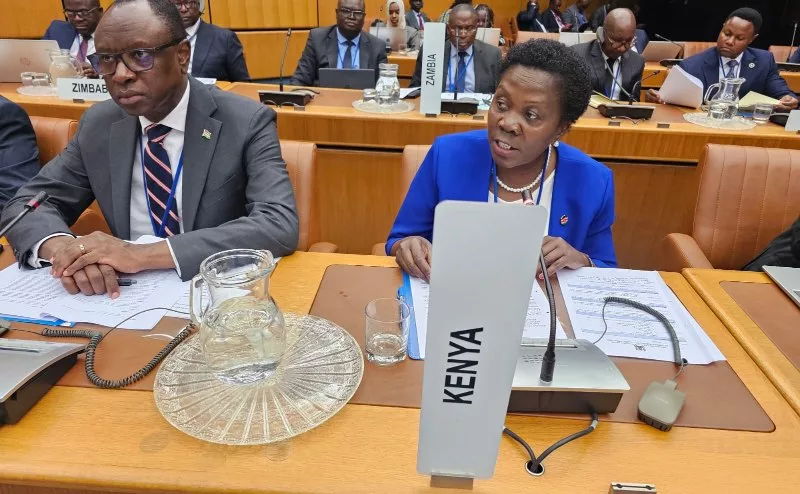
 Ambassador Edwin Afande, Kenya’s Ambassador and Permanent Representative to the United Nations in Vienna and Chair of the Africa Group and Beverly Opwora, Principal Administrative Secretary in the Ministry of Interior and National Administration/HANDOUT
Kenya has called for stronger global cooperation to tackle the growing threat posed by synthetic drugs, warning that illicit markets are evolving faster than conventional law enforcement and regulatory systems.
Speaking at the 33rd Meeting of Heads of National Law Enforcement Agencies (HONLEA) in Vienna, Ambassador Edwin Afande, Kenya’s Ambassador and Permanent Representative to the United Nations in Vienna and Chair of the Africa Group, said the world drug problem remains a common and shared responsibility.
Afande expressed concern over the growing threat of synthetic drugs and disparities in access to controlled substances for medical and scientific purposes.
He also highlighted the links between drug trafficking, corruption, illicit financial flows and terrorism, calling for stronger regional and international cooperation.
The Ambassador urged the United Nations Office on Drugs and Crime (UNODC) to support member states in preventing, detecting and responding to substandard and falsified medical products.
He said the international community should also remove barriers to equitable access to controlled substances for medical purposes, particularly pain relief and palliative care.
Kenya’s position was further outlined by Beverly Opwora, Principal Administrative Secretary in the Ministry of Interior and National Administration and Head of the Kenyan delegation.
Opwora said Kenya has established a legal and policy framework aligned with the 2019 Ministerial Declaration. She highlighted the country’s National Policy for the Prevention, Management & Control of Alcohol, Drugs & Substance Abuse, which prioritises security, public health and comprehensive care.
She, however, warned that the drug landscape is changing rapidly.
The expanding range of drugs, misuse of precursor chemicals and the shift from plant-based narcotics to synthetic substances have complicated efforts to control the trade.
Synthetic drugs, she noted, can be manufactured anywhere and by anyone.
She also pointed to the growing practice of combining different substances, describing it as a “fashionable” trend that has further complicated enforcement efforts.
Afande similarly described the “scourge of synthetic drugs” as a game changer that has challenged traditional interventions.
In its national statement on disrupting the production and trafficking of synthetic drugs, Kenya said emerging substances are increasingly exploiting legitimate pharmaceutical and chemical supply chains, postal and courier services, air cargo and online platforms.
The country said it has adopted an intelligence-led, evidence-based and multi-agency approach that brings together regulatory oversight, law enforcement, forensic science, surveillance and international cooperation.
Kenya also completed its first national wastewater analysis study on new psychoactive substances and emerging drug-use trends this year.
The study confirmed the presence of synthetic cathinones, benzofurans and alpha-ethyltryptamine, as well as methamphetamine and MDMA.
According to the statement, the findings have strengthened efforts to establish an Early Warning System, improve forensic surveillance and make domestic drug scheduling more responsive.
Kenya has also tightened controls on controlled medicines and precursor chemicals through import and export authorisations, inspections, record verification, supply-chain monitoring and investigations into suspected diversion.
Regulatory information, including unusual transactions, stock discrepancies and suspicious distribution patterns, is increasingly being integrated with law enforcement intelligence to support earlier intervention.
The country is using a multi-agency approach involving the Pharmacy and Poisons Board, NACADA, the Anti-Narcotics Unit, Customs, the Directorate of Criminal Investigations, the Government Chemist and other agencies.
Kenya said the objective is not only to seize illicit substances but also to identify and disrupt the networks, supply chains and mechanisms supporting their production and trafficking.
At the regional and international level, Kenya has participated in Operations African Star I and II. It also continues to use International Narcotics Control Board mechanisms, including GRIDS and IONICS, to strengthen operational information sharing on new psychoactive substances and emerging synthetic drug threats.
Opwora called for a shift from traditional responses towards stronger early-warning systems, modern forensic capacity, improved precursor monitoring, responsive scheduling mechanisms and real-time information exchange.
Kenya also stressed the importance of public-private partnerships involving pharmaceutical and chemical industries, courier and logistics operators, financial institutions and other stakeholders.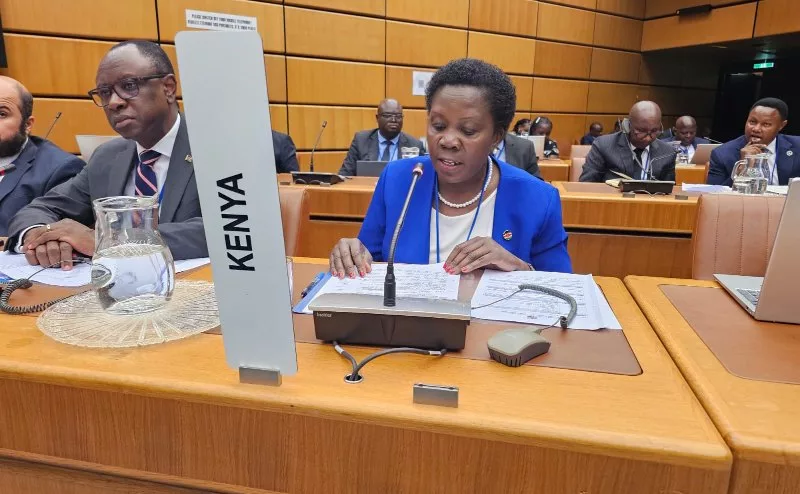 Ambassador Edwin Afande, Kenya’s Ambassador and Permanent Representative to the United Nations in Vienna and Chair of the Africa Group and Beverly Opwora, Principal Administrative Secretary in the Ministry of Interior and National Administration/HANDOUT
In collaboration with the International Narcotics Control Board, Kenya has scheduled a November 2026 meeting bringing together financial institutions, money-transfer organisations and government agencies to strengthen information sharing and identify suspicious financial transactions linked to synthetic drug trafficking and diversion.
Kenya called for stronger cooperation among African states in early warning, forensic information exchange, precursor control, intelligence sharing, joint operations, capacity building and investigations into cross-border synthetic drug supply chains.
“Kenya believes that synthetic drug markets are evolving faster than conventional regulatory and enforcement systems. Our response must therefore be equally dynamic,” the statement said.
Kenya said it remains committed to working with member states, UNODC, the International Narcotics Control Board and other partners to move from reacting to synthetic drug threats after they become established to anticipating, detecting and disrupting them at the earliest possible stage.







