
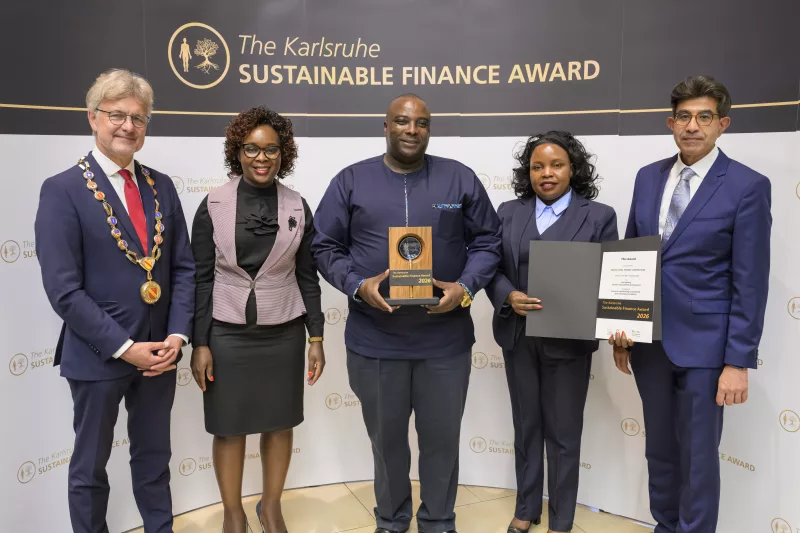
 Dr Frank Mentrup, Lord Mayor of Karlsruhe; Junetapelin Karimi, AFC Senior Credit Officer - George Kubai, AFC Managing Director, hold the 2026 Karlsruhe Sustainable Finance Award. Betty Suge, AFC Chief Finance & Investment Officer, holds the certificate. Arshad Rab, CEO of EOSD, European Organisation for Sustainable Development (EOSD)
The Agricultural Finance Corporation (AFC) has received global recognition for its sustainability efforts after winning the ‘Outstanding Business Sustainability Achievement’ award at the Global Sustainable Finance Conference (GSFC) 2026 in Karlsruhe, Germany.
The award was presented during a high-level leadership forum on August 27, 2026, in recognition of AFC’s efforts to integrate sustainability into its corporate strategy, governance and lending operations.
The recognition places the state corporation among institutions being recognised for using sustainable finance to strengthen long-term resilience and support economic transformation.
The award was presented by Karlsruhe Lord Mayor Dr Frank Mentrup and Arshad Rab, Chairman of the International Council of Sustainability Standards for Value-Driven Financial Institutions and CEO of the European Organisation for Sustainable Development.
AFC Managing Director George Kubai received the award on behalf of the Corporation. He was accompanied by Betty Suge, Chief Finance and Investment Officer, and Junetapelin Karimi, Senior Credit Officer.
Rab said the recognition should be viewed beyond sustainability certification, noting that the real measure was how institutions applied sustainability principles in their operations.
“The recognition of the Agricultural Finance Corporation of Kenya for Outstanding Business Sustainability Achievement carries a particularly important message: Sustainability Certification should never be seen as the destination,” Rab said. “Its real value lies in what an institution does with it.”
He said agriculture remains central to food security, employment, enterprise development and national economic resilience.
“When AFC became the first institution in Kenya to achieve Sustainability Certification, it made a commitment to embed sustainability into the way the Corporation is governed, how it does business and, most importantly, how it contributes to the transformation of Kenyan agriculture,” Rab said.
“Since then, AFC has continued to translate that commitment into action,” he added.
Kubai said the award reflected AFC’s growing focus on climate resilience and sustainable agricultural financing.
“This recognition underscores AFC’s growing role in steering Kenya’s agricultural sector toward climate resilience and sustainability,” Kubai said during the reception at Karlsruhe City Hall.
“This milestone affirms our role as a trailblazer in sustainability initiatives,” he added.
Kubai said AFC would continue expanding its sustainable finance portfolio while supporting farmers and strengthening agricultural value chains.
“Looking ahead, AFC remains steadfast in its commitment to growing the sustainable finance portfolio, empowering farmers, strengthening value chains, and building resilience against climate change—all in direct alignment with Kenya’s Bottom-Up Economic Transformation Agenda (BETA),” he said.
The award builds on AFC’s position as the first institution in Kenya to achieve certification under the globally recognised Sustainability Standards and Certification Initiative (SSCI).
AFC has integrated climate risk management into its operations and financing decisions. The Corporation currently supports 213,740 active borrowers through an agricultural financing portfolio of approximately KES 13 billion, equivalent to USD 99 million.
The Corporation has also introduced environmental measures at the lending level. Environmental and Social Management System screening is mandatory for loan applications.
AFC has further introduced a condition requiring borrowers to plant one tree for every KES 10,000 advanced.
The initiative has resulted in more than one million trees being planted by AFC, its clients and local communities. The afforestation effort was carried out across all 47 AFC branch locations between the financial years 2024/2025 and 2025/2026.
The Corporation is also implementing programmes aimed at expanding access to finance among underserved groups.
Through the De-Risking, Inclusion and Value Enhancement of Pastoral Economies programme, AFC is expanding climate-smart financing in arid and semi-arid counties to support livestock productivity and household resilience to climate shocks.
The Supporting Access to Finance and Enterprise Recovery programme provides affordable financing to micro, small and medium enterprises, with priority given to women- and youth-owned businesses.
AFC’s Rural Kenya Financial Inclusion Facility is using SACCOs to channel green financing to underserved rural communities. The programme currently reaches 5,870 beneficiaries, the majority of whom are women.
At the Ahero Irrigation Scheme, AFC and the National Irrigation Authority implemented a climate-resilient irrigation financing initiative that used a USD 77,370 credit guarantee facility to mobilise KES 161,812,500, equivalent to USD 1.25 million.
AFC is also reducing its internal environmental footprint through end-to-end digital loan processing, electronic procurement and the Kliq Management Information System.
The Corporation has also launched the AFC E-Academy to support continuous employee training on environmental, social and governance priorities, climate finance and responsible business practices.







