
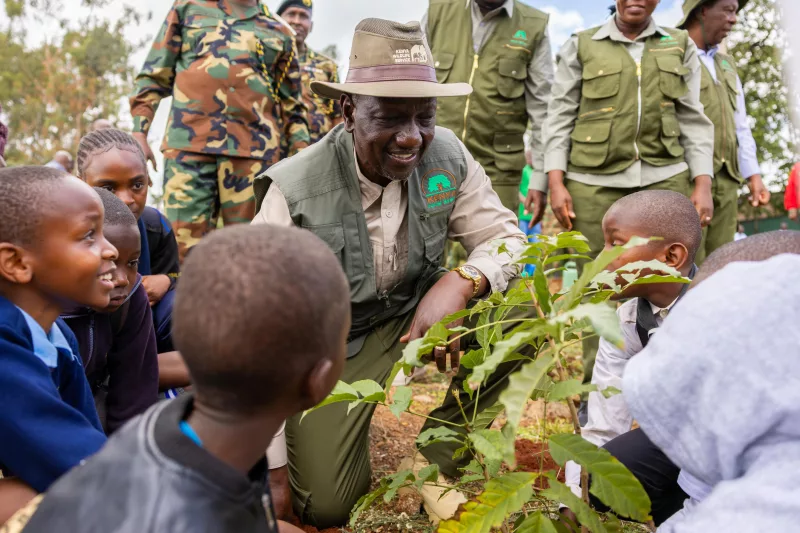
 President William Ruto plants a tree alongside schoolchildren at the State House on October 10, 2025/PCS
Four years into President William Ruto’s administration, the government says 1.7 billion trees have been planted under its national tree-growing campaign, with the programme targeting 15 billion trees by 2032.
Deputy President Kithure Kindiki said in May 2026 that Kenya was on course to achieve the target, as the government continued to expand restoration programmes across the country.
“As a government, we are focused on planting 15 billion trees by 2032 because conserving the environment is one of our priorities,” Kindiki said during the launch of the Cherangany Hills Ecosystem Restoration Programme in Elgeyo Marakwet County.
The 15-billion-tree programme was launched by President Ruto on December 21, 2022, as part of the government's wider landscape and ecosystem restoration agenda.
But the campaign was given a much broader structure than annual tree-planting exercises. In a January 30, 2023, directive to all Principal Secretaries, Head of the Public Service Felix Koskei said the national campaign was based on a target of at least 15 billion trees by 2032.
The directive stated that the initiative anticipated each person living in Kenya planting at least 30 trees every year.
It also required all Ministries, Departments and Agencies to allocate funds and other resources towards the campaign. Each institution was to establish its own target based on its staff complement and the 30-trees-per-person-per-year benchmark.
The targets were to be incorporated into the institutions' performance contracts for monitoring and reporting.
The directive required Ministries, Departments and Agencies to work with the Kenya Forest Service when purchasing seedlings to ensure quality standards and appropriate species for different ecological zones.
KFS was also directed to give priority to seedlings sourced from youth groups and community forest associations operating tree nurseries.
The government also directed that all government programmes and public events incorporate a tree-planting session.
Koskei said the government expected to see the results of the initiative at the end of the 2022/23 financial year and in subsequent years.
The directive established three key components of the programme: tree-growing targets, institutional accountability and monitoring.
The latest figure released by the government is 1.7 billion trees planted since the programme began. The State Department for Forestry says the wider 15-billion-tree initiative is intended to restore 10.6 million hectares of degraded landscapes and increase national tree cover to 30 per cent by 2032.
The programme covers forests, water towers, rangelands, farmlands, wetlands, marine ecosystems and urban areas.
The National Landscape and Ecosystem Restoration Strategy 2023–2032 provides the framework for the restoration programme and links the 15-billion-tree campaign to the restoration of 10.6 million hectares of degraded landscapes.
The government's 2026 Budget Policy Statement sets another milestone: growing 4.5 billion trees by 2027.
To support that target, Treasury says the government will produce and distribute 700,000 kilogrammes of tree seeds, establish 400 tree nurseries and produce 2.2 billion seedlings for rehabilitation of degraded landscapes.
The same plan provides for the rehabilitation of 330,050 hectares of degraded forest areas and protection and conservation of 2.6 million hectares of gazetted public forests.
The State Department for Forestry says the programme is being supported by the Jaza Miti platform, which is intended to support the documentation and monitoring of tree-growing activities.
At individual restoration sites, government agencies and partners have reported different measures for ensuring trees survive.
In its 2026 Budget Policy Statement, Treasury reported that under the 15-billion-tree programme, the government had coordinated the planting of 1.076 billion trees, produced 260.1 million assorted seedlings and rehabilitated 58,976.4 hectares of degraded natural forests. It also reported the establishment of 27,633.2 hectares of woodlots on private farms.
The State Department for Forestry currently reports Kenya's forest cover at 8.84 per cent, against the government's target of 30 per cent by 2032.
The 30 per cent target is therefore being pursued alongside the 15-billion-tree target. The government says the two targets are part of the same restoration programme.
The State Department for Forestry describes the 15-billion-tree initiative as a national mission to restore 10.6 million hectares and increase tree cover to 30 per cent by 2032.
The programme includes natural forest regeneration, restoration of water towers, agroforestry, rangelands, wetlands, marine ecosystems and urban landscapes, with communities expected to participate in restoration activities.
Several large restoration programmes are currently being implemented. In Cherangany Hills, the State Department for Forestry reported that 14,000 seedlings were planted at Tebe Grounds in May 2026 as part of the ecosystem restoration programme.
The exercise was linked to the national target of 15 billion trees and increasing national tree cover to 30 per cent. In Loita Forest, Narok, the government reported planting 270,000 seedlings in April 2026.
Of these, 20,000 were planted on site while another 250,000 were dispersed through aerial seed balling by the Kenya Air Force.
In Kaptumek/Kajulu Forest Block, the State Department for Forestry reported that EarthLungs had planted 1.97 million trees since April 2023 as part of restoration work undertaken with the government.
The project also includes infrastructure intended to improve access to restoration areas and support nursery and field operations.
For the 2026/27 financial year, Treasury allocated Sh3.2 billion to the Tree Growing Campaign, alongside Sh13.4 billion for forest resources conservation and management and Sh1.7 billion for forest research and development.
The Sh3.2 billion allocation was significantly below the estimated annual requirement of Sh60 billion cited for the wider 15-billion-tree programme.
In July 2026, the State Department for Forestry convened development partners, research institutions and private-sector representatives to discuss financing mechanisms and partnerships to accelerate implementation of the 15-billion-tree programme.
Figures show that 1.7 billion trees have been planted since 2022, while the 2026 Budget Policy Statement sets a target of 4.5 billion trees by 2027.
The national programme also has a restoration target of 10.6 million hectares and a national tree-cover target of 30 per cent by 2032.
The government has established institutional targets, nursery production plans and restoration programmes in different ecosystems.
The government has also reported large numbers of seedlings produced and trees planted, while restoration programmes increasingly incorporate community participation, agroforestry, natural regeneration and protection of degraded ecosystems.
The State Department for Forestry continues to describe the programme as a whole-of-government and whole-of-society effort involving national and county governments, communities, private-sector actors and development partners.







