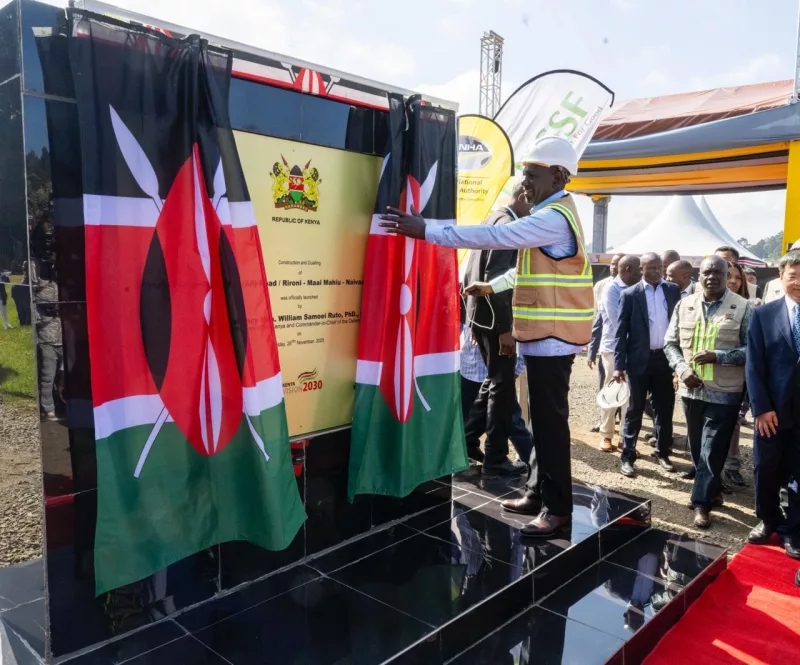
 President William Ruto commissions Rironi-Mau Summit Road at Kamandura, Kiambu, on November 28, 2025/PCS
President William Ruto’s road development record is a mix of completed projects, upgrades, ongoing works, stalled contracts, and ambitious plans yet to be implemented.
When Ruto assumed office in September 2022, his administration inherited hundreds of road projects at different stages of implementation. Four years later, the government’s road record is being measured against a major promise: how many kilometres have actually been delivered?
On March 28, 2026, Ruto announced plans to tarmac 28,000 kilometres of roads over the next 10 years as part of an ambitious infrastructure programme aimed at transforming Kenya into a first-world economy.
Speaking during the 19th Ambassadors and High Commissioners Conference in Nairobi, Ruto said road development remains a major concern for Kenyans and called for a comprehensive approach to expanding the network.
“If you go to any meeting in Kenya, somebody will ask you about a road — this road, that road, and the other road. We cannot continue discussing 10 kilometres here and 20 kilometres there. We just have to have a comprehensive plan and do it,” Ruto said.
He said the government planned to construct at least 2,500 kilometres of dual carriageways and 28,000 kilometres of additional roads over the next seven to 10 years.
“We want to tarmack another 28,000 kilometers in Kenya in the next 10 years. And it's possible, and we're going to do it. If you go to any meeting in Kenya, somebody will ask you about a road,” he stated.
Ruto compared Kenya’s ambition with Japan, which he said had tarmacked nearly one million kilometres of roads over six decades.
The proposed road programme forms part of a wider infrastructure plan that includes modernising railways, upgrading airports and seaports and expanding energy generation.
Ruto said the government had established a National Infrastructure Fund to attract long-term capital from domestic and international investors.
The government estimates that the wider infrastructure programme will require at least Sh5 trillion ($40 billion) in financing.
But while the President’s 28,000-kilometre target points to the scale of his ambition, official records show that a significant portion of the current road programme comprises projects inherited from previous administrations, ongoing contracts and projects still awaiting implementation.
The National Treasury says that over the last three years, the government constructed 1,798.25 kilometres of new roads and rehabilitated another 305.87 kilometres. It also reports routine maintenance of more than 102,561 kilometres, periodic maintenance of 2,111.3 kilometres and performance-based maintenance covering 28,844.55 kilometres.
The figures are significant but should not be interpreted as roads initiated and completed exclusively during Ruto’s presidency.
The government’s records combine projects at different stages and programmes involving new construction, rehabilitation, upgrading and maintenance.
The project-by-project record therefore offers a clearer picture of what has actually been delivered.
The roads completed
Among the projects recorded by the Ministry of Roads and Transport are major highways and bypasses completed during the period covered by its strategic plan.
The ministry says 147.6 kilometres of bypass roads were completed under its decongestion programme. They include the Wajir Bypass, Meru Bypass, Kericho Bypass, Nyahururu Bypass, Nairobi-Western Bypass and Thika Bypass, among others.
The Nairobi Eastern Bypass was also dualled along a 26.8-kilometre section.
Under the Lamu Port-South Sudan-Ethiopia Transport corridor, the ministry records 196 kilometres completed against a target of 190 kilometres.
The completed works included the 133-kilometre Lamu-Witu-Garsen road, a 10-kilometre link to Lamu Port, the 40-kilometre Lamu-Ijara-Garissa road and the Loruk-Barpello section.
The ministry also reports that 4,351 kilometres were upgraded under the Roads 10,000 Programme through the low-volume seal method during the period covered by its strategic plan.
These figures should not be added together mechanically because some represent components of broader programmes while others describe different types of road intervention.
Roads upgraded
Upgrading is another major component of the government’s road programme.
The Ministry of Roads and Transport reports that 4,351 kilometres were upgraded through the low-volume seal programme. Another 119.34 kilometres were upgraded under the Roads 2,000 programme, while 1,060.85 kilometres were gravelled.
The government has also continued awarding contracts for rural and urban roads.
In Meru, the Kieni-Kiandege-Mworoga-Maara road was launched as a 10-kilometre project at a cost of Sh700 million, with works expected to take 24 months.
In Isiolo, the government awarded an 8-kilometre network of township link roads under a Sh840 million project supervised by KURA. The project was initially scheduled for completion in July 2025.
KeNHA’s project portfolio also includes major upgrading and reconstruction works such as Kibwezi-Kitui-Migwani, Garsen-Witu-Lamu, Voi-Mwatate-Taveta, Turbi-Moyale and Isiolo-Modogashe-Wajir-Elwak-Rhamu-Mandera.
Roads still under construction
A large portion of the government’s road programme remains unfinished.
KeNHA lists several major projects as ongoing, including the Mwache Junction-Tsunza-Mteza road, Mombasa-Mtwapa-Kilifi road, Athi River-Machakos Turnoff, Naivasha-Njabini road and Mombasa-Mariakani highway.
The Kenya Rural Roads Authority also maintains a list of projects under construction.
These include the 53-kilometre Mariakani-Bamba road, 29-kilometre Kutus-Kianyaga-Kiamutugu-Githure road, 80-kilometre Kamatira-Cheptongei road, 56.2-kilometre Brooke Bond-Maili Nne-Kipkelion-Londiani road and 65-kilometre Daraja Sita-Dikirr-Chebole-Labotiet road.
The status of individual contracts can change as works progress, meaning completion figures must be checked against the latest project and handover records.
Construction on the Sh184 billion Rironi–Nakuru–Mau Summit Highway is also accelerating as contractors push to meet a targeted completion deadline of mid-2027.
The Kenya National Highways Authority (KeNHA) confirmed that the 233-kilometer project is progressing on two major fronts. China Road and Bridge Corporation (CRBC), partnering with the National Social Security Fund (NSSF), is managing the Rironi–Gilgil stretch, while Shandong Hi-Speed Road and Bridge International is constructing the 94-kilometer Gilgil–Mau Summit segment. Official inspections indicate that CRBC has reached approximately 15 percent completion, with Shandong at roughly 10 per cent.
Work currently focuses on extensive earthworks, road widening, and the relocation of water, electricity, and ICT utilities across Kiambu, Nyandarua, and Nakuru counties. To facilitate the expansion, the National Land Commission (NLC) has issued compulsory acquisition notices to secure necessary land parcels.
Once complete, the corridor will expand into a four-lane dual carriageway between Rironi and Naivasha, widening to six lanes near Nakuru to eliminate major traffic bottlenecks along the Northern Corridor. The project is operated under a 28-year Public-Private Partnership (PPP) toll concession model.
The Illasit-Rombo-Chala-Njukini-Taveta road also provides another example of a major project that cannot yet be counted among roads delivered by the Ruto administration.
The government is constructing the approximately 67-kilometre corridor linking Illasit in Kajiado County with Taveta in Taita-Taveta County at a cost of Sh9.4 billion. KeNHA’s tender documents put the project length at 66.5 kilometres, while the Kenya Roads Act lists the corridor at 67.05 kilometres.
The project runs through Rombo, Njukini and Chala and terminates at the junction with the Voi-Mwatate-Taveta road. KeNHA says the scope includes construction of the pavement, drainage structures and urban road facilities.
Treasury allocated Sh4 billion for construction of the Illasit-Njukini-Taveta Road in the 2024/25 supplementary development estimates.
The Roads Annuity Fund’s 2024/25 annual report provides another important detail. The project was initially procured as Lot 32 under the annuity model, but that contract was terminated and the road moved to an Engineering, Procurement and Construction (EPC) model. The report lists the road at 67 kilometres.
By September 3, 2026, Ruto said construction had reached 48 per cent after works commenced in June 2025. The President said the Sh9.4 billion project was expected to be completed by March 2027, nine months ahead of the original schedule.
Once completed, the government expects the road to reduce travel time between Illasit and Taveta from about two hours to roughly 40 minutes and improve the movement of agricultural and livestock products, tourism and cross-border trade with Tanzania.
Roads promised but not yet delivered
Beyond completed and ongoing projects is a much larger category: roads that have been announced, budgeted for, designed or proposed but have not yet become completed roads.
Ruto’s March 28 announcement places the government’s long-term ambition at 28,000 kilometres of new tarmacked roads, alongside 2,500 kilometres of dual carriageways.
The 2026 Budget Policy Statement similarly outlines plans to dual 2,500 kilometres of priority highways and tarmac an additional 28,000 kilometres over a 10-year period.
These figures are targets, not completed roads.
The same distinction applies to roads appearing in annual development budgets. A road can receive an allocation without the physical works being completed in that financial year.
The 2026/27 development estimates therefore provide evidence of government spending plans, but not proof that the corresponding kilometres have already been delivered.
So, how many kilometres has Ruto actually delivered?
The most defensible answer from the available official figures is that the government reports 1,798.25 kilometres of new roads constructed over a three-year period, alongside 305.87 kilometres rehabilitated.
But that does not mean Ruto personally delivered 1,798.25 kilometres of entirely new roads after taking office.
The government’s own documents cover projects at different stages, including roads inherited from previous administrations, projects completed during the period, roads upgraded rather than newly constructed, and maintenance works.
The distinction matters.
Ruto’s 28,000-kilometre promise is a future target. The 1,798.25 kilometres is a reported government achievement over three years. The two figures should not be presented as though they measure the same thing.
The clearer measure is the project-by-project record: which roads were completed, which were upgraded, which remain under construction, which stalled because of funding problems and which exist only as plans or budget allocations.
For voters, the question is therefore not simply how many kilometres were announced.
It is how many kilometres were actually completed, where they are, when they were completed, how much they cost, and whether they were new projects launched under Ruto or roads inherited from previous administrations.