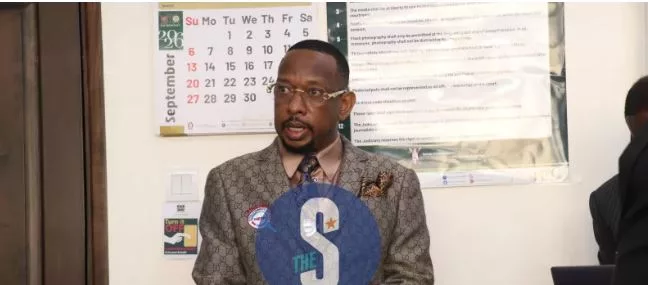
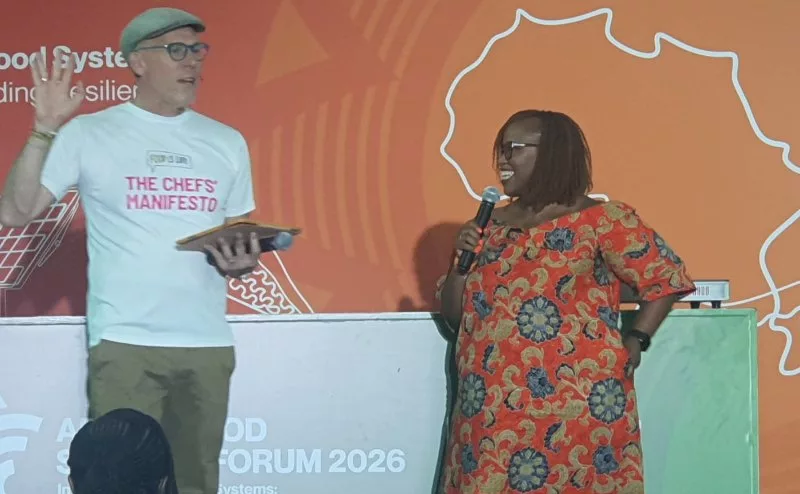
 Food4Education (F4E) official Nelisa Ngqulana during a side event at Africa Food System Fourm 2026/Gilbert Koech
Kenyan school-feeding innovator Food4Education (F4E) is making the case that school meals can be an economic engine for Africa.
This is as thousands of delegates gather in Kigali, Rwanda, for the Africa Food Systems Forum (AFSF) 2026.
The five-day summit has brought together government leaders, investors, farmers, researchers, development partners, women and youth to explore ways of building food systems that are healthier, more inclusive and resilient.
Under the theme, “Investing in Africa’s Agri-Food Systems: Growing Jobs, Nourishing Nations, Building Resilience,” school feeding has emerged as a key agenda.
Governments and partners are examining how successful national models can be scaled across borders.
At a side event, F4E presented its Kenyan model as evidence that partnerships between governments, private investors and development organisations can transform school feeding from small pilots into large-scale systems while creating jobs and markets for smallholder farmers.
What began in 2012 as a programme feeding 25 children in founder Wawira Njiru’s hometown of Ruiru now reaches more than 660,000 children daily across more than 1,900 schools, with over 200 million meals served.
About 80 per cent of the food procured by F4E comes from local smallholder farmers. The organisation employs more than 6,000 people, mainly women and young people.
Its technology-driven model includes the Tap2Eat platform, which allows families to contribute towards meal costs through NFC-enabled wristbands and cards while providing real-time data for planning.
At its Nairobi Giga Kitchen, which uses solar and steam power, F4E produces a nutritious meal for about 30 US cents, with food waste kept below one per cent.
The model has attracted interest beyond Kenya. Zambia is working with F4E to develop a nationally led feeding system targeting 5.6 million learners by December 2026, while Ethiopia has also expressed interest.
Vincent Muiruri, who represented F4E at the Kigali forum, said the organisation was developing a pan-African strategy based on its experience serving more than 660,000 learners daily.
“We have learnt so much around sustainability of school feeding programmes and we have been receiving a lot of requests from other African governments,” Muiruri said.
He said F4E had signed memoranda of understanding with Zambia’s Ministry of Education.
F4E is also involved in a trust fund established with the African Development Bank to support six to eight African governments in adopting practices from its model.
Wawira has argued that school feeding should be viewed not merely as charity, but as economic infrastructure that creates jobs, supports farmers and keeps public spending within local economies.
Her model has recently earned international recognition, including the German Africa Prize 2026 and the Diane von Furstenberg Award.
For Kenya, F4E’s presence in Kigali provides an opportunity to showcase a homegrown model as a potential blueprint for feeding children while strengthening Africa’s wider food systems.