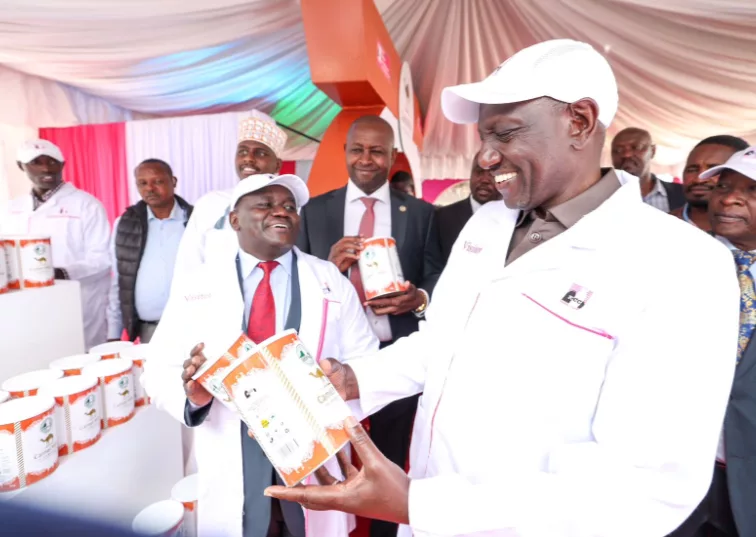
Four years after President William Ruto came to power promising to make agriculture more productive and profitable, the verdict from the farms is emerging as a mixed but increasingly positive one.
Across key value chains, there is evidence that farmers are receiving better prices, getting paid faster and accessing markets that were previously difficult to reach.
But the gains are far from uniform.
Official data shows that average gross commodity prices to farmers increased between 2022 and 2025 for coffee, sugarcane, cotton and milk, while tea prices remained volatile.
At the same time, production has risen sharply in some value chains, although others have struggled with market access, high production costs and weak infrastructure.
The strongest evidence of improved farmer returns is perhaps in coffee, where reforms have targeted the payment system, marketing and the role of middlemen.
When Ruto took office, coffee farmers were receiving as little as Sh50 to Sh60 per kilogramme in some areas.
The President said in June that payments had since risen to as much as Sh158 per kilogramme in some factories, although he wants this increased to between Sh250 and Sh300.
“Farmers used to wait for months before being paid. We have agreed now that farmers should get their money within five days. That is a must; we are not begging anyone,” Ruto said.
The change is backed by the Direct Settlement System, under which farmers can receive proceeds within five days of sale.
The government says farmers should receive at least 80 per cent of coffee sale proceeds, while the system is intended to reduce deductions and improve transparency.
The numbers are beginning to support the reform story.
Kenya's coffee production rose 3.8 per cent to 51,400 tonnes in the 2024/25 season, according to KNBS.
By Sale 29 of the 2025/26 season, coffee sold through the Nairobi Coffee Exchange was already worth Sh31.94 billion, compared with Sh27.92 billion for the entire previous season.
Data from the NCE covering sales up to Auction Sale 29 shows farmers sold 36.36 million kilogrammes of clean coffee valued at $247.62 million (Sh31.94 billion), up from 31.33 million kilogrammes worth $216.44 million (Sh27.92 billion) recorded during the entire 2024/25 season.
The figures represent an increase of more than five million kilogrammes of coffee and nearly Sh4 billion in earnings, reflecting improved production and stronger returns for farmers.
Kericho retained the top position after selling six million kilogrammes of clean coffee valued at Sh5.29 billion, almost double the Sh2.61 billion earned during the previous full season.
The county nearly doubled its auction volumes from 3.03 million kilogrammes, overtaking Kirinyaga to become the country's leading coffee-producing county by both volume and value at the exchange.
Murang'a ranked second after delivering 4.96 million kilogrammes worth Sh4.33 billion, while Nyeri came third with 4.63 million kilogrammes valued at Sh4.18 billion.
Kirinyaga offers perhaps the clearest farmer-level example.
Growers in the county shared Sh7.4 billion from the latest crop, with payments ranging between Sh104 and Sh157.40 per kilogramme of cherry and an average of Sh139.
Edward Njoka, a farmer who expanded his coffee acreage from one to 10 acres, harvested 46,000kg from eight mature acres.
“My experience as a coffee farmer over the years is that it is difficult. It is not an easy task because, first of all, the cost of production is too high,” Njoka told the Star.
Yet the marketing reforms are making a difference.
Direct coffee sales between October 2025 and June 2026 generated an average of Sh52,400 per 50kg bag, compared with Sh43,900 at the auction, a difference of about Sh8,400 per bag.
Tea presents a more complicated picture.
Kenya remains a global tea powerhouse, but higher production has not automatically translated into steadily rising farmer prices.
Tea production reached 598.5 million kilogrammes in 2024 but fell to 550.4 million kilogrammes in 2025.
KNBS data also shows the average gross commodity price to farmers at Sh27,806 per 100kg in 2025, down from Sh29,736 in 2024.
There have nevertheless been important reforms aimed at improving the farmer's share.
The tea sector recorded a marketed value of Sh218.79 billion in 2025, while the government has pushed value addition and direct market access.
Ruto has argued that farmers must earn more from a crop that generates billions of shillings in export revenue.
Some of the measures introduced to farmers get higher pay include reforms at the tea auction and payment system, strengthening direct sales and support for value addition.
In 2025, Ruto noted that the average green leaf price had risen from Sh51 per kilogramme in 2022 to Sh64 in 2024.
But the government's own interventions show that the sector still has a long way to go.
In February, Agriculture Principal Secretary Paul Ronoh ordered KTDA-managed factories in western Kenya to review monthly payments and pay a minimum of Sh26 per kilogramme.
He also ordered the Tea Board of Kenya to ensure that factory clerks tampering with weighing machines are arrested.
That means tea offers an important lesson: higher export earnings do not necessarily translate directly into higher and more predictable farmer incomes.
Sugar: payment is the big change
Sugar is where the government's reform agenda has produced perhaps the most visible change in market access and payment timelines, although farmers still face major structural problems.
KNBS puts the average sugarcane price to farmers at Sh5,437 per tonne in 2025, up from Sh4,514 in 2022. Sugarcane deliveries to marketing boards, however, fell from 9.4 million tonnes in 2024 to 7.1 million tonnes in 2025.
Production of sugar itself had jumped 72.5 per cent from 472,800 tonnes in 2023 to 815,500 tonnes in 2024, showing the potential of the revived mills.
At Nzoia, where the government leased the miller to West Kenya Sugar Company, farmers are reporting a major improvement in one area that has historically hurt them, payment delays.
Ferdinand Makhanu, a farmer with more than two decades in cane growing, said growers previously waited about two months for payment.
“It reached a point where they were paying farmers in piecemeal and it was not helping much,” he said.
He now says the situation has changed.
“From what I have seen so far, I strongly believe that leasing was the best thing and I thank our President for the decision because farmers are now being paid regularly and there is money in circulation,” Makhanu said.
Nzoia CEO Sohan Sharma said more than Sh700 million had already been injected into farmers' pockets through cane payments.
“We are paying the salaries on time, farmers’ weekly payments are going on. So these are all the things that we have achieved so far,” Sharma said.
But the sugar story also exposes the limits of the reforms.
A Senate inquiry found that farmers continue to complain about cane prices, input costs and delayed payments, with the average yield in the Nzoia region estimated at 49.71 tonnes per hectare against a potential 85 to 100 tonnes under better conditions.
So while payment access has improved, productivity and profitability remain unfinished business.
Dairy: more milk, but the cost question remains
Dairy farmers have also seen measurable changes.
The government has invested in programmes designed to increase milk production, improve quality and strengthen access to formal markets.
Support for cooperatives, mil-cooling infrastructure, breeding and animal-health services has helped address some of the constraints facing small-scale producers.
Milk production increased by 3.5 per cent to 5.5 billion litres in 2025, while marketed milk rose 11.5 per cent to one billion litres, according to KNBS.
The average gross price to farmers was Sh49.58 per litre in 2025, compared with Sh47.20 in 2022.
In Meru, farmers supplying Meru Central Dairy Cooperative Union were set to receive Sh52 per litre from August, up from Sh50.
The government has also intervened on production costs.
The price of sexed semen has been reduced from Sh7,000 to Sh1,400, while an animal feed mill in Meru is selling dairy meal at Sh2,800 per 50kg bag instead of Sh3,200.
Kindiki said the measures were designed to make dairy farming more profitable.
“This year, dairy farmers have received better incomes as a result of government subsidies on sexed semen,” he said.
For farmer Nelly Gacheri, the change is being felt at household level.
“We can now pay school fees and do other things from the money we get from dairy farming,” she said.
During a visit to Nyahururu KCC in 20254, President William Ruto directed New Kenya Cooperative Creameries to increase farmers' milk prices from Sh45 to Sh50.
"Tunataka mkulima ajue kwamba akizalisha maziwa kuna mahali atapeleka na apate pesa ajitegemee," Ruto said.
(We want to make sure that the farmers have a ready market when they produce milk and are paid on time so that they become independent)
The next challenge is quality.
The government is moving towards quality-based milk payments, meaning farmers producing cleaner and safer milk could earn more.
Cotton: productivity is improving, but the market is still too small
Cotton provides one of the clearest examples of how technology can improve productivity.
KNBS data shows the average seed cotton price rose from Sh5,609 per 100kg in 2022 to Sh7,200 in 2025.
Production sold to marketing boards increased from just 3,800 tonnes in 2022 to 8,800 tonnes in 2025.
This is attributed to interventions by the government to support farmers by providing improved seed, extension services and access to markets.
Bt cotton is helping some farmers achieve much higher yields.
One farmer from Busia reported harvesting about 800kg from an acre after adopting Bt cotton, compared with about 300kg previously.
His selling price also rose from Sh50 to Sh72 per kilogramme.
But cotton's biggest problem remains the market.
Kenya produces only a fraction of what local textile manufacturers need, with estimates putting production at between 5,000 and 30,000 bales against demand of 140,000 to more than 200,000 bales.
This means improved productivity will only translate into sustained income if Kenya also builds the cotton-to-clothing value chain.
Maize
For maize farmers, government intervention has largely focused on reducing production costs, improving access to inputs and strengthening food markets.
The subsidised fertiliser programme has been one of the key interventions, with the government making fertiliser available to farmers at below-market prices during planting seasons.
The government has also worked to improve grain storage and market access while supporting the National Cereals and Produce Board.
If sustained, lower input costs can improve farmers’ margins, particularly when combined with better farm-gate prices.
The verdict
Four years into Ruto's administration, the evidence suggests farming is paying better in several major value chains, but not yet consistently enough to declare victory.
Coffee has perhaps recorded the strongest improvement in farmer payments and market access. Sugar has seen a major change in payment timelines and factory operations.
Dairy production and prices have risen, while cotton productivity is showing promise.
Tea remains the warning sign: a major export earner where sector-wide earnings and farmer incomes do not always move together.