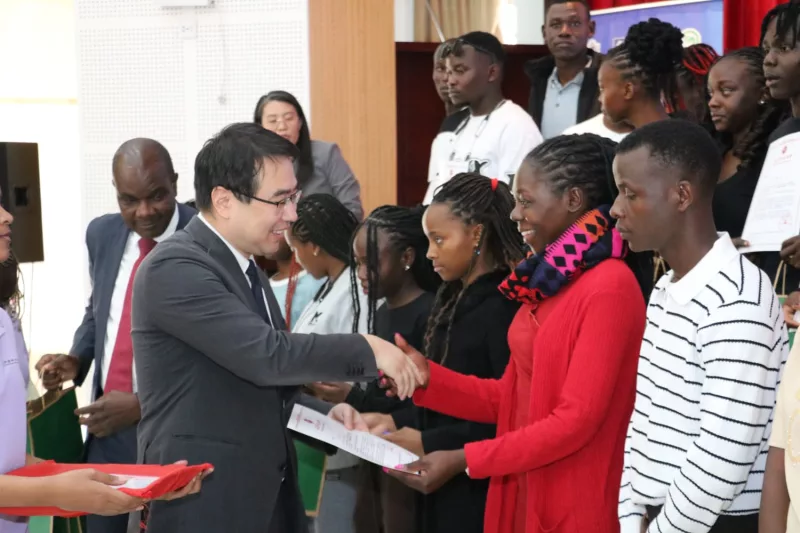
Twenty-three students have left for China under a scholarship programme designed to produce Chinese language teachers for Kenya’s schools amid rising demand for speakers of the language.
The students departed on Wednesday for Tianjin Normal University, where they will undertake two years of study before returning to Kenya to teach Chinese.
Their departure marks the second cohort of students under the 2+2 joint programme for international Chinese language education scholarship students.
The scholarship is run through a tripartite agreement involving China’s Centre for Language Education and Cooperation, Tianjin Normal University and the University of Nairobi.
Parents of the students joined University of Nairobi officials, government representatives and Chinese officials at the Confucius Institute to see off the beneficiaries.
The programme is increasingly being seen as a way of developing local capacity to teach Chinese in Kenya as education, trade and other ties between Nairobi and Beijing deepen.
Confucius Institute director Prof Wang Shangxue said the programme had been deliberately designed to help Kenya develop its own pool of Chinese language teachers.
“We have developed a good development model to enable Kenya have capacity to teach Chinese,” Wang said.
She said demand for Chinese speakers and teachers was growing, making it necessary to train more Kenyans rather than relying on teachers from outside the country.
Teachers Service Commission representative Reuben Ntamburi welcomed the development, saying the programme could help address a gap in Kenya’s competency-based curriculum.
“We have not employed any Chinese teachers in the CBC programme. Hearing that some are almost returning is a dream come true. I am happy to hear that,” Ntamburi said.
The students are expected to return after completing their two-year studies in China and join efforts to expand Chinese language teaching in Kenyan schools.
University of Nairobi Deputy Vice Chancellor for Academic Affairs Prof John Mande, who represented the vice chancellor, said the Confucius Institute had played a key role in strengthening people-to-people ties between the two countries.
“Confucius Institute has played important role in promoting people to people exchange, contributing to the development of Chinese language in Kenya,” Mande said.
He said the university had strengthened admission requirements for the scholarship programme, ensuring that students selected for the opportunity met higher academic standards.
“We have strengthened our admission requirements. The standards are higher. We are happy these students have met these requirements,” he said.
Mande said the programme had also been designed around Kenya’s education needs, allowing the two sides to combine their strengths.
“The programme has been designed with the local education requirements in mind, bringing the complementarity of strength between the two sides,” he said.
Wahome Rureri, representing the Higher Education PS Beatrice Inyangala, said Kenya should continue strengthening its relationship with China.
He noted that language was increasingly important as the two countries expanded their engagement.
“We are grateful for the relationship we have with China and should be made stronger,” Rureri said.
He said the agreement demonstrated a shared commitment to developing competent graduates and strengthening human resource development through international cooperation.
“Language is one of the most powerful instruments for building bridges between people. The need to understand Chinese is increasingly becoming important,” he said.
Chinese Embassy Charge de Affairs Zhang Zhizhong said the students were embarking on a journey that went beyond language training, describing the programme as part of the relationship between Kenya and China.
“It is a great day for us and we would like to extend our warmest and sincere congratulations to the students embarking on the journey to China,” Zhang said.
He said the programme would continue to grow as demand for Chinese language speakers increased.
“The programme will continue to flourish year after year. It is more than language, reflects a much bigger story,” Zhang said.
This year, 36 Kenyan students were awarded scholarships under various programmes.
They include the 23 students travelling under the 2+2 programme, three students pursuing bachelor’s studies and others undertaking short-term scholarship programmes.
The number of beneficiaries has grown steadily in recent years.
In 2025, a total of 245 Kenyans travelled to China under scholarship and exchange programmes. The initiative has also supported Chinese language teachers, educators and exchange students.
Last year, the University of Nairobi launched the Future Urban Builders Scholarship, through which a company donated Sh2 million towards tuition and sponsored 40 students to travel to China.
A railway scholarship is also being rolled out, with the second student expected to travel to China this year. The beneficiaries will study in China before returning for employment in the railway sector.
Wang said such programmes were helping expand the areas covered by Kenya-China cooperation while giving young Kenyans skills that could be applied locally.
Zhang urged the students to embrace the opportunity and return ready to contribute to Kenya’s development.
He said their journey represented the hopes of their families, the university and both countries.
“Each of us may seem but a small ripple but every ripple triggers lines. As you set sail, congratulations and may your journey be extraordinary as you are,” Zhang told the students.
The scholarship is part of the people-to-people exchanges between Kenya and China, whose diplomatic and bilateral ties have developed over more than 60 years.
Officials say the latest cohort could play a key role in meeting future demand for Chinese language teachers as the two countries deepen cooperation in education, trade and other sectors.