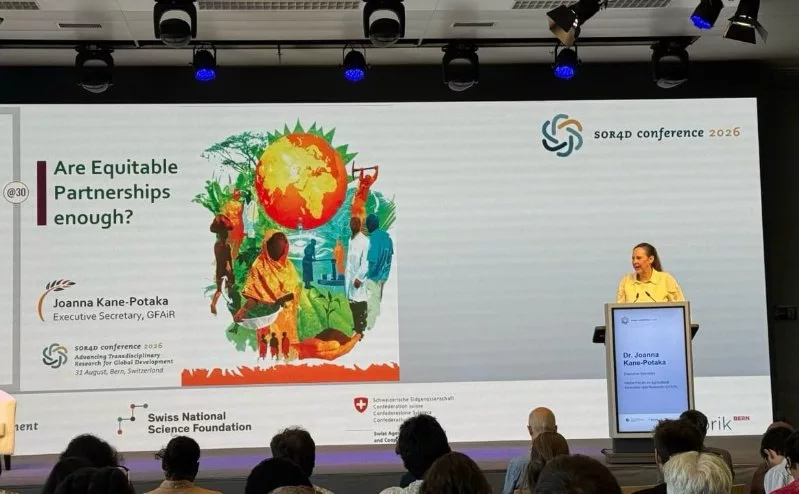
 GFAiR Executive Secretary Joanna Kane-Potaka, while delivering the
keynote address at the recently concluded SOR4D conference in Bern,
Switzerland.
GFAiR Executive Secretary Joanna Kane-Potaka, while delivering the
keynote address at the recently concluded SOR4D conference in Bern,
Switzerland.As the global community grapples with off-track Sustainable Development Goals (SDGs), the Global Forum on Agricultural Research and Innovation (GFAiR) is issuing a direct challenge: Are Equitable Partnership principles, on their own, enough to transform agrifood research and innovation for development?
Delivering the keynote address at the recently concluded SOR4D conference in Bern, Switzerland, GFAiR Executive Secretary Joanna Kane-Potaka spoke candidly. While the agrifood research and innovation for development community is moving in the right direction, she noted, progress is happening at a snail's pace.
"My overall message was that when outside countries and organisations contribute to help tackle the huge development challenges, working with Equitable Partnership principles is important but absolutely not enough," she said.
"Equitable Partnership principles ensure partners co-design and co-implement with joint responsibility and ownership. A range of partners are certainly needed to solve these complex problems, but missing most in these partnerships is ensuring 'Local Leadership'."
About the Conference
The SOR4D conference—organised by the SOR4D programme, a joint initiative of the Swiss National Science Foundation (SNSF) and the Swiss Agency for Development and Cooperation (SDC)—stands as one of the premier events in the field of research for development. Designed as a platform for meaningful exchange, the conference brings together researchers, policymakers, and development practitioners to share results, critically examine methodologies, and build cross-sectoral collaborations.
Held this year in Bern, Switzerland, from 31 August to 1 September 2026, the conference was anchored by the theme "Advancing Transdisciplinary Research for Global Development: Crisis, Collaboration, and Change," underscoring the urgent need for research that not only responds to global crises but also delivers sustainable and scalable solutions.
Against a backdrop of interconnected challenges—from climate change to food insecurity—the conference asked how transdisciplinary approaches can bridge the gap between knowledge and action, ensuring that research translates into real-world impact where it is needed most.
And that is where Equitable Partnerships come in.
Moving from principles to local leadership
Globally, Equitable Partnerships are increasingly recognised as essential to effective research for development (R4D)—though progress remains slow.
The concept of Equitable Partnerships is defined as collaborative relationships that are co-designed, co-implemented, and co-owned by all partners from the very beginning. They are not merely transactional or donor-recipient relationships but are grounded in shared purpose, trust, and mutual accountability.
Noting that Equitable Partnerships, on their own, are not enough to transform R4D systems, Ms Kane-Potaka proposes that moving from working through Equitable Partnerships to also ensuring Local Leadership will require some partners relinquishing power.
"The power of who has the money should not be the ultimate decider of who leads," she stated.
Comparative Advantage or Local Leadership?
On whether the focus should remain on advancing the Equitable Partnerships agenda or pivot towards identifying and strengthening areas of comparative advantage, Ms Kane-Potaka offered a thought-provoking perspective:
"Coming from an economics and marketing background, I have had it drilled into me that we should focus on where we have a comparative advantage. However, I challenge this. If the external development agencies are to aim for local leadership, then focusing on their 'current' comparative advantage could be a major barrier to the long-term goal. Instead, the external research and development agencies should instead 'leverage' their current comparative advantage to build the future scenario. In many cases this may be to build the national actors to have these comparative advantages to be in a better position to lead their own research and innovation."
Funding fragmentation: A double-edged sword
On how reducing fragmentation and waste in research funding contributes to more Equitable Partnerships and better development outcomes, Ms Kane-Potaka noted that the time and cost of writing proposals that typically may only have a 20 per cent success rate is huge, and many organisations cannot afford this.
"However, reducing funding fragmentation, and funders collaborating more, can lead to larger more complex projects that can further disadvantage those with less expertise and also smaller organisations. So, reducing funder fragmentation may lead to more inequity. However, it is possible but only if undertaken and planned with the values of Equitable Partnerships and local leadership being front and centre, in the design," she pointed out.
The role of national institutions and governments
On the role that national institutions and governments should play in ensuring that R4D partnerships are aligned with local priorities and leadership, Ms Kane-Potaka said national institutions and governments can increase their advocacy for Equitable Partnerships and local leadership with funders and other international organisations.
"The national voice needs to be heard and amplified. They should be the agenda setters that others rally around."
Measuring What Matters
With regard to meaningful indicators and Key Performance Indicators (KPIs) that should be used to measure progress on Equitable Partnerships —and how to move beyond rhetoric to demonstrate real impact—Ms Kane-Potaka acknowledged a significant gap.
"There are no standards on measuring Equitable Partnerships and a lot more work is needed. You have identified a huge gap that needs filling. That is why GFAiR is launching, this week, a series of guides for how to apply Equitable Partnerships in projects as well as how to measure Equitable Partnerships at each stage of a research for development project."
A major highlight of this journey was the co-creation of the Partner Inclusive Language Guide.
"Creating the 'Partner-Inclusive Language Guide' was particularly exciting as we put out a call for who would like to collaborate on co-designing this. We had over 60 people offer to contribute, and the majority from Africa. Contributors shared language that made them feel excluded and provided alternatives we could use. It was inspiring having real-life examples from actors in the field," shared Ms Kane-Potaka.
 SDG Goal 17 on partnerships.
A Paradigm Shift
Ms Kane-Potaka also addressed the reality of many SDGs being seriously off track, and proposed the single most important change needed in how stakeholders in agri-food research and innovation partner, prioritise, and allocate resources for R4D.
She noted that studies have shown that much of the international agricultural research for development has partnerships that are underleveraged, constrained by transactional approaches, and have weak engagement with national systems.
"So the problem is not the technical part of the research but 'how' the research is undertaken with the relevant stakeholders and partners. We need to keep advocating for Equitable Partnerships and local leadership to reach this goal. We also need more shared methodologies, KPIs and evidence of the value of partnering leading to more ownership, uptake of solutions, scaling and ultimately impact. This is core to the purpose of GFAiR to better link the national and international actors," she noted.
30 Years of Partnership
Drawing from GFAiR's 30-year legacy of catalysing change and transforming global agrifood research and innovation systems, Ms Kane-Potaka reflected on the most significant milestones and lessons learned over the past three decades.
"The biggest lesson is to never give up and keep advocating for equity. Every actor influenced makes a difference. It is important to work from multiple angles to make change. Work with the early adopters and champions first, and others will follow later. GFAiR has helped with platforms that have amplified the voices of the national systems as well as influencing how researchers and their institutes think about equitable partnerships."
A Call to Action
In her final message to those working at the intersection of agri-food research and innovation, Ms Kane-Potaka issued a call to action:
"We are still at the beginning of the journey to reach Equitable Partnerships, yet we need to aim higher and to reach local leadership. The tipping point will come when funders require local leadership in the work – they have an opportunity and responsibility to accelerate this journey and action. GFAiR will continue to advocate for this change."