For months, Mary* told herself things would get better.
The insults would stop. The constant checking of her phone would end. The jealousy would fade. And perhaps, if she changed the way she spoke or behaved, her partner would finally change too.
But the relationship only became more controlling.
Her story mirrors that of many people who remain in toxic or abusive relationships despite recognising that something is terribly wrong.
Psychologists say staying in such relationships should not simply be viewed as a matter of choice or weakness.
They say abuse can gradually affect a person's confidence, judgment and ability to make decisions, making it increasingly difficult to walk away.
Psychologist Leah Wanjiru says people need to learn to recognise when a relationship is no longer working and, most importantly, choose their peace and safety.
She says signs of assault and abuse are often visible long before a relationship turns deadly, but many people ignore them, hoping their differences will eventually be resolved.
Wanjiru says accepting that a relationship has ended can be painful, but it is sometimes necessary for one's safety.
“Once you realize that you are no longer aligned, and the best thing about the cycle of violence is once you get normalized to it, it becomes something normal among the two of you”, she says
She also wants people to remember that leaving does not mean life is over.
“One can always start over again. Choose your peace,” she says.
Psychologist Silas Kiriinya says there is, however, more to staying in an abusive relationship than simply refusing to leave.
He says fear, emotional and financial dependence, isolation, threats, low self-worth and trauma can trap victims in relationships.
He explains that the repeated cycle of violence followed by affection can also create a psychological reality in which victims begin doubting their own judgment and believing that the situation will improve if they change themselves.
“People often stay not because they are weak, naive, or comfortable with abuse,” Kiriinya says, noting that abuse can progressively alter how a person thinks, feels and makes decisions.
Look beyond physical injuries
Kiriinya says family and friends should not wait until they see physical injuries before recognising that someone could be in an abusive relationship.
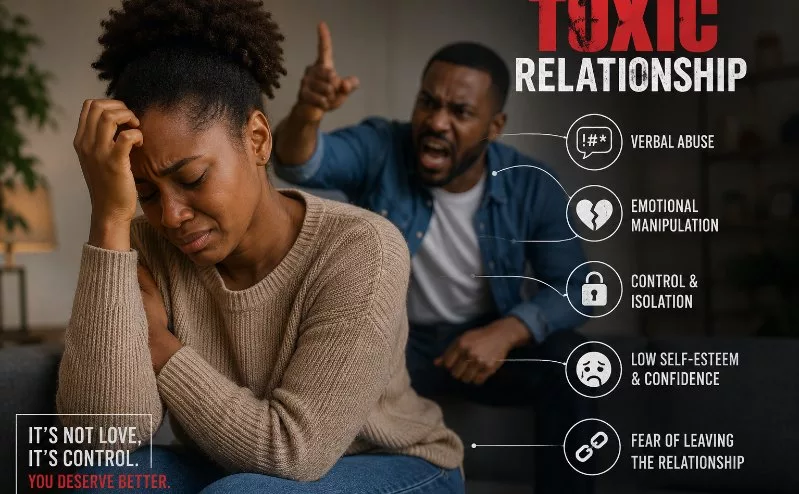
He identifies increased isolation, unexplained fear of a partner, sudden personality changes and withdrawal from family and friends as some of the warning signs.
Other red flags include excessive monitoring of someone's movements and communication, controlling finances, possessiveness, humiliation, threats and destruction of property.
He says particular attention should be paid to escalating control, where an abusive partner increasingly limits the victim's freedom and ability to seek help.
“Anyone who would like to help someone who is going through a toxic relationship has to learn how to look beyond visible injuries,” Kiriinya says.
Don't ask, ‘Why don't you just leave?’
For families and friends, Kiriinya says the response to someone experiencing abuse should not be blame or condemnation.
Instead of asking, “Why don't you just leave?” he says loved ones should ask, “How can I help you stay safe?”
He advises victims who are unable to leave immediately not to feel ashamed or blame themselves.
His advice is particularly important where there are threats or violence: safety should come before announcing plans to leave.
Kiriinya warns that confronting or informing an abusive partner about plans to leave could sometimes increase the risk of violence.
He encourages victims to speak to someone they trust and seek professional psychological support while developing a safety plan.
Families can also help by maintaining contact, listening without judgment and respecting the victim's autonomy, even when they make decisions the family may not agree with.
Practical support can also make a difference, including helping someone access professional or legal assistance, accommodation or finances where these have been controlled by the abusive partner.
For Kiriinya, escaping abuse is therefore not simply about walking away from a person.
It can involve rebuilding a person's sense of safety, identity, confidence and ability to trust their own decisions.
Fixing a toxic relationship
Experts say that fixing toxic relationships is very difficult because it is not possible for one person to change the behavior of the other. Instead, the effort to repair the relationship has to center on attempting to convince the other person to change. Psychologists say that the only sure way to do this is to be prepared to leave the relationship.
The process involves confronting the toxic person about their behavior. It is necessary to set boundaries as to what behavior the nontoxic person will tolerate.
This will often cause the toxic person to escalate the behavior in an effort to reassert control. The nontoxic person needs to make it clear that those boundaries are a requirement for the relationship to continue.
If the toxic person persists, the other person needs to be prepared to end the relationship. In adult parent-child or sibling situations where permanent separation is not possible or desirable, it may be necessary to severely limit contact. Teens and children in toxic relationships with family or others should seek the help of a trusted adult for guidance.
Experts stress that leaving the relationship immediately is essential in cases where physical violence exists or is threatened. Reaching out to a trusted friend or family member or to an abuse hotline is essential in these cases.
Experts also note that if a person’s friends or family express concerns about the toxic nature of a relationship, it is best to take those concerns seriously.