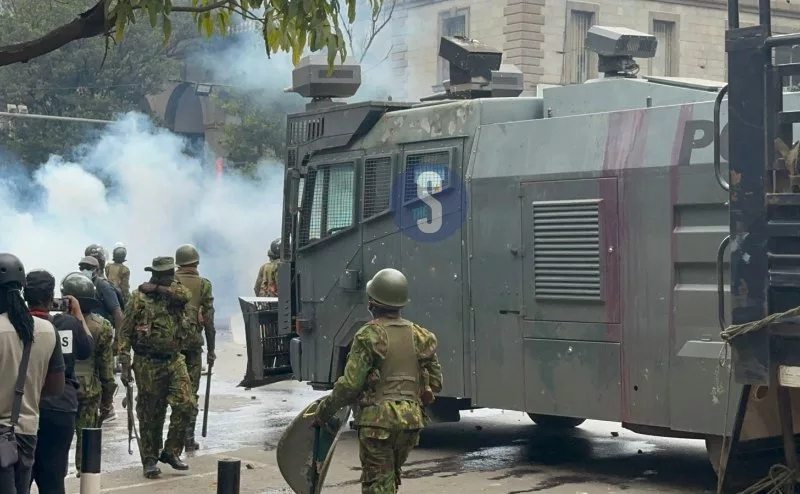
On February 27, 2018, Evans Njoroge was running.
The Meru University Students Association Secretary had organised a peaceful protest against fee hikes and poor facilities.
He was unarmed, fleeing from police, just metres away from the demonstration. Officers shot him dead.
When Miriam and Monicah Njoroge learned their brother had been shot dead by police, they began a journey that would test the promise of justice.
Six years later, the officer accused of his murder still walks free.
Their fight exposes a painful truth-for most Kenyan families, police killings rarely lead to accountability.
Evans was a fourth-year student at Meru University of Science and Technology, serving as Secretary General of the Student Council.
He had accused the vice-chancellor of failing to honour a pledge to reduce fees by Sh8,500.
That afternoon, as students barricaded the Meru-Maua road, police officers were deployed.
The Nchiru police station Officer Commanding divided his officers into two groups, with one group led by the Tigania West sub-county Administration Police commandant.
Other officers carried rubber bullets. But the accused, Constable Leakey Maina, was carrying a gun loaded with 25 live bullets, a court later heard.
Witnesses told the court that a police car pursued the fleeing students. Njoroge ran into a farm at Kabebe village, Tigania West, seeking shelter. He was shot at close range, the gun pressed against his head. A post-mortem later revealed the bullet entered the back of his head and exited through his forehead.
His body lay in the potato farm until 5pm, when a contingent of police overpowered protesting students and carried it away.
When the Independent Policing Oversight Authority concluded its investigation, the Director of Public Prosecutions finally charged Maina with murder.
On July 26, 2018, the officer attached to Miathene AP camp pleaded not guilty before Meru High Court. He was released on Sh200,000 cash bail. The case remains unresolved.
In August 2024, the Meru High Court revisited the crime scene for the second time, six years after the killing.
The Njoroge family's fight is not unique.
According to Missing Voices, a coalition of civil society organisations, 157 people were killed by police in Kenya in 2020 alone, with an additional ten cases of enforced disappearances.
The government does not keep a formal record of police killings and enforced disappearances. In 2019, the figure was 144.
Houghton writes in Dialogue and Dissent that Njoroge's family “reminds us that without vigilance, even murders by uniformed officers can evaporate from our public conscience”.
Their courage offers a rare example of justice prevailing against police brutality.
The family's determination forced change. Education Cabinet Secretary Amina Mohamed sent Vice-Chancellor Japhet Magambo on terminal leave following sustained student protests and public pressure.
The prosecution of Officer Maina, however slow, represents a rare instance where a police officer has faced murder charges for killing a civilian. Most extrajudicial killings never see a courtroom.
Miriam and Monicah Njoroge carried their grief into courtrooms and press conferences, speaking for mothers across the country whose sons never came home.
Their father Peter Gathuri had planned to attend his son's graduation later that year. Instead, he sat through court hearings, watching the accused plead not guilty, watching justice move at a pace that mocks the urgency of grief.
Six years on, Maina remains out on bail. The Njoroge family still waits. Their fight is a measure of how far Kenya has come—and how far it still must go.