
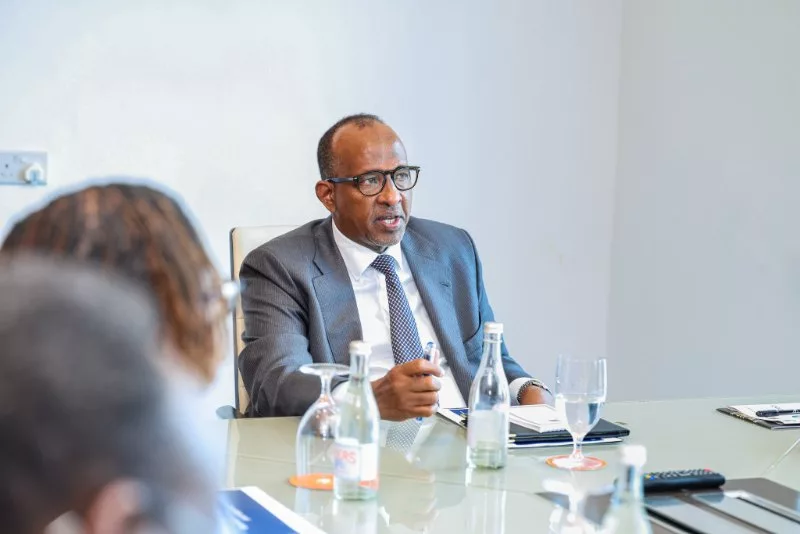
 Health CS Aden Duale/X
Health Cabinet Secretary Aden Duale has welcomed a proposed Sh129 million initiative aimed at strengthening the diagnosis and management of sickle cell disease in three counties.
The proposed two-year Sickle Cell Disease Demonstration Project will seek to strengthen early diagnosis, and capacity among frontline health workers.
Duale said the initiative was discussed during a bilateral engagement with Denmark's Ambassador to Kenya, Stephan Schønemann, and a Novo Nordisk delegation led by its Managing Director for Middle Africa, Jacob Mollerup.
“I welcomed the proposed two-year, USD 1 million (Sh129m) initiative in three counties, which will strengthen early diagnosis, referral and continuity of care, frontline capacity, data systems and coordination,” Duale said.
He said sickle cell disease continues to place a significant burden across 17 counties, highlighting the need to address gaps in screening, diagnosis and access to essential care.
The project is intended to build on existing progress while addressing gaps in screening, diagnostics, essential medicines, referral systems and patient care.
However, the CS said the programme should be implemented under a framework that ensures government leadership and ownership by the counties selected to participate.
“To ensure a Government-led and county-owned programme, I proposed an MoU defining the scope, financing, institutional roles, data governance, safeguards, deliverables and sustainability,” he said.
The proposed memorandum of understanding would outline the responsibilities of the institutions involved, financing arrangements and safeguards for the implementation of the project.
It would also establish measures aimed at ensuring that the benefits of the initiative can be sustained beyond the proposed two-year demonstration period.
Duale said the technical design of the programme would proceed through the national working group, with meaningful participation by county governments, people living with sickle cell diseases among other stakeholders.
“Technical co-design will proceed through the national working group, with meaningful participation from counties, people living with sickle cell disease and caregivers,” he said.
The selection of the three counties will be guided by the burden of sickle cell disease, gaps in health services, readiness for implementation, geographical equity and commitment by county governments.
Implementation is also expected to be supported through primary healthcare networks and national health information systems.
The initiative is aligned with Sustainable Development Goal 17, which promotes partnerships in advancing sustainable development.
Sickle cell disease is a genetic blood disorder that requires early diagnosis and continuous care to manage complications and improve the lives of people living with the condition.
Duale was accompanied during the meeting by the Ministry of Health's Director for Family Health, Dr Bashir Issak, and the Head of the Division of Non-communicable Diseases, Dr Gladwell Gathecha, among other ministry officials.
The Novo Nordisk delegation also included Associate Vice President for Business Area Africa, Malika de Maillard.
Further technical consultations are expected as the government and other stakeholders work towards agreeing on the framework for implementation.







