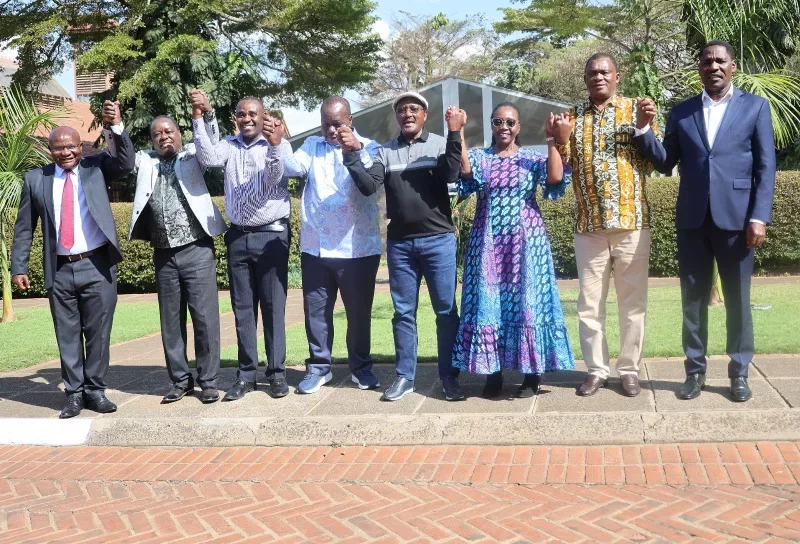
Opposition luminaries are assembling to challenge President William Ruto in 2027, but agreeing on a common presidential candidate is emerging as their biggest test.
None of the figures positioning themselves for the top ticket in the coalition has so far showed willingness to concede for another.
Former Deputy President Rigathi Gachagua, Wiper leader Kalonzo Musyoka and Nairobi Senator Edwin Sifuna, have all insisted on running.
Gachagua recently said his Mt Kenya numbers make him king, not kingmaker. Mt Kenya West, including Nakuru, has about 4.8 million voters.
Kalonzo, on the other hand, is being touted as the senior-most in the team, and with 2027 said to be his best run on account of his age. He is 72.
Sifuna has created a wave around him, with his backers saying it is his moment, his candidature said to be appealing to Gen Zs.
Besides Gen Zs, who account for a majority of the 5.6 million new voters expected in 2027, Sifuna also has a huge following in Western.
As such, there is a push for Kalonzo to step down and be his running mate, to guarantee the opposition a win.
Following the competing interests, the opposition team has been unable to settle on a candidate.
While some members want the puzzle solved now, some quarters, among them Gachagua, insist it is too early.
The challenge has been made harder by the fact the opposition has yet to establish a common structure for making decisions.
As such it is unable to coordinate its parties or resolve the matter, as revealed by Mukhisa Kituyi, who was appointed spokesman of the opposition.
In a televised interview, the Mwai Kibaki-era Trade minister acknowledged that efforts to establish a joint secretariat have failed.
It emerged the prevailing situation has seen each party operating through its own structures.
“It has been very challenging. Our attempt to create a common secretariat aborted. I am a head of a secretariat that doesn't exist. Each party has their own secretariat,” Kituyi said.
The sentiments lifted the lid on the difficulties facing the alliance whose parties and leaders are angling to defeat Ruto.
Kituyi said the absence of a common structure had also affected the coalition's ability to communicate a common position.
“There has been little joint communication from the opposition team, each party speaking its own positions,” he said.
“There are still fundamental problems of what is the architecture of unity but I don't see the agreement or the building blocks for the unity.”
“It is not very pleasant...let the opposition become as one and then we will have a functional communication function.”
The admission came hot on the heels of the opposition recent move to sign a unity pledge. Pundits, however, read it as just on paper.
For the political observers, the question of the presidential ticket poses the greatest test, much as the team may claim to be united.
Gachagua has presented himself as a leading contender, citing Mt Kenya support, resources and networks as putting him ahead of the rest.
His Democratic for the Citizens Party (DCP) is also developing its own structures ahead of the election.
Gachagua, who says his secretariat is largely being run by Gen Z supporters, argues that the priority is to consolidate support across regional voting blocs.
“The politics of Kenya revolves around the regional blocs. Once mobilised successfully, the remaining work is much easier,” he said.
For Gachagua, the opposition could settle the question of its candidate around March or April next year.
“Those asking we make the decision today should be ready to show the numbers they have put on the table,” he said.
“After Christmas, we should be able to sit down, work on a formula through which we will agree on a candidate.”
Kalonzo has also maintained his presidential ambitions, with his allies saying he brings a substantial Ukambani base.
“Kalonzo is the senior-most, has the experience having served as Vice President. It would just be tidy if he is the flagbearer, and then we can see within our strengths, who can be his deputy,” Kitui Central MP Makali Mulu.
He said Kalonzo could also be persuaded to serve as a transitional president as the team sorts the issue of accommodating its talent.
“We have actually mulled the idea of having some serve one term for the sake of the team staying together, otherwise we won’t handle the Ruto side,” the MP said.
Sifuna’s emergence has triggered fresh political calculations, even as it emerges the team has yet to agree on a formula.
It is understood they are split on whether to apply scientific opinion polls, boardroom consensus, or use delegates.
PLP Martha Karua, a major player, said they will involve Kenyans in the decision about candidate. She is yet to state exactly how.
Political risk analyst Dismas Mokua says the opposition’s chance is to use elimination, starting with those whose candidacy is not clear.
“Gachagua, for instance, has the uncertainty around his eligibility. Kalonzo is likely to argue that he has sacrificed enough, hence may not succumb to Sifuna pressure,” he said.
“He is likely to say how he relinquished his bid in favour of Martha Karua in 2022, and twice when he conceded for Raila Odinga.”
The competing ambitions bring to the fore the critical question of who will surrender the presidential ticket for the sake of a unifying candidate.
Political observers warn of the disastrous fallout that could follow should either of them feel dissatisfied by a choice.
Political analyst Martin Andati argued the dilemma has been sweetened by the perception that a candidate backed by the team has an automatic win.
“Those are normal challenges given the depth of talent in the opposition and the stakes involved, given that whoever is picked and gets the support of the rest of the team is almost certain of being the next president,” he told the Star.
For Gachagua, stepping aside would mean asking supporters who have rallied behind his political comeback to back another candidate.
For Kalonzo, accepting another subordinate position would have to be explained to a political base that has sacrificed several election cycles.
“The moment the opposition presents five, six or seven serious presidential candidates against one incumbent, the mathematics will become brutally simple. Ruto wins,” political analyst Sospeter Stephen said, adding that it “would be a historic political failure.”
Embakasi East MP Babu Owino said unity was the only way out, holding that Sifuna, Kalonzo, Gachagua, Orengo, and all the players must remain united.
“The government is working hard to ensure the opposition remains divided. When Kalonzo and Sifuna separate, Ruto will come back,” the MP said amid talks of division in the Linda Mwananchi movement.
Negotiation of positions beyond the presidency, in this case the running mate, could become as contentious as the presidential ticket.
If Gachagua emerges as candidate, would Kalonzo accept the deputy position? What guarantees does Sifuna receive?
If Kalonzo takes the ticket, would Gachagua accept being his deputy after positioning himself as a leading presidential contender?
Political analyst Herman Manyora said the opposition's challenge was on how power would be shared, not just unity.
“The question is not whether they can unite, but who will lead the united opposition and what will the others get,” Manyora said.
He argued the longer the parties delay in establishing that framework, the more difficult it could become to get the leaders accept a compromise.
What remains uncertain is whether any of them is prepared to give up the top seat for the sake of victory.
Thus the big ask is: Who can actually surrender?