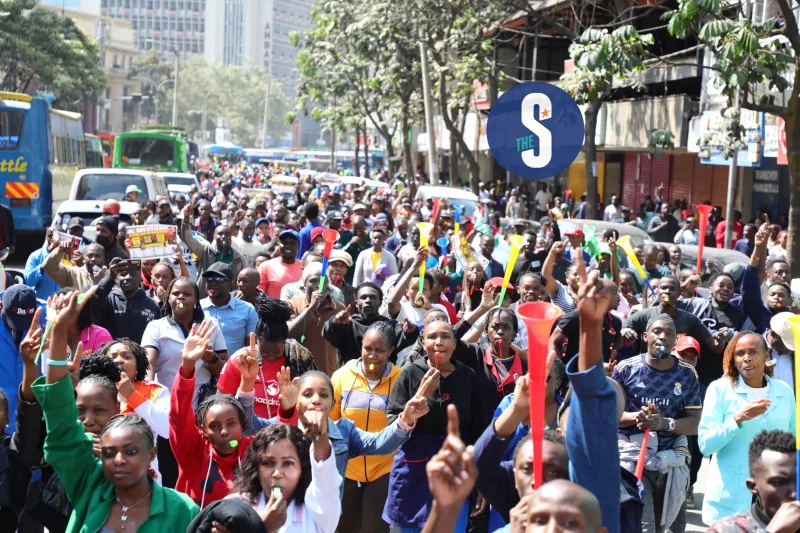
 Small business traders demonstrate along Moi Avenue in Nairobi, August 28, 2026. /EZEKIEL AMING'A
Small-scale traders in Nairobi have vowed to stage protests every Friday until the Kenya Revenue Authority (KRA) agrees to meet them over a new minimum customs yield applied to consolidated cargo.
The traders say the revised threshold is increasing their tax burden and could ultimately push up the prices of imported consumer goods.
The dispute centres on KRA's decision to raise the minimum yield for containers carrying general consolidated cargo from Sh2.5 million to Sh3.2 million.
The revised threshold took effect on August 21, following a one-month grace period granted to traders to prepare for implementation.
Consolidated cargo allows several small-scale importers to combine their goods in one container, helping them share shipping and logistics costs rather than importing separate containers.
The Sh3.2 million figure is not a flat tax charged on every container. KRA says the actual customs liability depends on factors including the nature, classification and value of the goods, as well as applicable customs and tax provisions.
However, traders say the new minimum yield creates a problem where the combined customs value of goods in a container falls below the benchmark.
Under the simplified clearance arrangement, such traders may have to meet the minimum yield or opt out of the arrangement and have their cargo individually verified so that taxes are assessed according to the actual contents and value.
They can also have the cargo de-consolidated, allowing individual consignees to make separate declarations and pay taxes based on their respective goods.
The traders took to the streets of Nairobi on Friday, demanding a physical meeting with KRA to discuss what they consider a more favourable and transparent framework for determining their tax obligations.
A spokesperson for the traders criticised the authority for relying on social media to respond to their concerns.
"They saw it fit to respond to us via the internet on X; all their responses are on X, which I feel is very unprofessional," the spokesperson said.
The protests came a day after KRA issued a statement on X explaining the basis for the revised minimum yield and outlining options available to traders.
The authority said the minimum yield was introduced as a simplified clearance mechanism for containers carrying commonly imported general goods.
It provides a reference point for clearing consolidated cargo without requiring every small-scale importer to present individual transaction documents.
The authority said the previous minimum yield had remained unchanged since the 2022/23 financial year, while exchange rates, freight costs and national and East African Community tax laws had changed significantly.
"These changes necessitated a review of the minimum yield applicable to containers carrying general consolidated cargo to ensure that it remains relevant to prevailing trading and economic conditions," KRA said.
The authority added that the review had been conducted in consultation with industry stakeholders and that it granted traders an additional month to prepare after they requested more time.
KRA stressed that the Sh3.2 million minimum yield should not be confused with the actual tax liability of a container.
"The minimum yield is not a representation of the actual tax liability for the goods contained in a container," the authority said, describing it instead as a risk-management reference under the simplified clearance arrangement.
It said traders who did not wish to use the simplified arrangement could request Customs to verify their containers and determine taxes based on the actual contents, customs value and classification of the goods.
They could also opt to de-consolidate their cargo and make individual declarations.
The traders, however, rejected KRA's online explanation and maintained that they want direct engagement with the authority.
They accused KRA of failing to listen to their concerns and said the new arrangement would raise the cost of doing business for small-scale importers, with the additional costs eventually passed on to consumers.
"We remain steadfast, our resolve unwavering; every Friday we will continue talking until KRA calls us for talks. And they should stop saying we don't want to pay. All we want is to have a meeting and talk, but they have refused; they are addressing us online."
Unless KRA agrees to the face-to-face consultations they are demanding, the traders' position sets the stage for recurring Friday demonstrations.