A decade ago, Kenya Airways had too many planes and too little money. Today, the national carrier faces the opposite problem, strong demand, but not enough aircrafts.
It is a striking reversal for an airline whose biggest crisis once came from expanding too fast.
An ambitious fleet expansion left Kenya Airways weighed down by debt, soaring costs and mounting losses.
A decade later, the carrier is struggling with grounded aircraft, spare-parts shortages and limited capacity, just as passenger demand is picking up.
However, the shortage has been attributed to global shortages that have seen turnaround time for spare parts hit 90 days.
The irony tells the story of a turbulent decade better than any balance sheet.
Between the two extremes, the airline has gone through a revolving door of turnaround strategies, from Project Mawingu and Operation Pride to Project Safari and Operation Kifaru, each promising to restore the Pride of Africa to financial stability.
Yet as Kenya Airways enters another chapter, its challenge has changed.
The question is no longer simply how to shrink the airline and stop the losses, but how to put enough aircraft back in the sky to take advantage of the passengers waiting to fly.
The national carrier has passengers ready to fly, lucrative routes and an established network linking Kenya to Africa, Europe, Asia and the United States, routes recording load factors above 90 per cent.
Yet the Pride of Africa is losing money again. After posting its first full-year profit in more than a decade in 2024, In the first six months of 2026, the losses deepened from Sh12.1 billion to Sh16.1 billion.
The airlines board holds that the problem is no longer simply whether Kenya Airways can attract customers.
The numbers point to a problem that goes beyond attracting passengers, Kenya Airways has demand, but lacks enough aircraft and financial flexibility to consistently turn that demand into profit.
Kenya Airways has a group fleet of 45 aircraft, including 11 operated by subsidiary Jambojet.
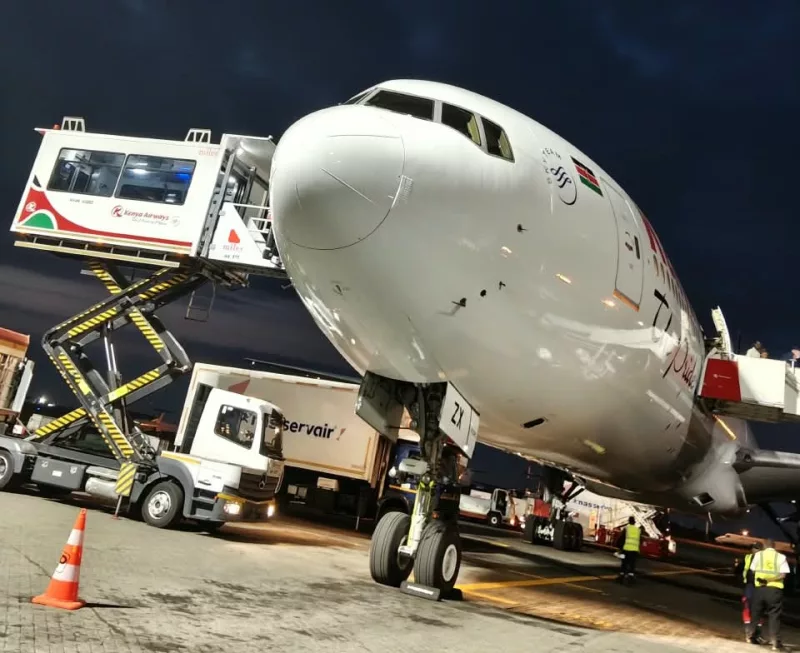
Its main fleet comprises 13 Boeing 737s, nine Boeing 787 Dreamliners, 11 Embraer E190s and one Boeing 777 that had initially been leased to Turkish Airlines.
However, only about 25 aircraft are currently operational, with at least nine grounded for maintenance, piling pressure on the carrier’s ability to serve its network of about 30 destinations.
Acting Group Managing Director and Chief Executive George Kamal says aircraft availability remains the biggest obstacle.
“Demand for Kenya Airways remains. Our biggest challenge has been availability of aircraft to meet this demand,” Kamal said.
Over the past decade, Kenya Airways has gone through almost every phase of a corporate turnaround.
It entered the period weighed down by an ambitious fleet and network expansion program that left it with heavy debt, lease obligations and foreign exchange exposure.
The airline lost Sh26.2 billion in 2016, before narrowing losses to about Sh10.2 billion in 2017 and Sh7.6 billion in 2018.
Revenue reached Sh128.3 billion in 2019 before the Covid-19 pandemic devastated the airline industry. Turnover collapsed to Sh52.8 billion in 2020, while losses ballooned to more than Sh36 billion.
The post-pandemic recovery brought another shock. Revenue rebounded to about Sh178 billion in 2023 and KQ posted an operating profit of Sh10.5 billion.
But massive foreign exchange losses wiped out the operational gains, leaving the airline with a Sh22.6 billion net loss.
The period illustrates Kenya Airways’ central weakness, even when the core airline business improves, its balance sheet can drag it back into the red.
The breakthrough came in 2024 when revenue climbed to a record Sh188.5 billion and the airline posted a Sh5.4 billion net profit, its first annual profit in more than a decade.
But the turnaround was also helped by foreign exchange gains following the strengthening of the shilling. That exposed another vulnerability.
A strong shilling helped produce gains, while a weaker currency, higher oil prices, grounded aircraft or geopolitical disruptions can quickly wipe out profitability.
The immediate cause of the 2025 reversal was the grounding of three Boeing 787-8 Dreamliners because of engine shortages, maintenance requirements and difficulties sourcing critical spare parts.
Capacity fell by 18 per cent, passenger numbers declined and revenue dropped 14 per cent to Sh161.5 billion. Costs, however, did not fall at the same rate.
KQ Chairman Kiprono Kittony has described the problem as structural rather than commercial.
“We have customers ready to travel but fewer aircraft were available to serve them,” Kittony said.
The problem has continued into 2026, with global shortages of spare parts, long maintenance lead times and component delays disrupting fleet availability.
The result is a painful contradiction, KQ is losing revenue not because people do not want to fly, but because it cannot always provide enough seats to sell.
On major routes, aircraft are flying nearly full, yet the airline has had to reduce frequencies and adjust its network because of fleet shortages.
In a meeting chaired by Head of Public Service Felix Koskei, that brought together senior government officials to review the airline’s turnaround plans on August 6, 2026, KQ Board Chairman Kittony said the airline is implementing a cost-reduction programme.
“Kenya Airways goes far beyond, and I would like to encourage the governments to look at it beyond a profit and loss play,” Kittony said during the presentation.
The airlines management says this demonstrates that the underlying business remains viable.
“The financial results are difficult, and we are not going to avoid that. But we have one important point of highlight. strong demand remains despite lower capacity,” said Kamal.
The Middle East conflict has added another layer to Kenya Airways’ problems.
Fuel is already one of an airline’s largest costs, but higher prices and airspace disruptions have increased operating expenses.
In the first half of 2026, fuel costs surged sharply, while supply-chain disruptions and maintenance delays continued to affect operations.
Kenya Airways is still carrying the legacy of years of financial distress. The airline has spent much of the past decade restructuring debt and negotiating with lenders and lessors. Even when operations improve, finance costs, debt obligations and currency movements can erase the gains.
Kittony says Kenya Airways is seeking both a capital-raising partner and a strategic investor as part of a wider restructuring plan.
In recent years, the airline has pursued restructuring measures including route optimisation, fleet adjustments, partnerships with other carriers, and tighter control of expenditure.
The government remains a major shareholder and has previously extended financial support to keep the carrier operational.
The airline is also considering cleaning up its balance sheet, including the possible conversion of principal debt owed to the government (48 per cent stake) and a consortium of local banks into equity.
“We have received interests from local and international investors who will inject both capital and other resources into KQ,” Kittony said.
According to the Business Daily, Kenya Airways is considering proposals from potential strategic investors willing to provide aircraft and capital in exchange for an equity stake.