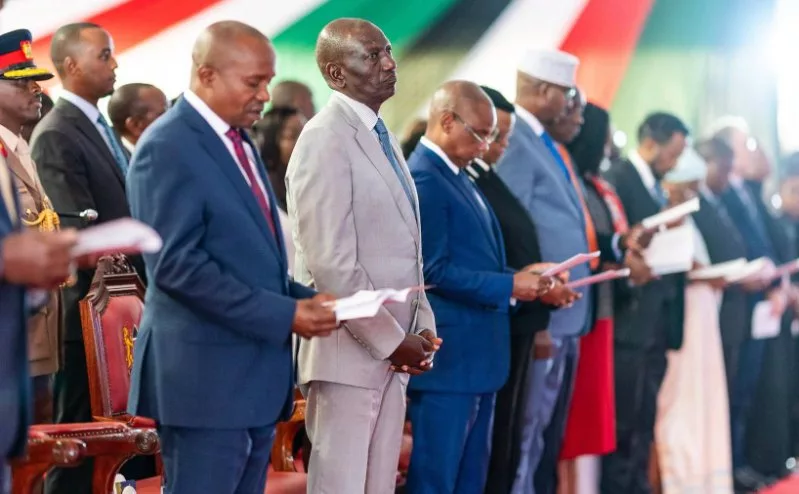
President William Ruto, Deputy President Kithure Kindiki and other top government officials during Katiba@16 celebrations at KICC in Nairobi on Thursday/PCS
Calls to strengthen constitutional institutions and deepen accountability dominated the 16th anniversary celebrations of the 2010 Constitution, marked at the KICC on Thursday.
President William Ruto and senior accountability officials said this was the only way the promises of the constitution, promulgated in August 2010, could become a reality.
Speaking during the event at the KICC in Nairobi, the leaders called for stronger institutions, greater cooperation between state agencies and a renewed commitment to constitutional accountability.
President Ruto said Katiba Day should not be reduced to an annual celebration but should provide an opportunity for the country to assess whether its constitutional institutions are delivering on their mandates.
“Katiba Day, sixteen years later, must be more than an annual anniversary. It must be a day of national accounting,” Ruto said.
He challenged the Executive, Parliament, Judiciary, county governments, constitutional commissions and independent offices to examine whether they had exercised their powers responsibly and delivered the rights guaranteed by the constitution.
The President said the constitution was designed not only to restrain power but also to ensure government used its authority to deliver services and protect citizens.
“Our responsibility is to uphold both obligations: power must be managed and rights must be assured,” he said.
Ruto singled out Article 43, which guarantees Kenyans the rights to healthcare, housing, food, clean water, social security and education.
“These are not ornamental provisions placed in our constitution. They are fundamental rights,” he said.
He argued that constitutional accountability must ultimately be measured by the experiences of ordinary citizens rather than government reports, speeches or statistics.
“The ultimate test of constitutional implementation is not how often we quote the constitution or invoke constitutionalism. It is how closely the daily experience of the citizen reflects the promise of the constitution,” he said.
The President said his administration had sought to translate these constitutional obligations into practical programmes through the Bottom-Up Economic Transformation Agenda.
He cited the registration of more than 32.4 million Kenyans with the Social Health Authority, more than 100,000 Community Health Promoters, the construction of more than 274,000 affordable homes, the recruitment of more than 100,000 teachers, and the construction of 23,000 classrooms.
But Ruto acknowledged that much remained to be done.
“By no means is this work complete. Significant steps remain,” he said.
Attorney General Dorcas Oduor said the country must now focus on strengthening the institutions created by the constitution to safeguard democracy, accountability and the rule of law.
She said constitutional commissions and independent offices were central to the country’s constitutional architecture because they protect the sovereignty of the people and hold state organs to account.
“Our institutions are independent, but they are not isolated,” Oduor said.
She warned against a situation where independent institutions interpret their autonomy as a licence to operate without engaging other arms of government.
“Independent, yes, but interdependent. Different mandates, but one constitutional mission. Different institutions, but one people. And ultimately, one Constitution,” she said.
The Attorney General said strong institutions were not simply those with extensive constitutional powers, but those that exercised those powers lawfully, fairly and effectively.
“They must be capable of resisting improper pressure, but they must equally be capable of accepting legitimate scrutiny,” she said.
Auditor General Nancy Gathungu said the success of constitutionalism should be assessed through outcomes experienced by citizens.
She said Kenyans were no longer satisfied with statistics and official claims of progress but wanted to know how government action had changed their lives.
“Citizens measure performance and productivity through their lived experiences,” Gathungu said.
She, however, raised concern over inadequate funding for constitutional commissions and independent offices, warning that financial constraints could undermine their ability to perform their constitutional duties.
EACC chairman David Oginde focused on corruption, calling for a fundamental change in the way public officials view state resources.
He said public money must be treated as a trust held on behalf of Kenyans rather than an opportunity for personal enrichment.
“The resources that come to us are not for us to use. It is for the public good,” Oginde said.
Oginde argued that stronger laws alone would not end corruption unless public officials accepted personal responsibility for protecting public resources.
“Unless and until we have that change of mind, we will continue to talk about corruption,” he said.
He also raised concerns about investigations involving sitting officials, saying those in positions of authority could interfere with evidence, documents and witnesses.
Oginde urged public officials to respect the work of constitutional commissions and independent offices when called upon to provide information.
“Let’s take it that the constitution is the one inviting you. It’s not Oginde,” he said.
INSTANT ANALYSIS
The Katiba@16 speeches expose a central challenge facing Kenya’s constitutional order: strong institutions must translate constitutional ideals into tangible outcomes. Ruto’s call for accountability, judicial restraint and respect for elected mandates contrasts with deeper concerns over institutional funding, corruption and implementation.
Oduor, Gathungu and Oginde emphasised that independence must be matched by accountability. Ultimately, Kenya’s constitutional success will depend less on its architecture than on how effectively institutions serve citizens.